Executive Summary
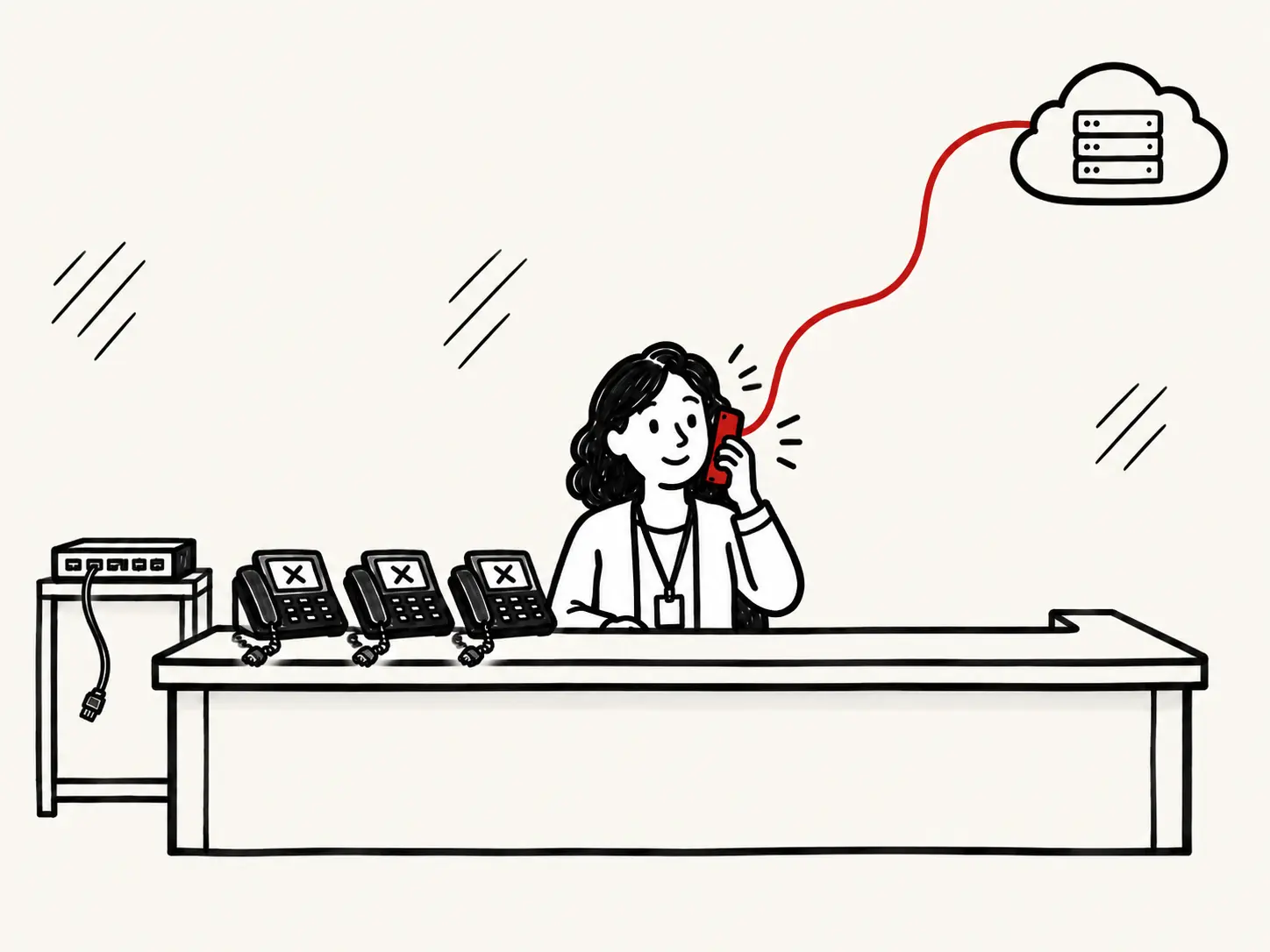
The front office calls the school district's technology department.
None of the desk phones are working.
The immediate assumption is that the phone system has failed. But that may not be the problem.
For a school district using a hosted 3CX telephone system, one of the fastest diagnostic steps is to have an authorized employee open the 3CX mobile application, disconnect from the school's Wi-Fi, and place an ordinary telephone call using cellular data.
If the call succeeds, the hosted telephone platform is accessible through an independent connection. The PBX and the external calling path used by that test are functioning.
The problem may be inside the campus network: its internet connection, firewall, switches, session border controller (SBC), or desk telephone connectivity.
If the mobile call fails, additional investigation is required. The failure could involve the mobile device, cellular service, application configuration, hosted PBX, or telecommunications provider.
A successful mobile-app call can quickly distinguish a likely campus-side outage from a complete hosted phone-system outage.
This simple diagnostic procedure illustrates the central argument of this paper:
The availability of a telephone system is not the same as the availability of communications at a school.
A provider can operate redundant infrastructure with excellent service availability, yet a classroom may lose communications through a damaged network cable, failed switch, or local power outage.
Conversely, the hosted PBX may experience a failure, making the provider's standby and recovery arrangements critical.
These are different problems requiring different solutions.
This whitepaper examines six findings:
- The first response to a reported phone outage should help isolate whether the problem is local or affects the hosted service.
- A remotely hosted PBX can remain operational during a local campus outage, offering an independent calling path through configured mobile applications.
- Active-passive PBX failover provides a different protection: recovering from failure of the hosted call-processing environment.
- Recovery time must be measured and tested. The presence of standby equipment is not proof of immediate restoration.
- Emergency calling, dispatchable location, and NG911 dependencies require independent verification, including during outages.
- District reliability decisions should be based on defined communication requirements, documented failure scenarios, and observed recovery performance.
The paper incorporates operating practices reported by SPARK VoIP, a managed 3CX provider serving Texas K–12 districts.
SPARK VoIP reports maintaining matching standby PBX configurations, testing failover monthly, and observing recovery times of approximately five minutes during those exercises.
The company separately asks district personnel to conduct monthly 933 emergency-location checks to detect discrepancies that can arise when telephones are relocated without notifying IT.
These are different controls addressing different risks.
The objective is not to prove that one hosting model is always superior.
It is to help districts answer a more useful question:
When something fails, what still works, how quickly can the affected functions recover, and how do we know?
1. The First Five Minutes: Find Out What Actually Failed
When multiple school desk phones stop functioning, diagnosing the problem quickly can reduce unnecessary troubleshooting and direct the right personnel to the problem.
The most useful initial diagnostic is often a test performed outside the affected campus network.
Step 1: Test the 3CX mobile application
An authorized employee who already has a working, configured 3CX mobile application should:
- Turn off Wi-Fi on the smartphone.
- Confirm the smartphone has a working cellular data connection.
- Open the 3CX application.
- Place an ordinary outbound call to a known working telephone number.
- Confirm that the call connects and two-way audio works.
This is a normal calling test, not an emergency 911 test.
Step 2: Interpret the result
If the call succeeds:
The hosted 3CX platform is accessible through the cellular connection, and the tested external calling path works.
A complete hosted PBX outage becomes less likely.
The investigation should focus on the affected campus's connectivity, firewall, switches, SBC, device provisioning, or other local components.
The test does not prove that every PBX function or carrier route is healthy.
If the call fails:
The result is inconclusive.
IT personnel should confirm the smartphone's cellular connection, application status, login or registration state, and normal calling configuration.
They should then check whether the hosted PBX and carrier services are operating correctly.
A failed mobile test does not, by itself, establish that the hosted PBX is down.
Step 3: Check the scope of the problem
If one campus is affected and other campuses operate normally, a site-specific issue becomes more likely.
If several campuses simultaneously lose their desk telephones, a common network, PBX, carrier, authentication, or other shared dependency deserves investigation.
An independent mobile-app test at more than one location can provide further evidence.
Step 4: Maintain communications during investigation
A successful 3CX mobile test demonstrates more than a diagnostic result.
Authorized staff may be able to continue using the school's telephone system through cellular data during the campus network outage.
This can preserve selected incoming and outgoing communication functions.
The district must still account for personnel without suitable devices or cellular coverage and functions dependent on local equipment.
The mobile application does not restore a failed classroom handset, PoE switch, paging system, or campus internet connection.
Operational rule
When desk phones stop working, test the hosted service from an independent connection before treating the incident as a PBX failure.
This should be part of a documented incident-response procedure, not the only step in one.
2. Two Different Outages Require Two Different Responses
The distinction between hosted PBX failure and campus infrastructure failure is fundamental.
Scenario A: The hosted 3CX platform fails
The active call-processing environment becomes unavailable.
The disruption may affect several or all campuses served by that PBX.
Where a properly configured standby PBX is available, the standby can take over when the required failure criteria are met.
The recovery process can involve monitoring, standby activation, routing updates, endpoint reconnection, and resumed calling.
Primary remedy: PBX failover and provider recovery procedures.
Scenario B: A school loses its local connection
The hosted PBX remains operational, but devices at the affected campus cannot reach it.
Other schools may continue operating normally.
Configured mobile applications can still connect over functioning cellular data, independently of the affected school's local internet service.
Primary remedy: Restore campus connectivity, local networking, power, or the relevant endpoint equipment. Use approved alternative calling methods during the disruption.
A third scenario: The carrier fails
The hosted PBX and campus network may both be working correctly, yet outside calls fail when the primary SIP carrier or its route is unavailable.
An alternate carrier or route can potentially restore supported external calling, subject to configuration and testing.
Primary remedy: Carrier troubleshooting and a verified alternate calling arrangement.
Comparison
| Failure | What may remain operational | Where investigation starts |
|---|---|---|
| Hosted PBX fails | Campus networks and local equipment | PBX monitoring and standby recovery |
| Campus internet fails | Hosted PBX and unaffected campuses | ISP, firewall, WAN, SBC, local network |
| Campus power fails | Hosted PBX and independent mobile service | Building power, UPS, switches, endpoints |
| SIP carrier fails | PBX and internal functions | Carrier status and external routing |
| SBC fails | Hosted PBX and potentially mobile clients | SBC host, local configuration, networking |
Real deployments may have multiple simultaneous failures. The table identifies diagnostic starting points, not guaranteed behavior.
3. The Complete School Communications Path
A typical hosted school telephone deployment contains several technical dependencies.
An ordinary desk-phone call may follow this conceptual path:
Desk phone → PoE switch → Campus firewall/router → Internet or WAN → SBC or supported connection method → Hosted 3CX → SIP carrier → Called party
Some deployments position the SBC differently or use other connection methods.
A mobile application connected through cellular data takes a different access path to the hosted system.
The district should document its actual design.
Seven dependencies to investigate
| Dependency | Function | Possible interruption |
|---|---|---|
| Desk phone or app | Initiates and receives calls | Device, provisioning, or app failure |
| Electrical power | Supports handsets and local equipment | Utility or circuit failure |
| Campus LAN | Connects local phones and infrastructure | Switch, cabling, VLAN, or DHCP failure |
| Internet/WAN | Connects campus to hosted services | ISP or district transport failure |
| SBC and PBX | Provides connectivity and call processing | Host, application, or routing failure |
| SIP carrier | Supports external calling | Carrier or trunk interruption |
| Emergency delivery services | Supports emergency routing and location | Routing or location-system failure |
Why the distinction matters
A school may maintain a perfectly functioning hosted PBX but lose all connected desk telephones through one failed local switch.
A district may invest in standby PBX infrastructure yet have no independent connection to its isolated campuses.
Two purchased internet circuits may share a single conduit or upstream provider facility.
The presence of redundancy must be evaluated against the failure it is intended to address.
4. What SPARK VoIP's Hosted 3CX Failover Actually Does
SPARK VoIP reports operating a managed failover arrangement for supported hosted 3CX deployments.
The arrangement addresses failure of the hosted call-processing system, not failure of an individual school's local network.
A corresponding standby PBX
SPARK VoIP maintains a standby 3CX installation with matching licensed capacity and configuration corresponding to the primary PBX.
The standby is prepared to assume the active role if the primary installation stops responding under the configured failover conditions.
The benefit is having a recovery environment prepared before the disruption rather than beginning a new installation after the failure occurs.
Monthly configuration and failover tests
SPARK VoIP reports conducting monthly failover tests.
The purpose is to verify that the standby environment matches the primary setup and can take over during the tested failure condition.
SPARK VoIP times the failover process and reports an approximate recovery interval of five minutes.
That is an observed operational estimate, not a guaranteed maximum.
Actual results can vary according to the failure, network conditions, endpoint behavior, and tested recovery criteria.
What the manufacturer documents
3CX's current failover documentation describes an active-passive architecture in which an active PBX processes calls and a passive PBX monitors the primary.
The standby can assume the active role under defined failure criteria.
The manufacturer documents configuration replication with a maximum offset of 24 hours. It identifies an AI Edition licensing prerequisite and distinguishes self-hosted arrangements from its own Hosted by 3CX service. [1]
SPARK VoIP's managed hosting arrangement must be evaluated according to its actual commercial and technical implementation.
Why configuration synchronization matters
Imagine that the district changes an extension, call route, or emergency-location association shortly before a primary PBX failure.
If the latest configuration change has not reached the standby environment, the recovered installation may not reflect it.
That is why replication frequency, verification, and recovery-point procedures matter.
SPARK VoIP's monthly test establishes whether the standby matches the expected primary configuration at the time of testing.
It does not, by itself, prove that every change made after that test has been replicated continuously.
What does five-minute recovery mean?
A timed recovery exercise should identify distinct events:
| Event | Measurement |
|---|---|
| T0 | Primary failure begins |
| T1 | Monitoring recognizes failure |
| T2 | Standby assumes active role |
| T3 | Relevant endpoints and routes reconnect |
| T4 | A new outbound test call succeeds |
| T5 | A new inbound test call succeeds |
The district should know which event concludes the provider's reported recovery interval.
Until the test procedure confirms the measurement endpoint, an approximately five-minute failover result should not be presented as a promise that every user can place a call within five minutes.
What happens to calls already in progress?
A failover process can restore the ability to establish new calls without preserving active conversations.
An active emergency call requires special attention.
A district should ask what happens if failover occurs during an established 911 call, whether a dispatcher can call back, and what independent emergency communication procedure staff should use.
The value of failover is demonstrated by the communication functions recovered, not merely by the standby server becoming active.
5. Local Campus Failures and Mobile-Application Continuity
A hosted telephone system offers a significant architectural distinction: the PBX does not physically depend on the affected school building remaining operational.
That can be useful when a local campus loses network connectivity or power.
Staff can retain access through cellular data
When a campus connection fails, authorized personnel with configured 3CX mobile applications may continue using their school phone service through functioning cellular data.
Their calls can be processed by the remotely hosted PBX without using the school's failed local internet connection.
This can help preserve administrative communications during an outage.
The district should establish which employees are authorized, how their applications are provisioned, and whether they have reliable independent connectivity.
What this approach does not restore
Mobile calling does not repair:
- Classroom desk phones without connectivity.
- A failed PoE switch.
- Local paging or intercom equipment dependent on the outage.
- Network-based classroom emergency devices affected by the same failure.
- An unavailable hosted PBX.
- Cellular coverage that is weak or absent.
It should be considered an alternate communication method for designated employees rather than a complete replacement for campus telephone survivability.
The school needs a written procedure
Districts should determine which staff members will use mobile calling during disruptions.
The procedure should address device availability, app configuration, backup charging, cellular coverage, incoming-call behavior, and emergency communication instructions.
A mobile application should be tested in advance.
Waiting until the school network fails to find out whether staff have activated their mobile applications undermines the continuity plan.
Emergency calling requires a separate policy
Calling 911 from a smartphone's native cellular dialer and calling through a VoIP application can involve different routing and location arrangements.
District personnel should follow established district emergency procedures, supported by verified device and provider behavior.
The success of an ordinary 3CX mobile call does not establish that the application is an approved emergency-call replacement for a fixed classroom phone.
6. PBX Failover, SBC Failover, and Backups Are Different Protections
Several features may be described broadly as failover.
Their actual functions differ.
PBX failover
A standby call-processing system assumes operation after a qualifying primary PBX failure.
This addresses the hosted PBX environment.
It does not restore failed campus equipment or a severed WAN connection.
SBC high availability
For supported configurations, 3CX documents an SBC cluster using active-passive hosts and a floating IP arrangement.
The manufacturer states that active calls are not restored across SBC failover. New-call connectivity can resume after the cluster transition, subject to the documented behavior and conditions. [2]
This protects against particular SBC host failures.
It does not preserve every active call or replace failed site connectivity.
Backups and restoration
A PBX backup preserves recoverable system information.
It can support recovery following corruption, accidental changes, or infrastructure failure.
Restoring from backup is not the same as maintaining an active standby system.
The restoration process can require service interruption and verification before normal operations resume. [3]
Comparison
| Protection | Primary purpose | Limitation |
|---|---|---|
| Standby PBX | Restore call processing after primary failure | Does not restore local campus infrastructure |
| SBC HA | Recover from selected SBC host failures | Does not preserve existing calls |
| PBX backup | Preserve and restore recoverable data | Does not provide uninterrupted calling |
| Alternate SIP route | Restore selected external calling functions | Emergency location must be separately verified |
| Backup WAN | Preserve connectivity during selected circuit failures | Shared physical paths can still fail |
| Mobile 3CX app | Provide independent access for authorized employees | Depends on mobile data and app availability |
Each protection should be purchased and evaluated against a defined failure.
7. Emergency Calling During an Outage
Emergency communication has requirements beyond the ability to complete an ordinary call.
A school's telephone system may depend on an emergency-capable carrier, correct location data, supported signaling, and appropriate routing toward the receiving emergency communications center.
Alternate calling arrangements can change those dependencies.
The four emergency-calling questions
For each normal or backup calling path, the district should establish:
- Does the emergency call reach the intended emergency communications destination?
- What callback information is transmitted?
- What dispatchable location information is delivered?
- Do applicable notifications reach the designated district personnel?
The requirements and implementation methods vary by device type and service architecture.
Testing must be coordinated with appropriate providers and emergency communications authorities.
The importance of current classroom locations
Teachers and other staff sometimes move telephones without telling the technology department.
The telephone can continue functioning from the new room, yet its registered emergency location may still refer to the previous location.
This is a practical risk that cannot be detected through ordinary call testing alone.
SPARK VoIP's monthly 933 recommendation
SPARK VoIP asks its district customers to perform monthly 933 tests.
For supported Bandwidth arrangements, 933 provides a test readback of provisioned calling and location information.
The person conducting the test can compare the announced information against the telephone's actual physical location.
If the location differs, the district and service provider should investigate, correct the record, and verify the result.
Bandwidth explains that its 933 service is a configuration-testing aid, not a comprehensive address validation or a substitute for coordinated live emergency-call testing. [4]
SPARK VoIP requests these monthly checks; their completion and results depend on district participation.
Failover must preserve appropriate location behavior
If the primary PBX is replaced by a standby system, the recovered configuration must contain the necessary emergency-calling settings.
If the external call follows an alternate SIP route, its location handling must be supported and configured correctly.
Successful restoration of an ordinary telephone call does not prove that emergency-location delivery functions identically.
8. NG911 Adds Another Provider Dependency
The transition to Next Generation 911 changes parts of the emergency communications infrastructure used to receive and process calls.
The FCC's 2024 NG911 framework established a two-phase transition for covered originating service providers, triggered by valid requests from 911 authorities.
The rules address IP-based emergency-call delivery, signaling, location information, and interoperability. [5]
In June 2026, the FCC adopted further rules addressing reliability and interoperability responsibilities for certain 911 service providers and emergency-network functions, with some compliance obligations subject to later dates. [6]
These rules do not impose a universal requirement for schools to replace their PBX systems in 2026.
They do require districts to understand how the provider arrangements supporting their emergency calling will continue operating as local emergency networks change.
Reliability questions for the SIP/E911 provider
A district should seek written answers concerning:
- Applicable local NG911 transition status.
- Primary and alternate emergency-call delivery paths.
- Location-information management and signaling.
- Emergency-call routing during provider outages.
- Dependencies shared by primary and backup delivery paths.
- Responsibility for planned changes and future testing.
3CX and Bandwidth example
3CX documents Geolocation-by-Reference functionality for compatible SIP providers, including supported Bandwidth arrangements. [7]
This mechanism can associate an emergency call with a configured location reference.
The carrier must support the method and the location data must be properly established and maintained.
The PBX sending a reference does not, alone, prove the complete downstream emergency network delivered the expected location.
Districts should obtain provider documentation and test the supported arrangement through approved procedures.
9. Ten Failure Scenarios Worth Testing
A district should evaluate failure conditions affecting its actual communication architecture.
| Scenario | Primary question |
|---|---|
| 1. Campus internet failure | Can designated staff continue calling through independent connections? |
| 2. Campus electrical failure | Which network devices, phones, and alternate communication methods remain available? |
| 3. Hosted PBX failure | Does the standby recover the agreed functions within the target time? |
| 4. Local SBC failure | Can connected desk phones establish new calls after recovery? |
| 5. Primary SIP carrier failure | Which external and emergency calls work over the alternate arrangement? |
| 6. Campus switch failure | Which classrooms lose calling, and what alternative is available? |
| 7. Shared conduit failure | Are nominally separate WAN circuits physically independent? |
| 8. Shared DNS or routing failure | Can primary and standby infrastructure still be reached? |
| 9. Failure during an active 911 call | What happens to the conversation, callback, and alternative communication? |
| 10. Outdated emergency location | Does recorded location still match where the device is installed? |
These scenarios should not automatically become live disruption tests.
The district and provider should agree on safe test methods, representative locations, expected effects, and the evidence required.
Common-cause failures deserve attention
Two separate servers may depend on the same DNS service.
Two internet providers may use the same conduit.
A primary and secondary carrier path may depend on a shared upstream component.
Redundancy without meaningful independence may not provide the protection a district expects.
The assessment must identify those dependencies.
10. Establishing Campus Communication Requirements
Different school facilities can require different minimum communications during an outage.
A district should document which functions must remain available and how they will be supported.
There is no single recovery target suitable for every district.
District communications continuity matrix
| Communication function | Requirement to establish | Verification |
|---|---|---|
| Emergency communication | Approved means of contacting emergency services | Routing, location, callback, and procedure review |
| Main office incoming calls | Reachable employee or alternate destination | Inbound test |
| District administration | Independent method for communicating with campuses | Connection test |
| Employee mobile calling | Configured access through independent cellular data | Mobile app test |
| Classroom desk phones | Defined survivability or restoration target | Site test |
| Paging and mass notification | Required functions under relevant outage scenarios | System-specific test |
| Hosted PBX recovery | Maximum acceptable restoration interval | Timed failover exercise |
Recovery Time Objective
A Recovery Time Objective (RTO) describes the target interval for restoring a particular function.
A provider's approximate five-minute observed failover does not automatically constitute a five-minute contractual RTO.
The district and provider should agree on the measurement start, the required restored function, and the acceptable maximum.
Recovery Point Objective
A Recovery Point Objective (RPO) defines acceptable loss or age of recoverable data.
For PBX recovery, this may include configuration changes, call-routing settings, or other stored information.
The district should document the impact of settings changed after the most recent successful replication.
NIST contingency-planning guidance supports defining recovery objectives, testing procedures, documenting results, and maintaining corrective actions. [8]
11. A Practical School District Reliability Assessment
An effective assessment should produce a clear record of what is known, what works, and what requires correction.
Stage 1: Document the infrastructure
Identify:
- Hosted PBX and standby infrastructure.
- All district campuses.
- Site internet/WAN services.
- Switches, routers, SBCs, and relevant gateways.
- Emergency-calling providers.
- Local power protection.
- Desk phones and mobile clients.
- Paging and related communication equipment.
Stage 2: Record the first diagnostic
For a reported campus desk-phone outage, use the approved mobile-app test over cellular data.
Record whether the application registers, whether an ordinary outbound call succeeds, and whether two-way audio is available.
Use the result to direct further investigation.
Stage 3: Identify critical failure scenarios
Group campuses and equipment according to materially different architecture and dependencies.
A central high school may have a different continuity requirement from a small administrative site.
Stage 4: Establish acceptance criteria
Agree on the required restored functions and timing measurements before testing.
For hosted PBX failover, record the time from the simulated failure through the agreed operational endpoint.
Stage 5: Conduct controlled tests
Perform only agreed and approved tests.
Emergency-call testing must follow the appropriate provider and local emergency communications center procedures.
Stage 6: Record evidence
Each test should document:
| Field | Recorded information |
|---|---|
| Campus and system | Tested site and equipment |
| Failure scenario | Defined event or simulation |
| Expected outcome | Agreed function and timing |
| Actual result | Observed performance |
| Measured recovery | Timed result and measurement endpoints |
| Emergency implications | Routing/location questions requiring verification |
| Finding | Pass, confirmed gap, or not verified |
| Responsible party | District, provider, carrier, or other owner |
| Corrective action | Required change and retest |
Stage 7: Recheck after corrections
Changes to the PBX, carrier, SBC, networks, emergency-location data, or standby configuration can affect previously tested behavior.
Material changes should trigger an appropriate reassessment.
12. How to Judge Reliability Investments
Reliability spending should be connected to defined outcomes.
A district may pay for standby hosting, additional network circuits, SBC redundancy, backup power, or managed recovery services.
The correct question is not simply how much the feature costs.
It is what failure it addresses and what service the district receives.
Evaluating managed PBX failover
A managed failover fee should be assessed against its actual scope:
- Standby PBX infrastructure.
- Applicable software licensing and service configuration.
- Monitoring and failover activation.
- Configuration synchronization.
- Monthly testing.
- Recovery support and technical responsibility.
- Documented service limits.
A standby PBX that has never been tested provides a different level of assurance from one that is regularly exercised with recorded results.
Still, a monthly test should be evaluated according to exactly what it covered.
Evaluating backup connectivity
A second internet circuit has value when it preserves required communications during a failure of the primary circuit.
Its effectiveness depends on physical route diversity, upstream dependencies, power, and network configuration.
Evaluating mobile continuity
The 3CX mobile application can provide an alternative communications route without requiring the district to operate additional local call-processing equipment.
Its practical value depends on authorized users having configured devices, reliable cellular coverage, and a tested procedure.
Reliability investment worksheet
| Investment | Failure addressed | Function preserved | Evidence needed |
|---|---|---|---|
| Standby PBX | Hosted PBX failure | Defined call-processing recovery | Timed failover test |
| Mobile app readiness | Campus-side connectivity failure | Selected employee calling | Cellular data call test |
| SBC high availability | SBC host failure | New calls after SBC recovery | Cluster failover test |
| Backup WAN | Primary access failure | Campus connectivity | Circuit diversity and connection test |
| UPS | Local power loss | Selected phones/network equipment | Runtime test |
| Alternate emergency route | Primary calling route failure | Appropriate emergency-call delivery | Approved routing/location verification |
A resilience investment should be justified by a required capability and credible testing, not the number of redundant devices purchased.
13. Writing Better Reliability Requirements Into an RFP
A district can reduce uncertainty by requiring providers to answer operational questions rather than merely list redundant components.
Ask every provider:
- When one campus reports all desk phones unavailable, what is the first diagnostic procedure?
- Can an employee make a normal call through an independent mobile connection?
- What happens when the primary PBX stops responding?
- Is there an operational standby installation?
- How are primary and standby configurations matched?
- How frequently is failover tested?
- What is the measured time until a new call can be completed?
- Are existing calls preserved during a PBX or SBC failover?
- How are primary and alternate emergency routes tested?
- Who owns each part of the recovery and incident-response process?
Require a clear description of the test
A statement such as "five-minute failover" should specify whether that means standby activation, phone reconnection, or a successful completed call.
A statement such as "monthly testing" should describe the configuration checks, failover events, calling tests, evidence collection, and corrective follow-up involved.
Require a documented mobile continuity method
If mobile calling is part of the proposal, the provider should explain what staff need installed, how access works, and which communications can continue during campus network outages.
Emergency-calling behavior should be addressed separately.
Require acceptance testing
The district should decide what constitutes a successful implementation before signing off on the system.
Testing should cover representative calling behavior, recovery mechanisms, and the relevant emergency communication arrangements.
14. Retain, Improve, or Replace?
A telephone reliability assessment does not always justify replacement.
If the hosted PBX is healthy but the campus network fails frequently, the priority may be improving local infrastructure.
If a supported PBX has adequate recovery mechanisms but no documented test records, the remedy may be testing and operational discipline.
If the system lacks a viable recovery path, or the existing provider cannot demonstrate required performance, a different architecture or replacement platform may be appropriate.
Decision framework
| Finding | Direction to investigate |
|---|---|
| Hosted PBX healthy; campus access fails | Local network, ISP, firewall, SBC |
| Mobile app works over cellular; desk phones fail | Focus on campus-side path and endpoint dependencies |
| Primary PBX fails; standby does not take over | Failover configuration and provider recovery |
| Backup exists; restore untested | Conduct controlled restoration |
| Emergency location is incorrect | Correct the records and verify |
| Alternate SIP route works for ordinary calls only | Validate emergency-call behavior separately |
| Current platform meets tested requirements | Retain and maintain |
| Required recovery cannot be achieved | Upgrade or replace |
The decision should follow the evidence.
A failed campus network is not, by itself, a reason to replace a functioning hosted telephone system.
15. A District Communications Reliability Report
A practical review should provide four deliverables.
Communications Dependency Map
Shows the relationship among school phones, local networks, hosted services, carrier arrangements, and alternate communications.
Failure-Mode Register
Identifies credible outages, existing protection, potential impact, residual exposure, and accountable parties.
Recovery Testing Record
Contains procedures, observed times, restored functionality, findings, and retest results.
Corrective-Action Plan
Identifies improvements, priorities, expected costs, responsible organizations, and whether the district should retain, improve, or replace its existing system.
This gives district leadership an operational basis for its next communications investment.
Conclusion: Start by Testing What Still Works
When the phones go down at a school, the initial assumption should not automatically be that the phone system has failed.
For districts using a hosted 3CX environment, a normal call from the configured 3CX mobile application over cellular data can provide a fast diagnostic starting point.
A successful test establishes that the hosted service remains accessible through that independent connection.
That can direct troubleshooting toward the school's local network, connectivity, or desk-phone infrastructure, where the problem may actually reside.
If the hosted PBX itself fails, a separately maintained standby environment provides a different recovery mechanism.
SPARK VoIP reports testing that failover arrangement monthly and measuring an approximate five-minute recovery interval during its exercises.
Neither approach eliminates every risk.
Mobile calling does not repair disconnected classroom phones. A standby PBX does not repair a failed campus switch. An alternate SIP route does not automatically preserve correct emergency-location information. A completed failover test does not automatically mean active calls survive.
Reliable school communications come from understanding the different failure scenarios, maintaining suitable alternatives, and regularly verifying the functions that matter.
The question a district should be able to answer is:
When our school phones stop working, what do we test first, what can staff still use, and how do we restore the affected service?
A district that can answer those questions has a stronger basis for making its next telecommunications decision.
Research Methodology and Disclosure
This whitepaper combines current manufacturer and telecommunications-provider documentation with provider-reported operating practices from SPARK VoIP.
SPARK VoIP operates managed 3CX telephone services and has a commercial interest in school telecommunications projects.
Its reported monthly failover testing, matching standby configuration practices, approximately five-minute recovery observations, and recommendation for monthly district 933 tests are presented as operational information supplied by the provider.
These statements are not represented as independently audited service guarantees.
Illustrative scenarios are hypothetical. Technical performance must be verified against each district's actual infrastructure, configuration, service provider, and operating requirements.
References
- [1]
3CX. Configuring Failover with 3CX. Manufacturer documentation for active-passive PBX operation, replication, and prerequisites.
https://www.3cx.com/docs/failover/ - [2]
3CX. Create an SBC High Availability Cluster. Manufacturer documentation for SBC clustering and active-call limitations.
https://www.3cx.com/docs/sbc-high-availability-cluster/ - [3]
3CX. Backup & Storage. Manufacturer documentation describing backup scheduling and restoration.
https://www.3cx.com/docs/manual/backup/ - [4]
Bandwidth. The 933 Service. Emergency-location readback testing guidance.
https://www.bandwidth.com/support/en/articles/12823286-the-933-service - [5]
Federal Communications Commission. Next Generation 911 Transition Requirements, 47 CFR §§ 9.29–9.30.
https://www.ecfr.gov/current/title-47/chapter-I/subchapter-A/part-9/subpart-J/section-9.29 - [6]
Federal Communications Commission. Second Report and Order, FCC 26-39. NG911 reliability and interoperability measures, June 2026.
https://docs.fcc.gov/public/attachments/FCC-26-39A1.pdf - [7]
3CX. Dynamic E911 with Geolocation Support. Configuration requirements for compatible emergency-location services.
https://www.3cx.com/docs/e911-geolocation/ - [8]
National Institute of Standards and Technology. Contingency Planning Guide for Federal Information Systems, SP 800-34 Rev. 1.
https://doi.org/10.6028/NIST.SP.800-34r1 - [9]
SPARK VoIP. Provider-reported hosting, failover testing, mobile communication, and district 933 verification practices. October 2026. Unpublished operational information.
Copyright © 2026 K12PhoneSystems.com. This publication provides educational and technical decision guidance. It is not a contractual service-level guarantee, a certification of emergency-calling compliance, or an independent audit of any provider's infrastructure. Actual performance and obligations must be confirmed for each deployment.