Executive Summary
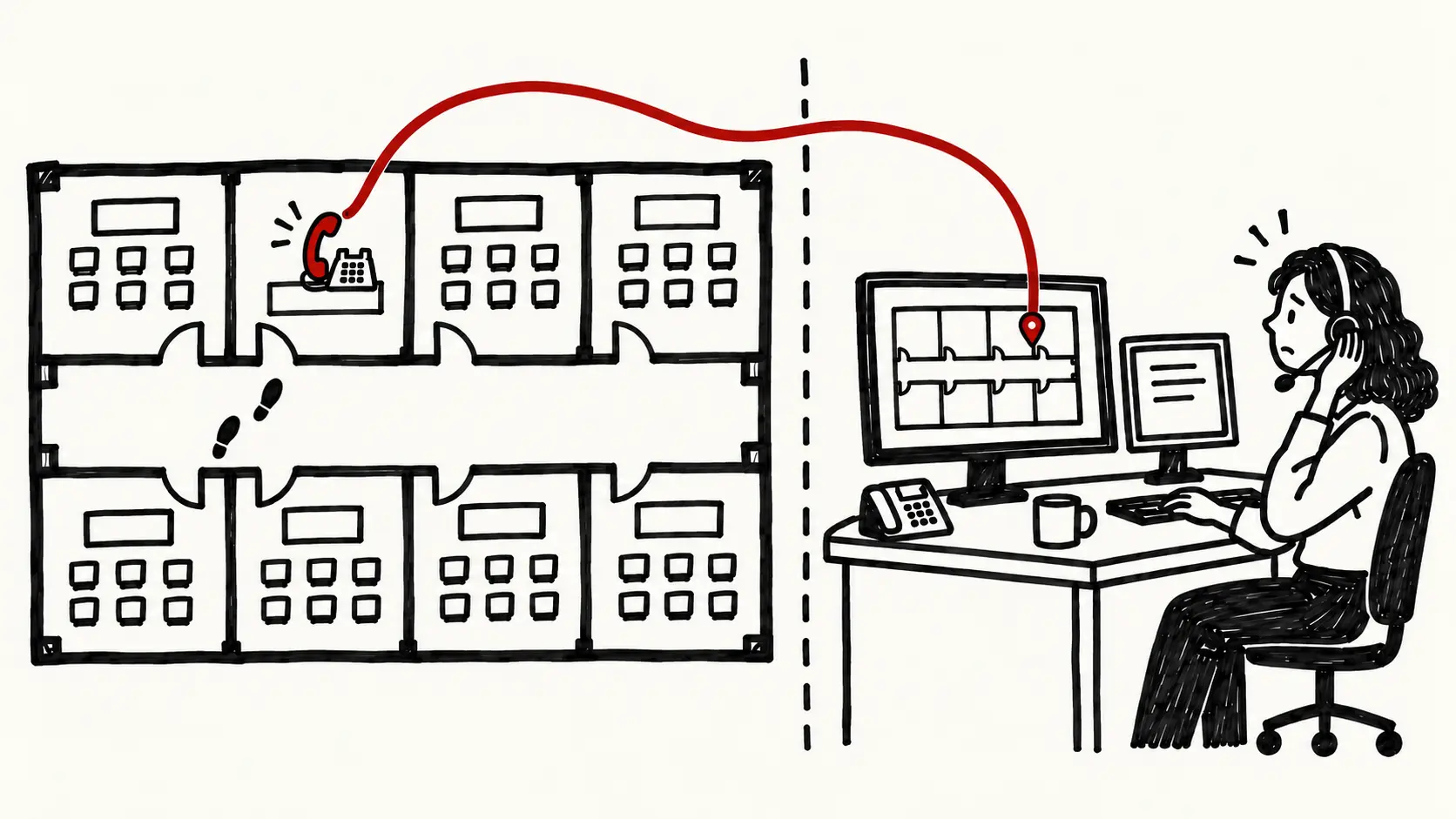
A teacher calls 911 from a classroom telephone.
The call connects. The dispatcher answers. Everything appears to be working.
But what location does the dispatcher receive?
Does the information identify the correct campus? The correct building? The correct floor or classroom, where that detail is needed to locate the caller?
And what happens if the telephone has been moved, the district's primary SIP connection fails, or the call originates from a software application rather than a fixed classroom handset?
These questions expose an important distinction between a phone system that can place emergency calls and an emergency-calling environment whose performance has been verified.
For K–12 school districts, the distinction can be consequential.
Emergency communications involve multiple systems and organizations: classroom telephones, network infrastructure, PBX software, emergency-location records, telecommunications providers, emergency networks, and public safety answering points.
A weakness anywhere in that chain may affect call completion, routing, location delivery, or notification.
Federal regulations address several aspects of this process through Kari's Law and the FCC's implementation of RAY BAUM'S Act. The national transition to Next Generation 911 (NG911) introduces new network-delivery and location-information requirements for covered originating service providers.
In June 2026, the FCC adopted further changes addressing NG911 network reliability and interoperability.
These developments warrant attention from school districts, but they must be interpreted correctly.
Federal NG911 transition rules do not automatically require every school district to replace its telephone system.
Instead, districts need to understand what their deployed equipment does today, which legal obligations apply, what their service providers are responsible for, and how those arrangements will operate as local emergency networks modernize.
This whitepaper addresses six principal findings:
- Successful 911 dialing does not, by itself, establish accurate emergency-location delivery.
- Fixed classroom telephones, movable devices, and off-premises applications require different location considerations.
- NG911 changes how covered providers deliver emergency calls and location information, but it is not a universal PBX replacement mandate.
- Emergency-call failover must preserve appropriate routing and location behavior, not merely ordinary telephone service.
- State panic-alert requirements, including Alyssa's Law, are separate from federal MLTS emergency-calling obligations.
- District readiness should be established through documented responsibilities, representative testing, risk classification, and corrective actions.
The purpose of this guide is to help districts answer two questions:
Can we demonstrate that our emergency-calling system performs correctly today?
Are our technology and service-provider arrangements prepared for changes in the emergency communications network?
Those answers should determine the next investment.
1. Will 911 Find the Right Classroom?
The problem is not always call completion.
Consider a hypothetical campus with three classroom buildings, a gymnasium, temporary classrooms, and a central administrative office.
The district operates an IP telephone system with a dedicated extension in each classroom.
A teacher moves from Room 112 to Room 208. The telephone is relocated and begins working at the new location.
The teacher can call other extensions. Parents can reach the classroom. Voicemail functions normally.
Yet the emergency-location record associated with that telephone still references Room 112.
If an emergency occurs in Room 208, an ordinary calling test may reveal nothing wrong.
This scenario is illustrative, not a documented customer incident.
It demonstrates why emergency-location records must be assessed independently from routine telephone functionality.
Five elements of emergency-calling performance
Districts should distinguish five functions:
Call initiation. Can the device initiate an emergency call under the applicable dialing rules?
Call completion. Does the call reach the correct emergency communications destination?
Location delivery. Is adequate and accurate information delivered to identify the caller's location?
Notification. Are required or configured local notifications delivered to appropriate recipients?
Continuity. What happens to those functions during defined equipment, network, power, and carrier failures?
Testing one function does not prove the others.
A school district should establish how these functions operate across its actual facilities and device types.
2. The Federal Framework: Kari's Law and RAY BAUM'S Act
Kari's Law: Direct emergency dialing
Kari's Law addresses multi-line telephone systems that require an access digit to make outside calls.
Under the applicable federal MLTS rules, a covered system must permit direct 911 dialing without first entering an additional digit, prefix, or trunk access code.
A familiar example is a business telephone system requiring users to dial 9 for an outside line.
That requirement cannot prevent direct 911 dialing on covered systems.
The rules address responsibilities of manufacturers, sellers, installers, managers, and operators, with applicability conditions established in 47 CFR §§ 9.15–9.16. [1]
Emergency-call notification
The federal MLTS rules require qualifying systems to be configured for notification to a central location or another designated recipient when the system can provide that function without hardware or software improvement.
Notification must not delay the emergency call. It must be initiated contemporaneously when technically feasible and reach a location where someone is likely to see or hear it.
The regulations do not universally prescribe that the recipient must be the school's front office.
For a district, a suitable arrangement might involve designated security personnel, district administration, or another monitored location.
The district should establish who receives alerts, how those people are reached during school and after-school hours, and what action follows notification.
A configured notification is not the same as a verified notification.
RAY BAUM'S Act: Dispatchable location
The FCC's MLTS location rules address the information necessary to identify a caller's location adequately.
Dispatchable location combines a validated street address with any additional information needed to locate the caller.
Depending on the physical environment, additional information may include a building designation, floor, room, or similar detail.
The legal definition does not impose one identical room-number format on every installation.
A district should evaluate what is sufficient for its campuses and coordinate appropriate practices with the relevant emergency-calling and public safety authorities.
Different device categories
The regulations distinguish three principal device situations.
| Device category | Federal location approach |
|---|---|
| Fixed on-premises MLTS devices | Automated dispatchable location |
| Non-fixed on-premises MLTS devices | Automated dispatchable location when technically feasible; permitted alternatives otherwise |
| Off-premises MLTS devices | Automated dispatchable location when technically feasible; specified manual or other fallback approaches otherwise |
The published compliance dates for the relevant location rules were January 6, 2021, for fixed on-premises devices and January 6, 2022, for the non-fixed and off-premises categories. [1]
A permanently installed classroom phone presents a different location-management problem from a softphone that can move among school buildings or be used from home.
The district's assessment must reflect those differences.
Who is legally responsible?
Regulatory applicability must be determined based on the actual system and the party's role.
An installer, manager, or operator may have responsibilities under the federal MLTS rules. An originating service provider may face separate requirements governing emergency-call delivery.
The district should not assume every obligation belongs entirely to its telephone vendor.
Nor should the vendor imply that merely purchasing a new platform establishes legal compliance.
A qualified review should record the applicable requirement, responsible party, implementation method, and evidence of performance.
3. Next Generation 911: What Changes and What Does Not
Why NG911 matters
Traditional 911 environments were built around telecommunications infrastructure that differs significantly from contemporary IP networks.
Next Generation 911 is a transition toward IP-based emergency communications infrastructure designed to support more capable and interoperable call and data delivery.
The transition includes Emergency Services IP Networks, commonly called ESInets, and NG911 Core Services.
The FCC adopted a two-phase transition framework in 2024 governing covered originating service providers when they receive valid requests from 911 authorities. [2]
For school districts, the practical concern is whether the complete calling arrangement continues to provide accurate, dependable emergency communications as local 911 networks change.
Phase 1: IP-based emergency-call delivery
Under 47 CFR § 9.29, a covered originating service provider receiving a valid Phase 1 request must implement specified IP-based delivery requirements.
These include delivering relevant 911 calls in the requested SIP format, using designated NG911 delivery points, and completing connectivity testing.
The requirements govern the provider's delivery relationship with the emergency network.
They do not automatically require every school PBX to connect directly to an ESInet.
Phase 2: Standards-based signaling and location
Phase 2 adds requirements concerning standards-compliant emergency-call delivery and location information.
These include delivery of location data in call signaling using Presence Information Data Format–Location Object, known as PIDF-LO, or a functional equivalent.
Covered providers must use a Location Information Server, or an equivalent arrangement, for verification of customer location information and records. [2]
For districts, this introduces a useful procurement question:
How does our PBX and telecommunications provider arrangement maintain, resolve, and deliver accurate location information as emergency networks transition?
That question requires an explanation of the full provider architecture.
It does not mean every school district must build its own Location Information Server.
Transition deadlines are request-triggered.
The federal schedule is not one universal nationwide completion date for school districts.
| Provider category | Phase 1 period following valid request | Phase 2 period |
|---|---|---|
| Interconnected VoIP, non-rural wireline, nationwide wireless, and covered text providers | 6 months | 6 months, subject to sequencing provisions |
| Rural local exchange carriers, non-nationwide wireless, and internet-based TRS providers | 12 months | 12 months, subject to sequencing provisions |
The rules address circumstances in which a Phase 2 request arrives before Phase 1 is completed. [3]
A district should obtain a provider-specific explanation of applicable dates and local transition activity.
The National 911 Program maintains a public tracker of reported NG911 requests from 911 authorities. [4]
That tracker can inform the review, but provider and local-authority confirmation remain necessary.
The most important distinction
Three propositions must remain separate.
The local 911 authority is transitioning its infrastructure.
The district's originating telecommunications provider has certain transition responsibilities.
The district must verify that its deployed telephone arrangement continues meeting its own applicable requirements.
One proposition does not establish the others automatically.
NG911 is a reason to ask better technical questions, not a justification for manufacturing replacement urgency.
4. The FCC's 2026 NG911 Reliability Changes
The regulatory environment continued changing in 2026.
On June 25, 2026, the FCC adopted its Second Report and Order, FCC 26-39, updating the NG911 reliability and interoperability framework.
The final rule was published July 10, 2026, and became effective August 10, 2026.
Certain compliance obligations have later implementation dates tied to additional Federal Register announcements. [5]
What the changes address
The order updates the categories of providers subject to NG911 reliability provisions, including entities responsible for major emergency-network functions.
These functions can include ESInet operation, NG911 Core Services, real-time location services, critical IP transport, call aggregation, and gateways connecting different forms of emergency traffic.
The updated framework addresses reliability practices such as physical network diversity, operational integrity, and network monitoring.
It includes changes to reporting and certification arrangements.
The FCC did not adopt a universal new end-to-end interoperability certification program for all school telephone systems.
Further interoperability measures were the subject of additional rulemaking considerations.
What this means for a school district
A district should distinguish the reliability of its classroom telephone environment from that of the external emergency communications network.
The school's PBX can be functioning correctly when a carrier or emergency-network component fails.
Likewise, a provider's redundant infrastructure does not guarantee local classroom telephone availability during a campus outage.
An assessment should identify each dependency and the party responsible for its operation.
Procurement questions
Districts should ask their telephone provider:
- Which organization delivers our 911 traffic to the emergency network?
- What redundancy and recovery arrangements cover that service?
- What is the process when the primary emergency route is unavailable?
- How is the district informed of significant outages or material service changes?
- What evidence is available regarding the provider's applicable NG911 transition responsibilities?
- Are any required changes anticipated as our local 911 authority transitions?
The purpose is to document provider readiness, not impose federal provider-specific requirements directly on the school district.
5. How Emergency Calls Travel Through the Network
Emergency calling is an end-to-end process.
A conceptual traditional IP telephone emergency path may include:
Classroom telephone → Campus network → PBX → SIP carrier → 911 routing and location services → Emergency communications center
The actual components and delivery methods vary.
In an NG911 environment, covered originating providers deliver calls through designated IP-based emergency-network arrangements, which may include ESInet and NG911 Core Services functions.
The school PBX may still communicate with its originating provider through a supported SIP arrangement.
Three forms of location information
Location information may be associated with a telephone number, represented in configured records, or conveyed through supported signaling methods.
The actual method depends on the platform, service provider, and deployment.
The important question is not merely where a location appears in the telephone administrator's console.
It is how the correct location becomes associated with the emergency call and reaches the downstream emergency-routing and receiving systems.
A classroom move illustrates the risk.
Assume a phone was originally assigned to Classroom 112.
Its location record identifies Building A, Room 112.
The phone is moved to Building B, Room 208.
The phone continues functioning, but the emergency-location association is not updated.
A call from the new location could convey outdated information, depending on the implementation.
The failure is not necessarily in SIP call routing.
It can be a data-maintenance problem.
A district must have a procedure connecting physical device changes to emergency-location updates and verification.
6. Understanding 3CX and Bandwidth Emergency-Location Integration
3CX is one commercial telephone platform used in school communications. Bandwidth is one SIP and emergency-service provider supporting emergency-location mechanisms relevant to these deployments.
Their published documentation provides a concrete example of the technical questions districts should ask.
3CX: Geolocation by Reference
Current 3CX documentation describes a Geolocation-by-Reference mechanism.
Locations are configured in association with supported SIP trunks and assigned to users.
When an appropriately configured user places an emergency call, the system can include a location reference in the SIP INVITE sent to the provider.
3CX identifies Bandwidth and Voxtelesys as supported providers for this feature. Generic provider templates require independent compatibility testing. [6]
The location reference is not equivalent to a blanket compliance certification.
Bandwidth: Location records and emergency call testing
Bandwidth's February 2026 Dynamic Location Routing guide describes provisioned geolocations and the use of a location reference in SIP signaling.
It identifies the requirement to validate and register location information before emergency calling.
Bandwidth recommends Location by Reference and documents 933 test calling as part of its validation process. [7]
The mechanism can support the relationship between a PBX user and a previously registered emergency location.
Yet the district still needs to verify correct records, routing behavior, and the applicable provider functions.
What must be proven
There are three layers of evidence.
PBX behavior: The configured 3CX system associates the intended location reference with the call.
Carrier behavior: Bandwidth recognizes the reference, resolves the location, and handles the call under its documented service arrangement.
End-to-end behavior: The emergency-call and location-delivery arrangement performs as required for the applicable location and network.
Technical documentation supporting one layer is not proof of the others.
A limitation of 933 testing
Bandwidth's 933 service can read back the calling number and provisioned location information.
It is useful for onboarding and diagnosing configuration problems.
Bandwidth cautions that 933 is not a complete address-verification service. It does not substitute for verifying the underlying records or conducting appropriately coordinated emergency-call acceptance testing. [8]
Districts should use the test methods approved for their installation and carrier arrangement.
Backup routing requires separate attention.
3CX documentation discusses configuring location references for more than one SIP trunk.
A secondary carrier or SIP route can use a separate location identifier.
This creates an important verification requirement.
The district should not assume a successful failover call carries the correct emergency location merely on account of the call connecting.
Each approved emergency route needs documented location behavior.
Applying the standard to every vendor
The same analysis should be applied to Cisco, Avaya, Mitel, Microsoft Teams Phone, and other communications platforms.
Vendor selection does not replace the need to establish emergency-call routing, location accuracy, carrier responsibilities, and operational testing.
7. Who Owns Each Part of the Emergency-Calling System?
A multi-campus district's emergency communications depend on several organizations.
Responsibility must be assigned rather than assumed.
| Responsibility | Primary questions |
|---|---|
| District facilities and IT | Who maintains building, floor, and room records? |
| PBX administrator or managed provider | Who configures emergency routes and device-location associations? |
| SIP/emergency service provider | Who validates, resolves, routes, and transmits emergency-location information? |
| Emergency network providers | Who operates the required emergency-network delivery functions? |
| Local 911 authority | What infrastructure and testing arrangements are available? |
| District safety personnel | Who responds to local notifications and coordinates procedures? |
These are functional roles, not universal legal assignments.
The final responsibility matrix should identify the actual parties, contractual obligations, and applicable regulations.
Four types of requirements
Every assessment finding should be classified as one of the following:
Applicable legal requirement: A federal or state obligation confirmed to apply to the situation.
District-adopted requirement: A requirement established by the district's safety policy, operational standard, or procurement specification.
Technical recommendation: An engineering or operational practice proposed to reduce identified risk.
Verification required: A question that cannot be answered from the available evidence.
This classification helps prevent technical suggestions from being misrepresented as legal mandates.
It makes findings more useful to the district's technology director, counsel, safety leadership, and business office.
8. Emergency Calling When Something Fails
An emergency-calling design should be evaluated under normal and defined abnormal operating conditions.
The relevant failure scenarios vary by district.
A large multi-campus installation may have different redundancy arrangements from a single-campus deployment.
Potential failures
Local power failure: Handsets, switches, routers, and gateways may require backup power.
Campus network failure: A phone may lose access to its call-processing environment or carrier route.
Primary SIP carrier failure: External emergency calling may require an approved alternate route.
Hosted platform interruption: Call-processing availability may affect some or all campuses.
Location-service disruption: A call might connect, but the intended location-resolution method may be unavailable.
Notification-system failure: Emergency calls may still connect even when local notifications are not delivered.
The response to each failure should be based on the actual architecture.
The four-part test
For each critical scenario, determine:
- Can the user initiate the call?
- Does it reach the correct emergency destination?
- What location and callback information is conveyed?
- Are applicable notifications delivered?
If a critical function cannot be verified, the assessment should describe the uncertainty clearly.
Continuity is not the same as redundancy.
A system can have multiple servers and still depend on a single campus network link.
A telephone carrier can offer geographically diverse facilities but still rely on a local connection exposed to failure.
A failover plan should document its assumptions, implementation, testing, and recovery steps.
The measure of success is the communications capability preserved—not the number of redundant components advertised.
9. Alyssa's Law and the Difference Between Panic Alerts and 911 Calls
School safety legislation increasingly addresses silent panic alert capabilities and emergency notification.
These requirements should not be confused with federal telephone emergency-calling requirements.
Texas: A relevant example
Texas Senate Bill 838, commonly referred to as Alyssa's Law, established classroom silent panic alert requirements.
Subsequent legislation moved the provision to Texas Education Code § 37.118. Texas Education Agency guidance identifies implementation beginning in the 2025–2026 school year. [9]
The statute requires districts and open-enrollment charter schools to provide classroom silent panic alert technology permitting immediate contact with specified emergency response organizations.
The statute separately states that panic alert technology does not satisfy the requirement to provide employees classroom access to a telephone or other electronic communication device.
This distinction is significant.
A district may operate a phone system with correct 911 routing yet have unmet panic-alert obligations.
A district may have a functioning silent panic alert system but still have incorrect emergency-location records associated with its telephones.
Neither function proves the other.
Four separate capabilities
Districts should evaluate:
Emergency voice calling: Can users initiate and complete calls to 911 with appropriate location information?
Silent panic alerts: Can authorized users activate the panic alert functions required under applicable state rules?
Mass notification: Can the district distribute instructions or announcements to the intended recipients?
Campus paging and intercom: Can authorized personnel communicate with designated areas and devices?
A vendor may integrate several capabilities, but integration does not automatically establish that each relevant requirement is satisfied.
Procurement implications
Districts should ask providers to identify precisely which functionality is included, which systems are required, who receives alerts, how delivery is verified, and what happens during outages.
Requirements should be based on enacted state law and the district's adopted plans rather than a generic nationwide Alyssa's Law checklist.
10. How a District Should Verify Emergency Calling
The purpose of an emergency-calling assessment is to produce evidence, not merely a collection of yes-or-no answers.
A district-wide verification program should begin with the actual deployed architecture.
Step 1: Inventory the environment
Identify campuses, buildings, calling devices, PBX components, carrier arrangements, and emergency-location records.
Inventory the relevant fixed and movable devices and their associated locations.
Step 2: Establish applicability
Record the relevant federal MLTS requirements, state requirements, district policies, and provider responsibilities.
Flag unresolved legal questions for appropriate review.
Step 3: Reconcile location records
Compare documented device locations and registered emergency-location data against current facilities.
A mismatch should be investigated before relying on a live call test.
Step 4: Identify distinct test groups
Group devices according to materially different configurations.
Examples include fixed phones at separate campuses, movable handsets, software applications, different SIP trunks, and different emergency-location schemes.
There is no reliable universal percentage of devices that proves the entire district is correct.
Testing should be justified by the configuration and risks.
Step 5: Agree on a test plan
Coordinate testing with the telecommunications provider and appropriate emergency communications center.
Use available provider test facilities and controlled procedures.
Do not generate unannounced live 911 calls for routine verification.
Step 6: Record what actually happened
For each approved test, document the source, physical location, expected result, observed routing, delivered location information, notification result, and any failure.
Step 7: Classify and correct defects
Findings should have a responsible owner, priority, corrective action, and retest requirement.
Step 8: Review NG911 readiness
Obtain written provider information about supported signaling, location resolution, local transition status, and known future dependencies.
Do not treat an unanswered provider question as proof of an existing call failure.
Step 9: Report the decision
Present what is verified, what failed, what remains unknown, and what action is recommended.
11. A Risk-Based Findings System
Not all emergency-calling findings represent the same level of urgency.
An actual failed emergency call should receive different treatment from missing documentation concerning a future network transition.
The following categories are recommended operational priorities, not federal statutory severity classifications.
| Priority | Example finding | Expected response |
|---|---|---|
| Critical | A device expected to reach 911 cannot complete the emergency call | Immediate escalation, incident response, and interim measures |
| High | Confirmed incorrect dispatchable location | Urgent correction and verified retest |
| High | Required emergency route fails under a defined outage scenario | Correct continuity failure and retest |
| High or moderate | Required or configured notifications reach unmonitored destinations | Evaluate operational impact and corrective action |
| Review required | Provider NG911 transition responsibilities are undocumented | Obtain carrier documentation and define follow-up |
| Moderate | Emergency-location records have no assigned maintenance owner | Assign accountability and change-control process |
| Routine review | Required tests pass and supporting documentation exists | Maintain review and change-control practices |
The appropriate priority depends on the particular device, system, legal requirements, operational circumstances, and possible consequences.
A compliance determination requires legal and technical analysis beyond a generic scoring label.
12. Preparing for NG911 Migration
A district should evaluate its existing emergency-calling service before local network transition activities create an urgent dependency.
This does not mean scheduling an automatic PBX replacement.
It means asking the relevant providers for documented information.
Provider-readiness questions
Transition status: Has a relevant 911 authority made a valid Phase 1 or Phase 2 request affecting the provider's delivery obligations?
Signaling: What emergency-call delivery format is used, and what changes are anticipated?
Location: How are customer emergency locations validated, maintained, resolved, and transmitted?
Compatibility: What has been tested for the district's PBX version and emergency-service arrangement?
Fallback: How are emergency calls routed when a primary route or location service is unavailable?
Testing: What controlled test procedures and evidence are available?
Accountability: Which party will coordinate technical changes and notify the district when action is required?
Costs: Are relevant updates included in the service agreement or separately billable?
A practical timeline
Districts can incorporate these reviews into regular telecommunications planning.
A useful sequence is to document the existing environment, obtain provider readiness information, identify dependencies, complete necessary testing, and update the assessment when network or service arrangements change.
The district's timeline should reflect actual local developments, applicable deadlines, and observed problems.
There is no justified reason to impose a fictional universal 2026 PBX replacement deadline.
13. Retain, Correct, Upgrade, or Replace?
The emergency-calling assessment should support an investment decision.
Four possible outcomes are appropriate.
Retain
Continue operating the existing platform when its required functions are supported, verified, and maintained.
Correct
Address inaccurate location records, notification settings, routing rules, or administrative procedures without replacing the system.
Upgrade
Add or replace selected software, carrier services, gateways, or location-management components when a targeted change resolves the identified requirements.
Replace
Consider a new platform when the current system lacks an acceptable technical solution, has become unsupported, presents unacceptable operational risks, or is uneconomic to maintain.
A replacement recommendation should identify the specific deficiency or financial justification it resolves.
NG911 readiness alone is not evidence that a currently functioning system must be replaced.
14. Reporting to District Leadership
A useful technical report should answer questions that matter to the superintendent, finance office, and school board.
What has been verified?
What remains uncertain?
Is there a current operational failure or a future compatibility issue?
Who is responsible for the next action?
What will corrective work cost?
How will the district determine that the problem has been resolved?
Recommended leadership summary
| Subject | District finding |
|---|---|
| Campuses and systems reviewed | |
| Applicable legal and adopted requirements | |
| Emergency-call routing results | |
| Dispatchable location results | |
| Notification findings | |
| Continuity and failover findings | |
| NG911 provider-readiness status | |
| Critical and high-priority issues | |
| Required corrective actions | |
| Responsible parties | |
| Cost and implementation considerations | |
| Retest and completion criteria |
Findings should distinguish observed results from unverified assumptions.
A district should not be declared fully compliant solely on the basis of a successful test at one telephone.
Equally, an NG911 transition documentation gap should not be described as an active emergency-calling failure without supporting evidence.
15. A Four-Part Emergency-Calling Readiness Assessment
An actionable assessment should produce four documents.
1. Applicability and Requirements Register
Identifies federal obligations, state-specific requirements, district policies, responsible parties, and outstanding interpretation questions.
2. Technical Verification Record
Documents the devices, locations, calling scenarios, observed results, evidence, and retests completed under an approved plan.
3. Risk and Corrective-Action Register
Records verified defects and uncertainties, their priority, accountable owner, interim procedures, required correction, and closure evidence.
4. NG911 Readiness Report
Summarizes provider information, local transition status, signaling and location-management methods, anticipated changes, and unresolved dependencies.
Together, these records provide a basis for a retain, correct, upgrade, or replace decision.
The scope of a particular assessment must be defined in advance. A preliminary document review should not be represented as a completed end-to-end technical audit.
Conclusion: Emergency Readiness Must Be Demonstrated
A school telephone system can function during ordinary operations and still contain emergency-calling weaknesses.
Those weaknesses may involve incorrect location records, incomplete notifications, unsupported mobile-device behavior, inadequate backup routing, or undocumented provider dependencies.
Kari's Law and RAY BAUM'S Act establish important federal requirements for covered systems.
The transition to NG911 introduces further changes in emergency-call delivery and location-information handling by covered providers.
The FCC's 2026 reliability changes reinforce the importance of understanding the full network and service arrangement.
None of these developments justifies replacing every functioning district telephone system automatically.
They justify asking better questions and collecting better evidence.
A district should be able to explain how an emergency call travels from a classroom telephone to the appropriate emergency communications center, what location information accompanies it, how the relevant functions respond to failures, and who is responsible for keeping the configuration accurate.
When those answers are documented and tested, district leaders can make informed decisions about maintaining, correcting, upgrading, or replacing their communications systems.
Research Methodology and Commercial Disclosure
This paper draws on federal regulations, FCC orders, National 911 Program materials, manufacturer documentation, and telecommunications-provider technical guidance.
Hypothetical school scenarios are used to illustrate possible failure conditions. They are not represented as incidents observed at named or unnamed customer districts.
Technical capabilities described in manufacturer documents require appropriate product versions, compatible providers, configuration, and testing.
K12PhoneSystems.com is associated with SPARK VoIP, a provider of managed 3CX-based telephone solutions, and has a commercial interest in district communications projects.
The paper applies the same fundamental verification questions to all platforms and does not claim that a particular product or service automatically satisfies legal requirements.
References
- [1]
Electronic Code of Federal Regulations. 47 CFR §§ 9.15–9.16, Applicability and General Obligations for Multi-Line Telephone Systems.
https://www.ecfr.gov/current/title-47/chapter-I/subchapter-A/part-9/subpart-F/section-9.16 - [2]
Electronic Code of Federal Regulations. 47 CFR § 9.29, Next Generation 911 Transition Requirements.
https://www.ecfr.gov/current/title-47/chapter-I/subchapter-A/part-9/subpart-J/section-9.29 - [3]
Electronic Code of Federal Regulations. 47 CFR § 9.30, Next Generation 911 Implementation Deadlines.
https://www.ecfr.gov/current/title-47/chapter-I/subchapter-A/part-9/subpart-J/section-9.30 - [4]
National 911 Program. NG911 Requests from 911 Authorities.
https://www.911.gov/projects/ng911-requests-from-911-authorities/ - [5]
Federal Communications Commission. FCC 26-39, Second Report and Order, June 25, 2026; Federal Register publication, July 10, 2026.
https://docs.fcc.gov/public/attachments/FCC-26-39A1.pdf - [6]
3CX. Dynamic E911 with Geolocation Support User Guide, updated September 10, 2026.
https://www.3cx.com/docs/e911-geolocation/ - [7]
Bandwidth. E911 Dynamic Location Routing Integration and Testing Guide, February 11, 2026.
https://www.bandwidth.com/support/en/articles/12822952-e911-dynamic-location-routing-integration-and-testing-guide - [8]
Bandwidth. The 933 Service, November 17, 2025.
https://www.bandwidth.com/support/en/articles/12823286-the-933-service - [9]
Texas Education Agency. School Safety 89th Legislative Updates; Texas Education Code § 37.118, Silent Panic Alert Technology.
https://tea2.tea.texas.gov/taa-letters/school-safety-89th-legislative-updateshttps://statutes.capitol.texas.gov/Docs/ED/htm/ED.37.htm
Copyright © 2026 K12PhoneSystems.com. This whitepaper provides educational and technical decision guidance. It is not legal advice, a determination of statutory applicability, or certification of emergency-calling performance. Legal and engineering review is required before publication and before making district-specific compliance determinations.