Checklist
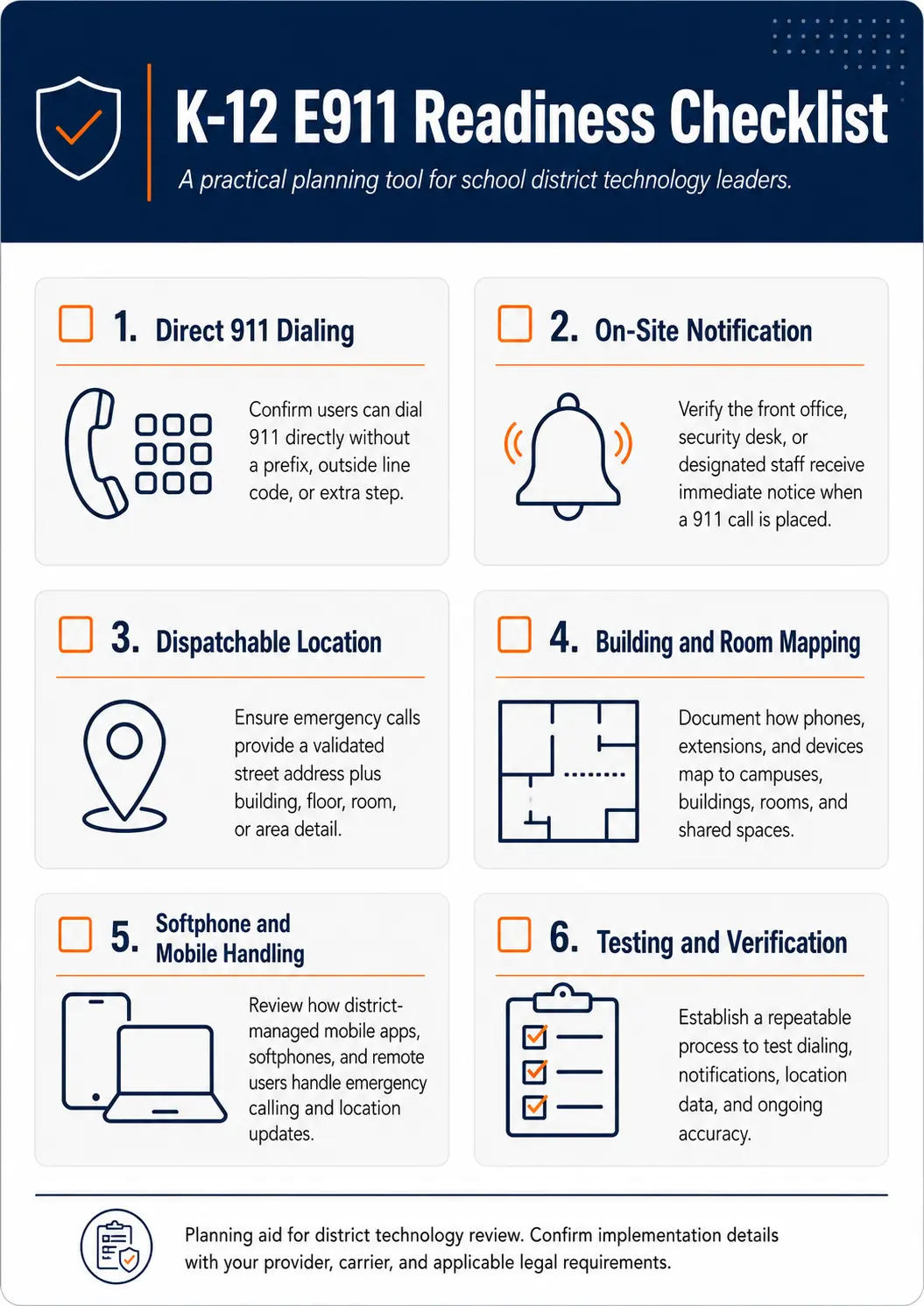
K-12 E911 Readiness Checklist
Use this checklist to review direct 911 dialing, on-site notification, dispatchable location, and testing.
Emergency communication
Plan direct 911 dialing, internal notification, and location data so emergency calls from any campus reach help with accurate information.
Emergency communication planning for schools covers how a 911 call is dialed, who is notified inside the district, and what location information is sent. Hosted VoIP supports direct 911 dialing, internal notification, and dispatchable location data, planned with Kari's Law and RAY BAUM'S Act requirements in mind.
The situation
Emergency calls are rare and high-stakes. The details that make them work have to be planned before they are needed.
Callers should be able to dial 911 directly without an access code or prefix.
Front office or security staff should be alerted when someone calls 911 on campus.
Dispatch needs to know the building, floor, and room, not just a district address.
Calls from softphones and mobile apps need location handling planned in advance.
Requirements
These are the elements a district should plan for when reviewing emergency calling.
Recommended approach
A structured review makes emergency calling something you can document and verify.
Document buildings, floors, rooms, and where devices live across the district.
Decide who is alerted internally when 911 is dialed and how they receive it.
Set every device to dial 911 directly with the correct location data attached.
Test call paths and keep records you can review during safety audits.
Use this checklist to review direct 911 dialing, on-site notification, dispatchable location, and testing.
Working on emergency calling? See School 911 Compliance Planning for how Kari's Law and RAY BAUM'S Act requirements factor into a district phone system replacement.
Related capabilities
Emergency calling and dispatchable location planning.
Learn more about School 911 complianceHosted VoIP phone systems built for districts.
Learn more about K-12 VoIPAdminister every campus from one platform.
Learn more about Multi-campus routingSee every K-12 phone system solution in one place.
Learn more about All phone system solutionsQuestions
Straightforward answers for district technology and operations leaders evaluating a phone system replacement.
No vendor should promise guaranteed compliance. We help districts plan and document direct 911 dialing, notification, and location data with those requirements in mind. Final compliance decisions belong to the district and its counsel.
Dispatchable location is the specific information sent with a 911 call, such as building, floor, and room, so responders can find the caller quickly.
Softphone and mobile calls need a plan for location, since the device can move. We review how those calls are routed and what location data is attached.
Yes. Internal notification can alert front office or security staff when a 911 call is placed on campus.
Review it whenever buildings, rooms, or devices change, and on a periodic schedule as part of safety planning.
We will look at your current setup, call flow, locations, numbers, and replacement risks so your district can plan the next step with clarity.
Questions before you request a review? Call 908-923-8241.