A multi-campus phone system is not just a larger version of a small office phone system. A school district has front offices, district administration, classrooms, transportation, maintenance, athletic facilities, shared spaces, portable buildings, and staff who may work across sites. The phone system has to support all of that without making callers guess where to go, forcing staff to manage workarounds, or leaving IT without a clear way to control routing, numbers, devices, and emergency calling records.
Request System Review | Download the District Phone System Modernization Roadmap
What a multi-campus phone system means for schools
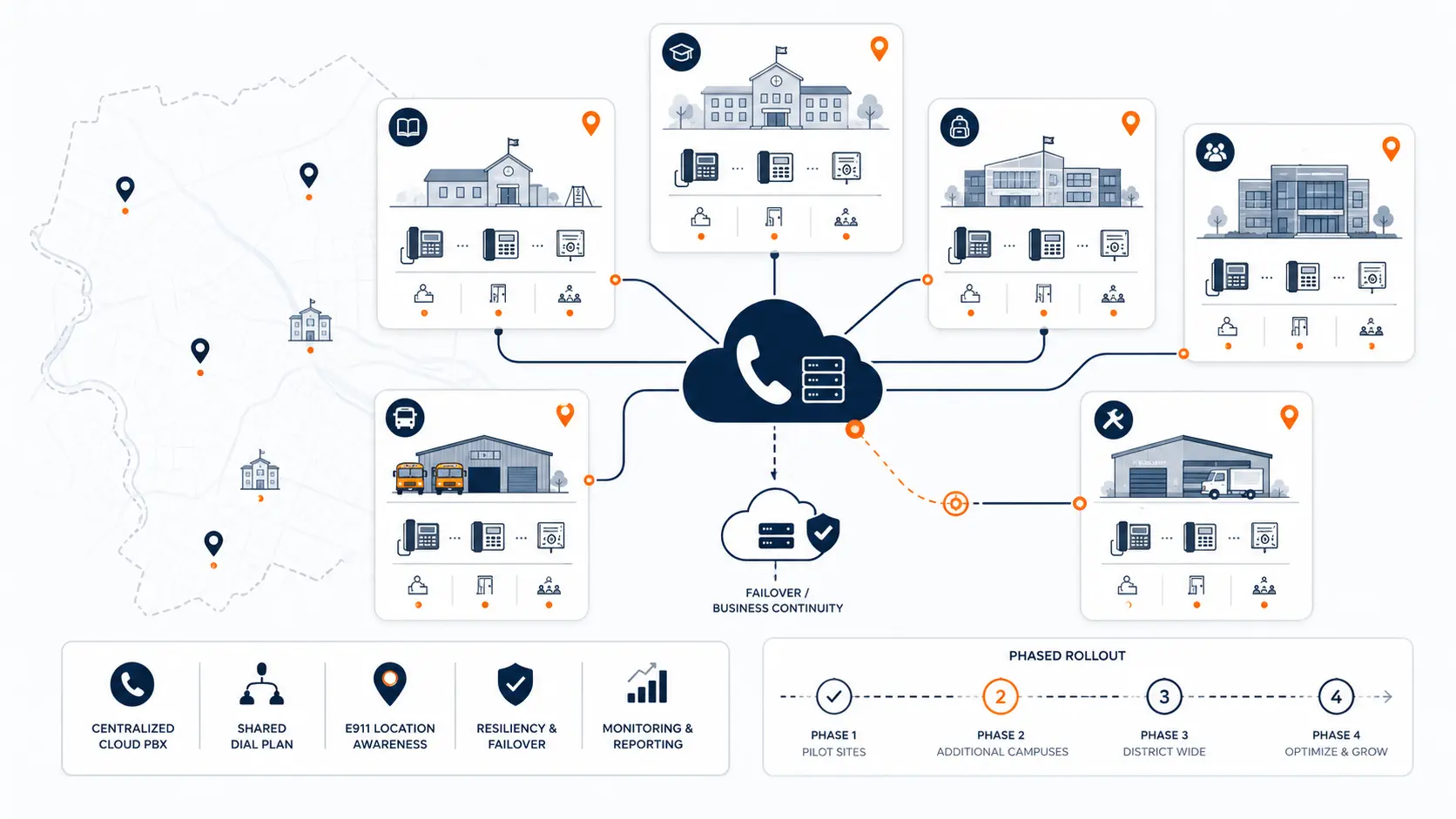
A multi-campus phone system connects more than one school, building, or district site under a common communications plan. That may include elementary schools, middle schools, high schools, district offices, transportation buildings, maintenance facilities, alternative campuses, athletic facilities, and temporary classrooms.
For a school district, the phone system has to do more than create extensions. It must handle main numbers, department numbers, front office call flow, campus-level routing, district-wide transfers, emergency calling, after-hours handling, voicemail, mobile users, and support needs. The system needs to reflect how the district operates.
A district may use a legacy PBX, several separate PBX systems, hosted VoIP, cloud calling, SIP trunks, analog lines, or a mixture of all of them. The real planning question is not whether the system has modern features. The real question is whether the district can manage communication across buildings in a way that is reliable, documented, and ready for staff use.
For broader planning context, see School Phone Systems.
Why multi-campus districts need a different phone system plan
Single-building phone systems can often rely on simple call handling. A district with several campuses cannot. Each building may have a separate main number, separate office workflow, unique bell schedules, different staff coverage, and different after-hours needs.
A multi-campus system needs to answer questions like these:
- Where should a parent call first?
- What happens when the front office is busy?
- Can calls transfer between buildings without caller confusion?
- Are campus offices managed locally or centrally?
- Who updates call routing during breaks, storms, holidays, or closures?
- How are emergency calls mapped to the correct building, floor, room, or area?
- How does the system handle transportation, maintenance, and district administration?
- Can the district phase deployment without breaking communication between old and new systems?
These questions are why multi-campus phone planning should start with operations, not hardware.
Common problems in multi-campus school phone systems
Many district phone environments grow over years. A system may start clean, then become harder to manage as campuses are added, numbers change, staff move, and vendors rotate.
| Problem | What it looks like | Why it matters |
|---|---|---|
| Separate systems by campus | Each school has its own PBX, vendor, or routing rules | IT has less control and support is inconsistent |
| Unclear call flow | Nobody knows exactly where a main number routes | Front office staff rely on memory and workarounds |
| Inconsistent extensions | Similar roles have different extension patterns by campus | Transfers are slower and training is harder |
| Weak failover planning | Calls fail when a site loses internet or equipment | Offices may become unreachable during disruptions |
| E911 location gaps | Devices are not mapped to the right building or room | Emergency responders may receive incomplete location details |
| Old analog lines | Fax, alarms, elevators, gates, or legacy voice lines remain undocumented | Replacement planning can miss specialty services |
| High per-extension pricing | The district pays for every extension, user, or device | Costs rise even when call volume does not |
A district does not need every problem on this list to justify a review. One or two may be enough to show that the system deserves closer attention.
Multi-campus call routing needs
Call routing is one of the most visible parts of a school phone system. Parents, vendors, staff, emergency contacts, and community members experience the phone system through the way calls are answered and transferred.
A multi-campus plan should review:
- District main number routing
- Campus main number routing
- Front office ring groups
- Department call paths
- Auto attendants
- After-hours messages
- Holiday and closure routing
- Voicemail rules
- Overflow handling
- Transfer paths between campuses
- Emergency or urgent call handling
The goal is not to create a complicated call tree. The goal is to make common calls simple and predictable.
A parent calling an elementary school should not have to understand district structure. A vendor calling maintenance should not be sent to the wrong campus. A staff member transferring a call should know where it will go.
Extension planning across campuses
Extension planning often gets overlooked. In a single building, extension numbering may seem simple. In a district, extension planning becomes part of operational design.
A good extension plan may account for:
- Campus identity
- Building groups
- Department numbers
- Staff roles
- Shared office phones
- Classroom phones
- District administration
- Transportation
- Maintenance
- Temporary users
- Future expansion
A district should decide whether extension ranges should identify a building, a department, or both. For example, one range may belong to a campus, another to administration, another to transportation, and another to maintenance. The pattern should be easy enough for IT to manage and easy enough for staff to learn.
The plan should not be over-engineered. Overly complex numbering can become just as difficult as no plan at all.
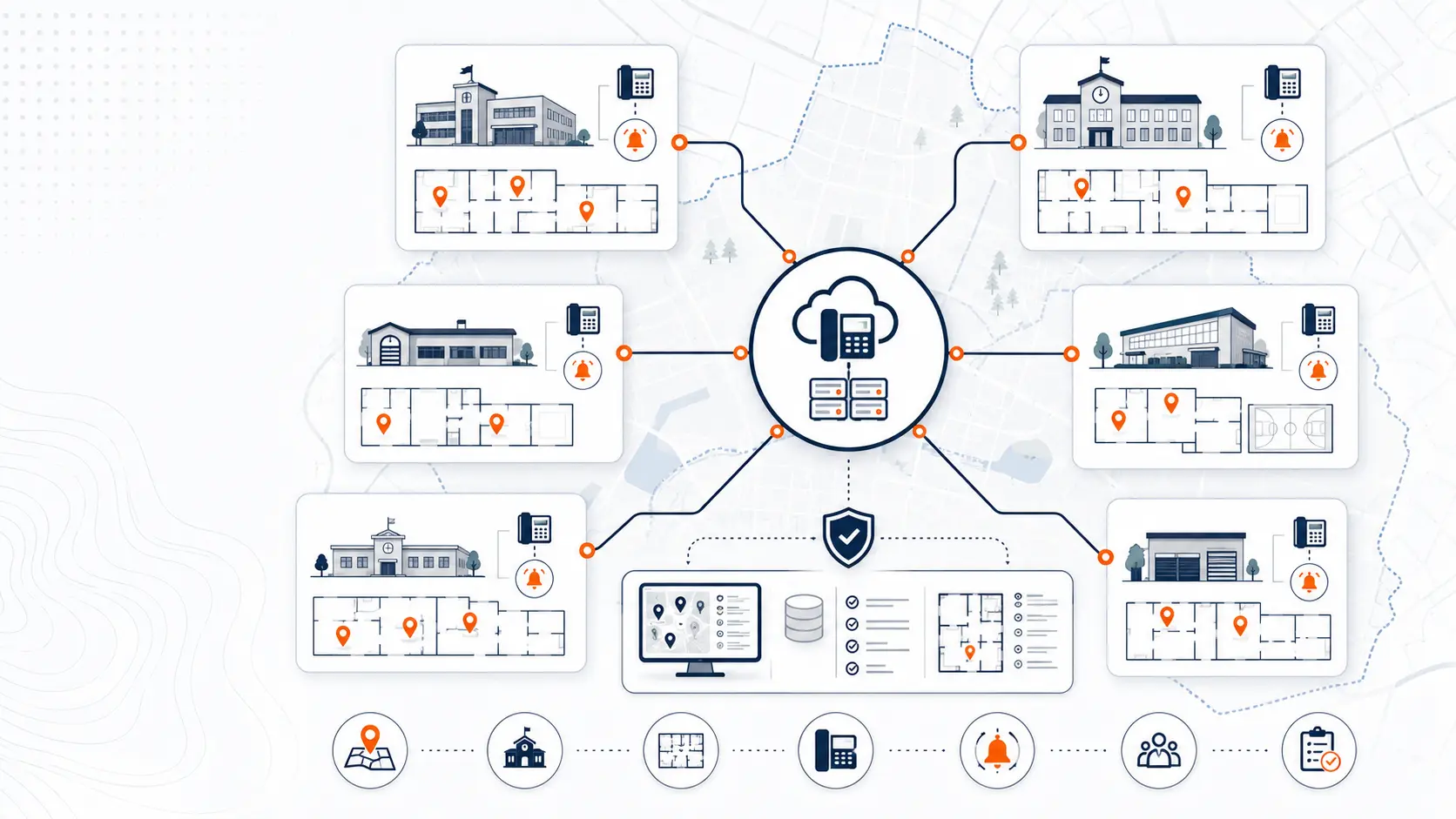
E911 planning in multi-campus districts
E911 planning becomes more complex when several buildings and campuses are involved. A street address may not be enough to identify a caller’s location inside a school environment.
A multi-campus E911 review should include:
- Direct 911 dialing
- On-site notification
- Dispatchable location
- Building names and validated addresses
- Floor, room, suite, zone, or area data where needed
- Phone location records
- Portable classrooms
- Shared spaces such as gyms, cafeterias, libraries, and auditoriums
- Softphones and mobile apps
- Testing and verification
- Ongoing location data ownership
Kari’s Law and RAY BAUM’S Act affect multi-line telephone systems and dispatchable location requirements. The FCC explains the direct dialing, notification, and dispatchable location requirements for multi-line telephone systems in its MLTS 911 guidance [1]. The National 911 Program offers related resources on Kari’s Law, RAY BAUM’S Act, and MLTS requirements [2].
This guide provides technical planning information, not legal advice. Districts should review compliance requirements with qualified counsel, public safety authorities, and appropriate state or local agencies.
For deeper planning, see E911 Compliance for Schools and the K-12 E911 Readiness Checklist.
Hosted phone systems for multi-campus districts
A hosted phone system can give a district a more centralized way to manage users, numbers, routing, voicemail, devices, and administrative changes. That can be useful when campuses have separate legacy PBX systems or when IT needs a consistent management model across the district.
A hosted system may help with:
- Central administration
- Shared call routing standards
- Easier extension management
- More consistent auto attendants
- Softphone and mobile options
- Faster changes during schedule shifts or closures
- Support across multiple sites
- A phased migration path
A hosted system still requires planning. It does not automatically fix bad call flow, inaccurate E911 records, weak internet connections, unclear carrier records, or poor staff training. The best results come from reviewing the current environment before designing the replacement.
For a broader hosted phone planning discussion, see K-12 VoIP.
Existing VoIP systems can still be wrong for a district
Some districts already have a hosted VoIP PBX or cloud phone system, but still need a review. Moving away from an old PBX does not always mean the district landed on the right design or pricing model.
A district should question an existing VoIP installation when:
- The district pays by extension, user, or device without reviewing actual call capacity needs
- The system charges for unused classroom extensions
- Every added phone creates another monthly license charge
- Support requires add-on fees or higher tiers
- Call routing is hard to change
- E911 location management is unclear
- Mobile apps exist but are not well governed
- Auto attendants were copied from old call flow without cleanup
- Phone bills are hard to explain to leadership
- The contract renews before the district has reviewed alternatives
Per-extension pricing can become a real issue in K-12. Schools may need many phones for offices, classrooms, shared spaces, libraries, kitchens, gyms, and administrative areas, yet not every phone is used at the same time. Paying for every extension may cost more than a model designed around actual usage, call paths, and operational needs.
The point is not that every per-extension plan is bad. The point is that districts should review whether the pricing model matches how schools use phones. A district may already be on VoIP and still be overpaying or operating with the wrong call design.
Network readiness for multi-campus phone systems
A hosted or cloud phone system depends on the district network. That does not mean every school needs a major network rebuild. It means the phone migration should account for the network conditions at each site.
Review these areas before rollout:
- Internet reliability at each campus
- LAN switching capacity
- Cabling conditions
- Power over Ethernet for desk phones
- Battery backup for network closets
- Voice traffic planning
- Firewall rules
- Wi-Fi limitations for voice devices
- Site-to-site connectivity
- Failover options
- Monitoring and support responsibility
USAC explains that the E-Rate program includes eligible services guidance and category structure for schools and libraries [3]. Districts should review funding and procurement details with their E-Rate consultant, finance team, and legal counsel. Do not assume that a phone system service, device, or network item is eligible without review.
The network review should be practical. The question is simple: can each campus support voice traffic reliably enough for front office, staff, and administrative communication?
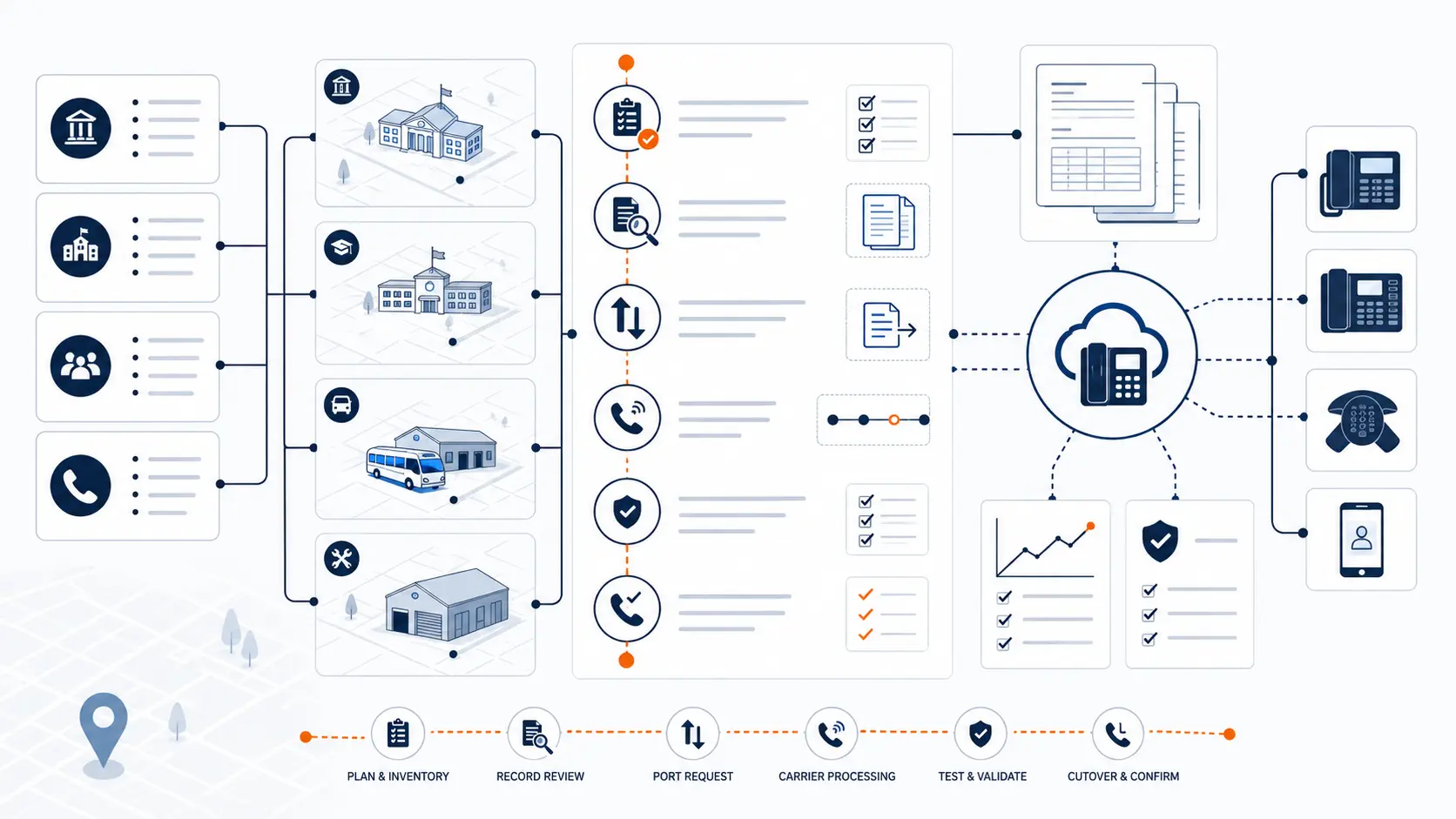
Number porting across multiple campuses
Number porting can become one of the most stressful parts of a district phone system migration. A multi-campus district may have main numbers, department numbers, direct inward dial numbers, fax numbers, alarm-related lines, and legacy carrier services spread across several accounts.
Before porting, document:
- Billing telephone numbers
- Campus main numbers
- District office numbers
- Department numbers
- Fax numbers
- Emergency or specialty lines
- Carrier account numbers
- Service addresses
- Authorized contacts
- Contract terms
- Numbers that should not be ported
- Numbers that may need temporary forwarding
Porting should be planned with the cutover sequence. If a district moves one campus first, that campus may need to communicate with sites still on the old system. Temporary routing and forwarding may be needed during transition.
A good number plan reduces surprises.
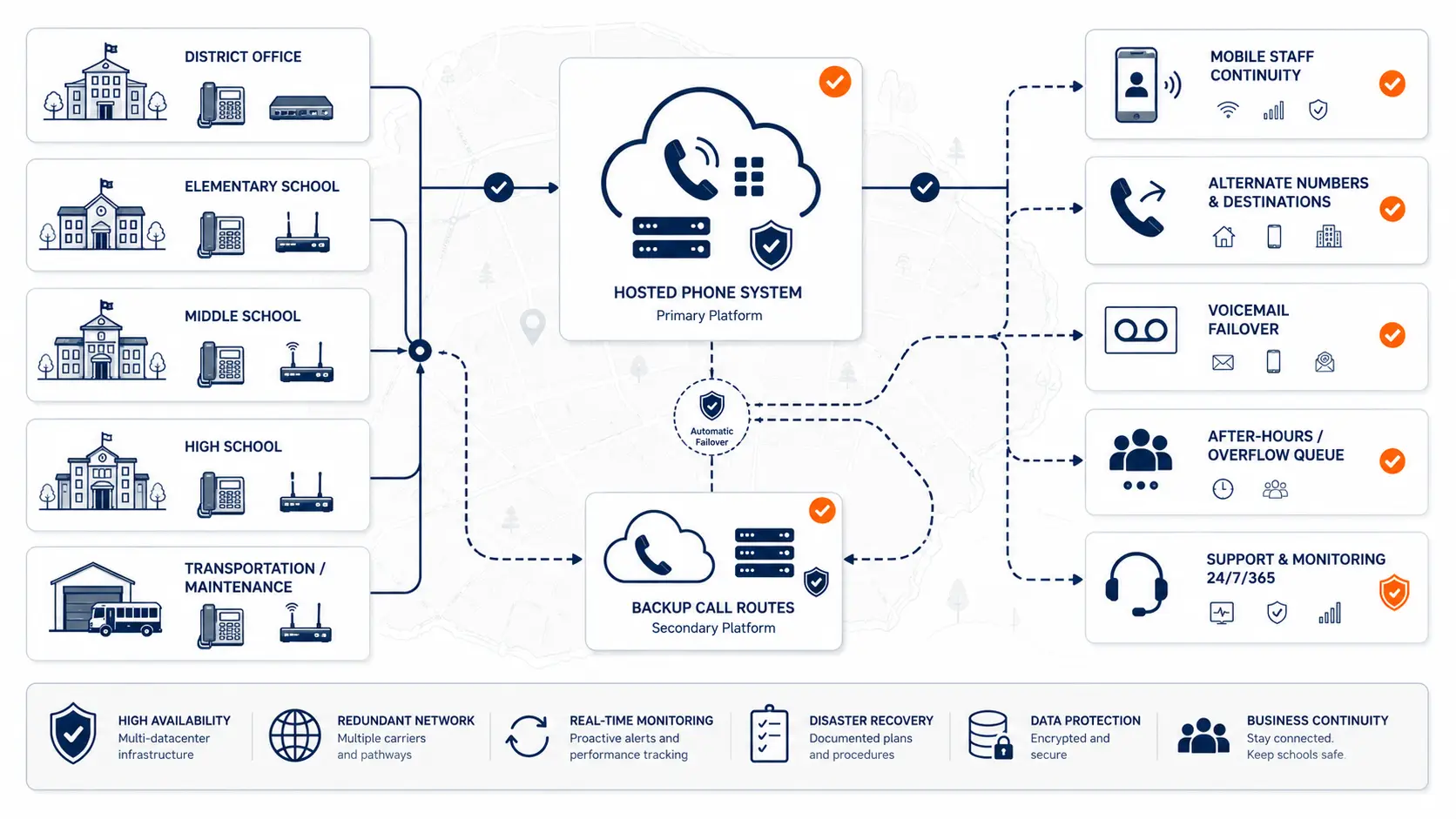
Failover and continuity planning
Phone failover is not just a technical feature. It is an operational plan.
For a multi-campus district, failover questions include:
- What happens if one campus loses internet?
- What happens if the district office loses service?
- Where should calls route during a site outage?
- Who can change routing during a closure?
- How are front office staff notified?
- Can calls forward to another campus or department?
- Are mobile apps part of the continuity plan?
- Are voicemail messages updated during closures?
- Is there a documented process for weather days or building-level disruptions?
Failover should not be designed in a vacuum. A technical reroute that sends calls to the wrong staff or the wrong building creates confusion. The district should decide who answers calls during different outage scenarios and how those staff members should respond.
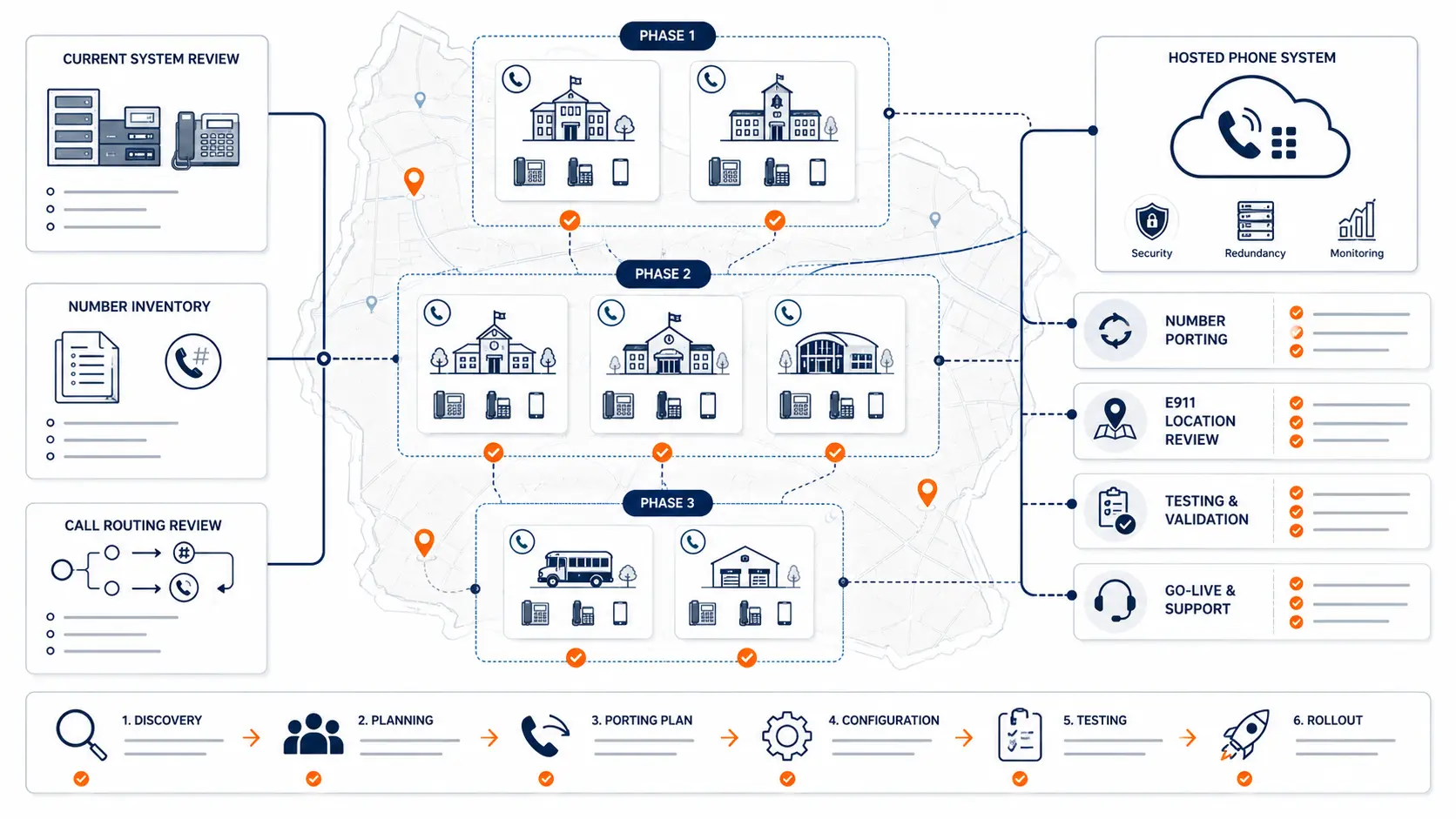
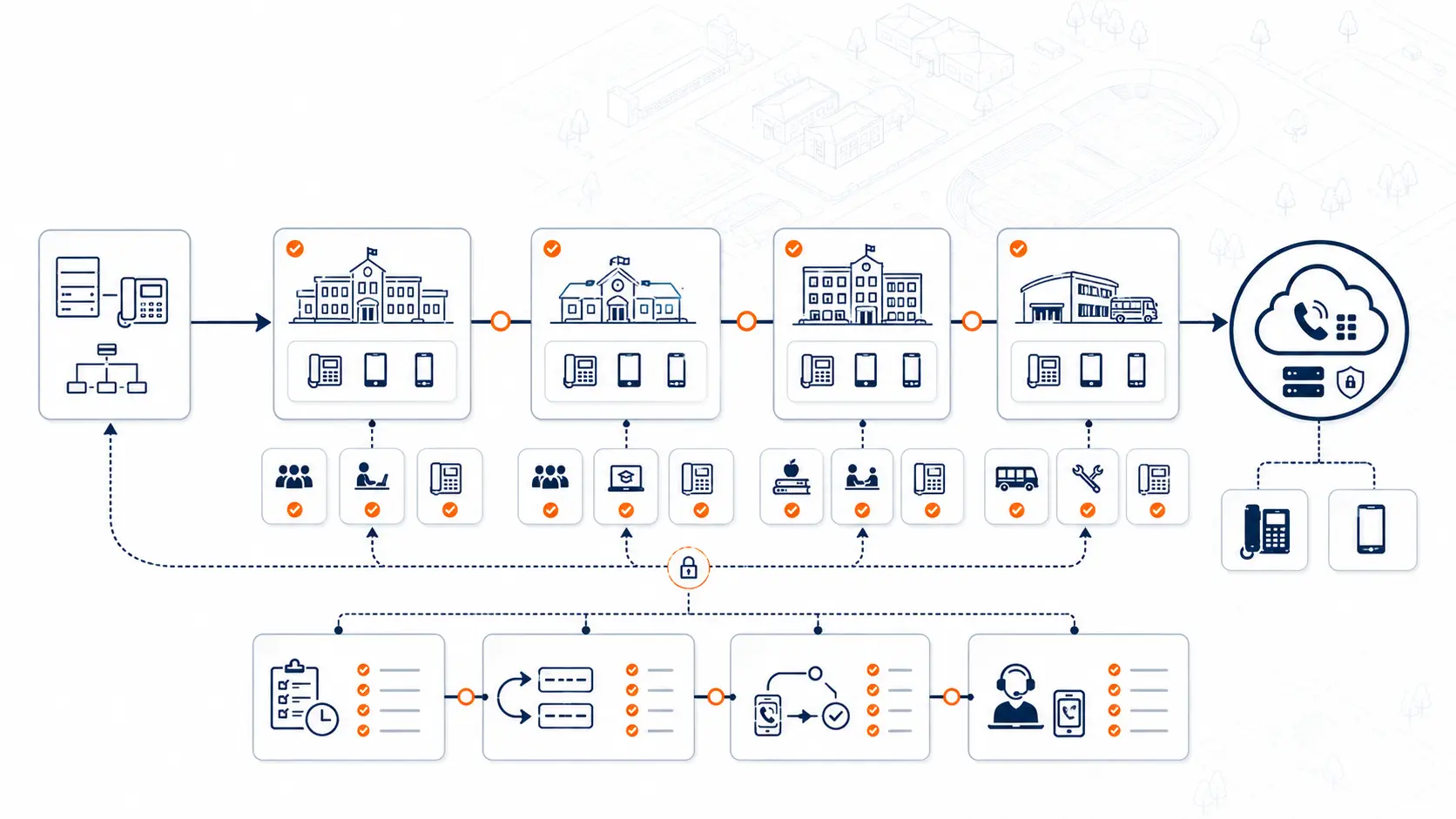
Phased migration for multi-campus districts
Many districts should not move every campus at once. A phased rollout gives IT, office staff, and leadership a better way to manage risk.
Common rollout approaches include:
- Pilot campus first
- District office first
- Small campus first
- Campus group by building type
- Department-by-department transition
- Summer cutover window
- Break-period cutover window
- After-hours or weekend cutover
Each approach has tradeoffs. A district office first rollout may help IT and administration learn the system before school campuses go live. A pilot campus may reveal training and routing issues early. A summer rollout may reduce school-day disruption but can compress staff availability.
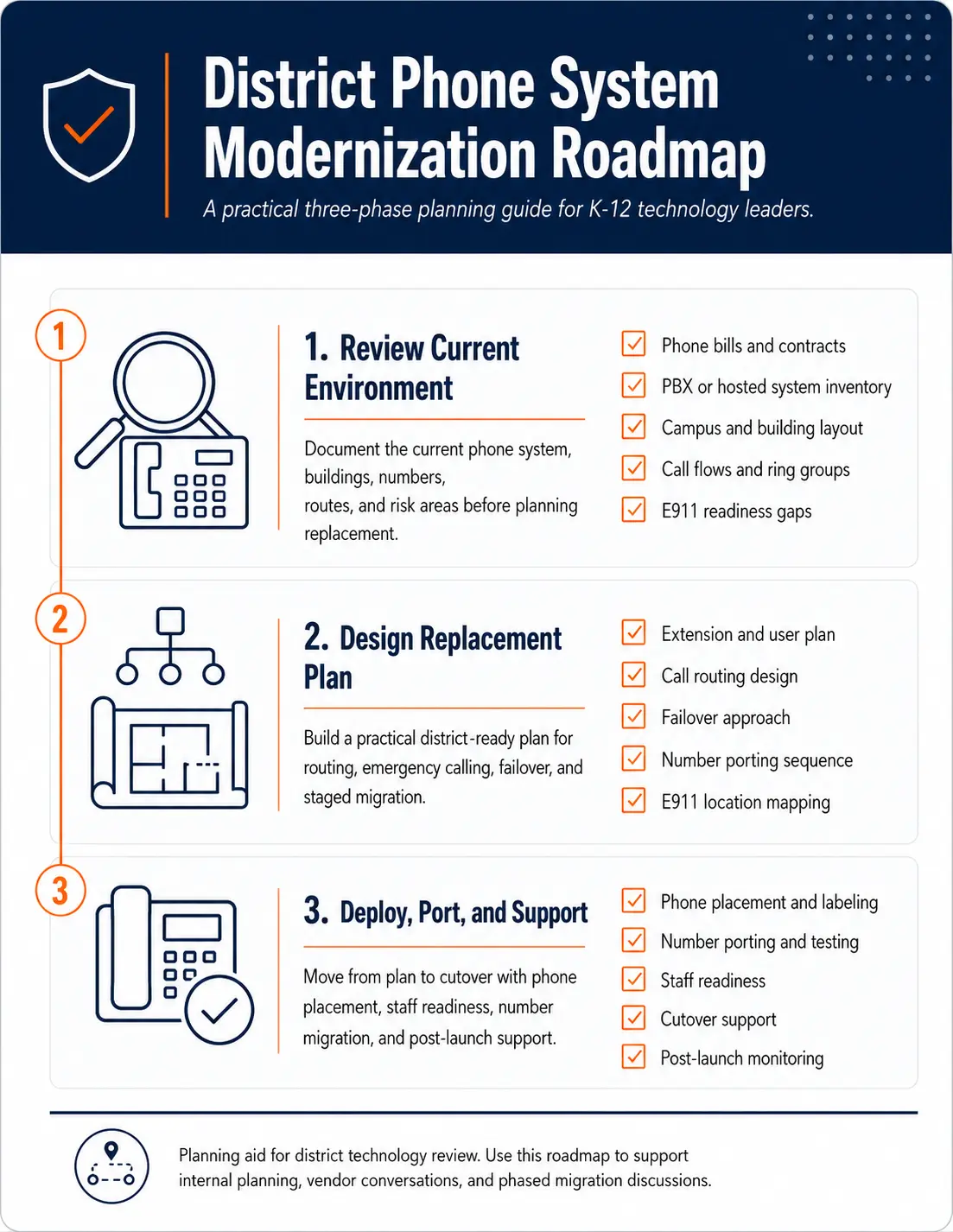
Use the District Phone System Modernization Roadmap to organize review, design, deployment, porting, and support phases.
What to document before designing the system
Good design starts with current-state documentation. A district does not need perfect records before asking for help, but it should gather what is available.
Document:
- Campus list
- Building list
- Service addresses
- Main numbers
- Department numbers
- DID numbers
- Extension list
- Phone locations
- Auto attendant menus
- Ring groups
- Voicemail boxes
- Front office call flow
- After-hours routing
- E911 records
- Analog lines
- Fax lines
- Alarm lines
- Elevator lines
- Gate or door lines
- Carrier accounts
- Internet providers by site
- Network closet notes
- Known outage history
- Current support process
- Contract renewal dates
- Existing VoIP licensing or per-extension costs
The District Phone System Review Checklist can help organize this information before a vendor conversation.
What to ask before choosing a multi-campus phone system
District leaders should ask practical questions before selecting a phone system or renewing a current VoIP contract.
- How will campus main numbers route during and after cutover?
- Can each campus keep its main number?
- Can deployment be phased by site?
- How are E911 locations mapped and maintained?
- How are portable classrooms handled?
- What happens to softphones and mobile apps for staff who move between buildings?
- How are analog lines inventoried?
- What happens to fax, alarm, elevator, gate, and specialty lines?
- Who handles number porting?
- How are auto attendants and ring groups rebuilt?
- What support is available during cutover?
- How are after-hours and closure routing changes handled?
- Is pricing based on every extension or a more appropriate model?
- What happens at contract renewal?
- What documentation does the district receive?
A good answer should be specific to district operations, not a generic feature list.
Multi-campus pricing questions districts should ask
Pricing deserves its own review. A district can replace old technology and still end up with an expensive, poorly matched pricing model.
Ask these questions:
- Are we paying per extension, per user, per device, or by another model?
- Are classroom phones billed the same as active office users?
- Are unused extensions still charged each month?
- Are voicemail boxes billed separately?
- Are mobile apps included or extra?
- Are support tiers included or extra?
- Are numbers, porting, taxes, recovery fees, or carrier charges clear?
- Are there equipment rental charges?
- Are we locked into a term that does not match district needs?
- Can we compare cost to actual call usage and required capacity?
In schools, the number of phones does not always match the number of simultaneous calls. A pricing model based only on extension count may not reflect how the district actually uses voice service. That is why a review should look at both system design and the cost model.
What a multi-campus phone system review should include
A proper review should connect technical information to school operations.
K12 Phone Systems reviews:
- Current PBX or hosted phone environment
- Campus and building structure
- Main numbers and extensions
- Call routing and auto attendants
- Ring groups and voicemail
- E911 planning needs
- Softphone and mobile app use
- Analog lines and specialty services
- Carrier records and phone bills
- Number porting needs
- Network readiness by site
- Failover and continuity requirements
- Existing VoIP pricing and renewal concerns
- Cutover risks
- Support expectations
The goal is not to sell a phone system before the district understands the current environment. The goal is to identify risk areas, cleanup opportunities, and the practical path forward.
Related planning resources
- District Phone System Modernization Roadmap
- District Phone System Review Checklist
- K-12 E911 Readiness Checklist
- Legacy PBX Risk Map for School Districts
- School Communications Infrastructure Framework
- School Phone Systems
- K-12 VoIP
Frequently asked questions
What is a multi-campus phone system?
A multi-campus phone system connects multiple schools, buildings, or district facilities under a common communications plan. It supports campus main numbers, extensions, call routing, voicemail, emergency calling, and district-wide administration.
Why do school districts need multi-campus phone system planning?
Districts have different buildings, staff roles, front office workflows, emergency calling needs, and routing rules. Planning helps prevent inconsistent call handling, poor documentation, E911 gaps, and cutover problems.
Can a multi-campus phone system be deployed one campus at a time?
Yes. Many districts benefit from a phased rollout by campus, department, or building group. The plan should account for routing between old and new systems during transition.
Can schools keep existing phone numbers?
Often, yes. The district should document main numbers, department numbers, DID numbers, fax numbers, and specialty lines before porting. Carrier records and service addresses need review before cutover.
How does E911 work in a multi-campus school district?
E911 planning should map phones and devices to the correct campus, building, floor, room, zone, or area. Direct 911 dialing, on-site notification, dispatchable location, softphones, and testing all need review.
Do hosted phone systems solve multi-campus routing problems automatically?
No. Hosted systems can centralize management, but the district still needs call flow design, location records, number porting, network readiness, staff training, and support planning.
Should districts review existing VoIP phone systems?
Yes. A district may already use VoIP and still have poor routing, weak E911 location management, confusing support, high per-extension pricing, unused licenses, or a contract that no longer fits.
Is per-extension pricing a problem for school districts?
It can be. Schools may need many phones across classrooms, offices, shared spaces, and buildings, but not every phone is used at the same time. Districts should review whether the pricing model matches actual usage and required call capacity.
What should a district document before a multi-campus phone system review?
Start with campus lists, building lists, main numbers, extension lists, call flows, phone locations, E911 records, analog lines, carrier bills, and known support issues. Perfect documentation is not required to begin.
What should we send before requesting a review?
Send your current phone bill, campus list, extension list, vendor proposal, or a summary of the issues you are trying to solve. The review can help identify what else is needed.
References
- Multi-line Telephone Systems 911 Requirements
- Kari’s Law and RAY BAUM’S Act Resources
- E-Rate Eligible Services Overview
Ready to review your multi-campus phone system?
Share your current phone setup, campus list, phone bill, or vendor proposal. We will help identify routing issues, E911 planning needs, cost concerns, cutover risks, and practical next steps for school district communications.