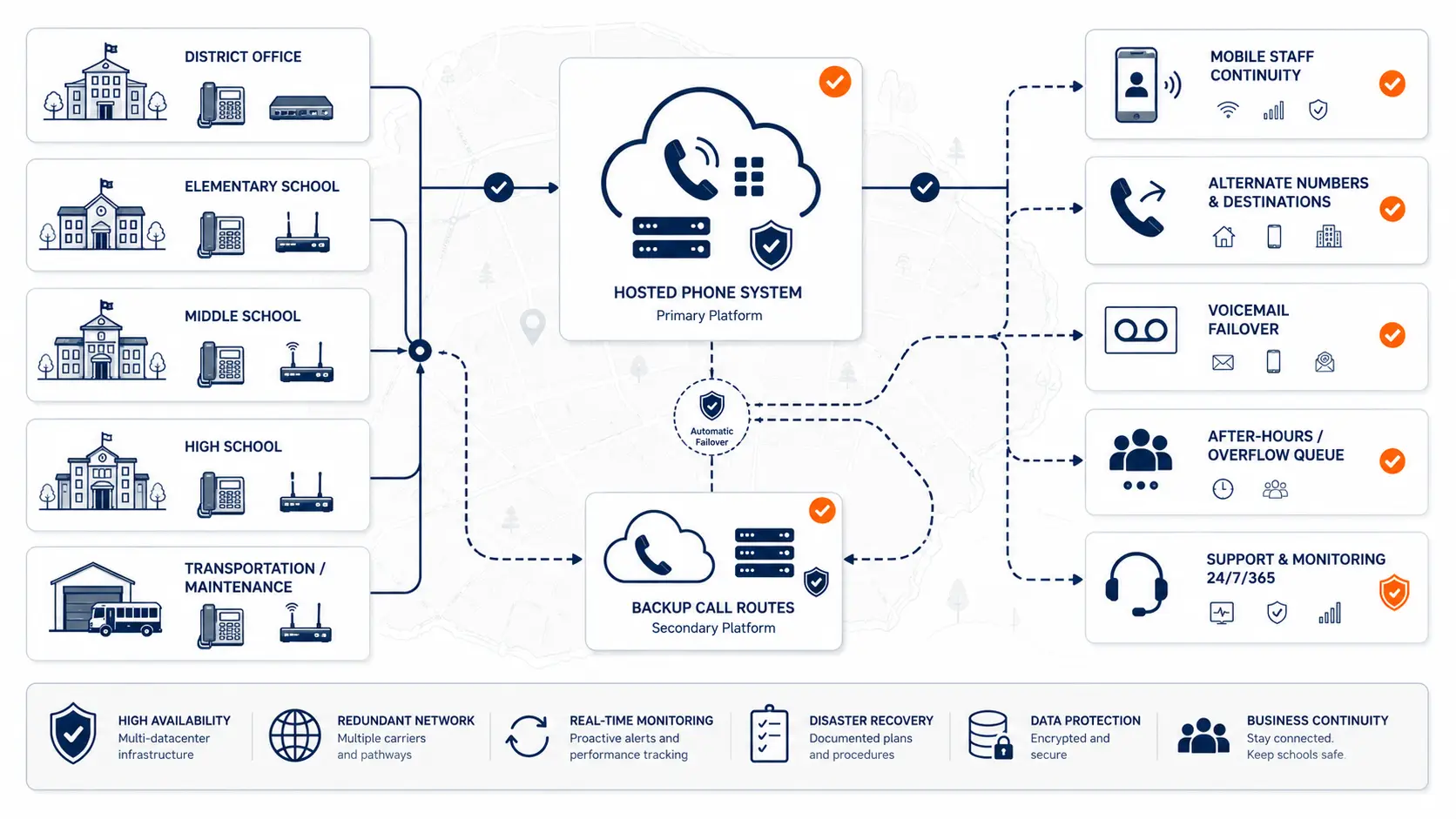
School phone system failover planning is the process of deciding what should happen when the normal calling path fails. For a school district, that may mean an internet circuit outage, power problem, carrier issue, hosted phone system interruption, local network failure, or building-level equipment problem. The goal is not to promise that nothing will ever fail. The goal is to know which calls matter most, where they should route during an outage, and what staff should do when the normal system is unavailable.
A district phone system supports front offices, district administration, transportation, maintenance, classrooms, and emergency calling workflows. That means failover planning should be part of every school phone system review, every PBX replacement for schools project, and every cloud phone system for schools migration.
This guide is for technical planning and general education only. It is not legal advice. Districts should review emergency calling, compliance, and public safety obligations with qualified counsel, public safety authorities, and appropriate state or local agencies.
Request System Review | Download the District Phone System Review Checklist
What phone system failover means for schools
Phone system failover means the district has a defined plan for what happens when normal phone service cannot operate as expected.
That may include:
- rerouting main numbers to alternate destinations
- sending campus calls to another office
- forwarding calls to district mobile numbers
- using backup internet connections
- keeping certain analog or specialty lines separate
- using battery backup for network and phone equipment
- defining manual procedures for front office staff
- testing call routing before the plan is needed
For schools, failover planning is not just an IT topic. It affects attendance calls, parent calls, transportation dispatch, maintenance emergencies, district administration, and building-level communication. It also intersects with E911 compliance for schools because emergency calling behavior during an outage must be reviewed carefully.
Why school phone systems need failover planning
School phone systems often depend on several connected pieces. If one piece fails, the district needs to know what still works and what does not.
Common failure points include:
| Failure point | What may happen | What districts should review |
|---|---|---|
| Internet outage | Hosted phones or softphones may lose service at that site | Backup internet, routing options, and manual procedures |
| Local network issue | Phones may be powered but unable to register | Switches, cabling, VLANs, PoE, and network monitoring |
| Power outage | Desk phones, switches, and internet equipment may go offline | Battery backup, generators, and phone placement |
| Carrier issue | Number routing or SIP connectivity may fail | Alternate routing, porting records, and escalation paths |
| Hosted platform issue | Cloud phone services may be degraded | Vendor status process, redundancy, and support escalation |
| Building equipment issue | One campus or department may be affected | Campus-by-campus failover and support contacts |
A district does not need the same failover plan for every phone. It needs a clear plan for the numbers and locations that matter most.
The first question: which calls must still be answered?
A useful failover plan starts by separating high-priority calling from routine calling.
Review these call types:
- main district number
- school front office numbers
- attendance lines
- transportation dispatch
- maintenance or facilities lines
- superintendent or administration office numbers
- after-hours emergency routing
- security desk or front entrance calls
- specialty numbers tied to gates, alarms, elevators, or other systems
This review often shows that not every extension needs the same continuity plan. A classroom phone, a fax line, a transportation dispatch number, and the district main number may all need different handling.
That distinction matters for cost. Districts paying per extension may be paying too much for users and devices that do not need full paid seats, mobile apps, or advanced features. A system review should compare actual usage against the billing model, not just count extensions.
Internet failover for hosted school phone systems
Hosted phone systems depend on network connectivity. If a campus internet circuit fails, the phones at that building may not work normally unless the district has planned for backup connectivity or rerouting.
Districts should review:
- primary internet connection for each campus
- backup internet availability
- firewall and router failover behavior
- whether phones reconnect automatically after internet service returns
- whether main numbers can forward to another campus or mobile destination
- whether front office staff know what happens during an outage
- whether softphones or mobile apps still work from cellular data
- how E911 behaves if a device is used away from its assigned location
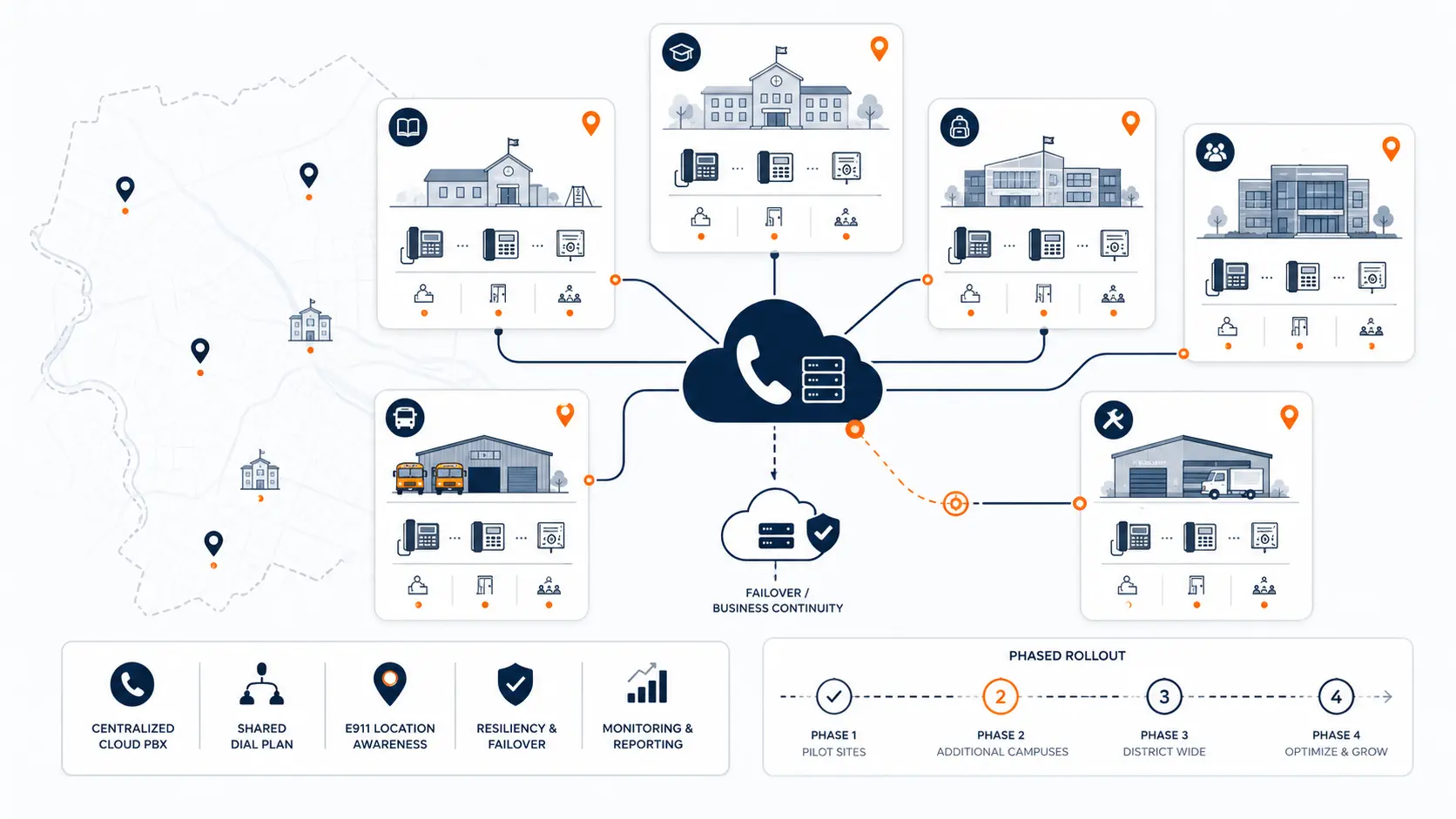
For a multi-campus phone system, failover should be planned by campus. A district may decide that one school’s main number forwards to the district office during a campus outage, while another campus uses an alternate local number or mobile fallback path.
Power and local network readiness
Many phone outages are not phone system outages. They are power, switch, cabling, or local network problems.
A hosted phone system may be healthy, but phones at a campus can still fail if:
- the network switch loses power
- PoE ports fail
- the firewall or router is offline
- cabling is damaged
- a local configuration change breaks phone registration
- Wi-Fi phones or softphones lose connection
Power over Ethernet, often called PoE, allows network switches to power desk phones through network cables. That can be useful, but the switch still needs power. If the switch is not connected to battery backup or generator-backed power, phones may go offline during a building power outage.
Districts should review which phones need to stay powered during short outages and which network equipment supports them.
E911 and failover planning
Emergency calling needs careful review in any failover plan.
A district should ask:
- If a campus internet connection fails, can phones at that campus call 911?
- If calls are forwarded to another building, what location information is sent?
- If a softphone or mobile app is used during an outage, how is location handled?
- If a backup circuit is used, does E911 routing still behave as expected?
- Who receives on-site notification if a 911 call is placed during failover?
- Has the district coordinated safe testing with the appropriate public safety answering point?
Federal MLTS rules address direct 911 dialing, on-site notification, and dispatchable location requirements for covered multi-line telephone systems. Districts should review current requirements with counsel and public safety authorities, and use the K-12 E911 Readiness Checklist during any replacement or failover review.
Analog lines and specialty services
Failover planning should not assume every line is a normal voice line.
Schools may still have analog or specialty services tied to:
- elevator phones
- fire alarm panels
- security alarm panels
- fax machines
- gate systems
- door entry systems
- emergency phones
- athletic facility lines
- maintenance shop lines
- kitchen or cafeteria lines
Some of these services may be regulated, vendor-managed, or dependent on specific equipment. They should be inventoried separately before a phone system cutover.
Do not assume every analog line can be moved to hosted VoIP without review. Some specialty services may require coordination with alarm vendors, elevator vendors, facilities teams, carriers, or public safety authorities.
For more on this, review Why Analog Line Replacement Matters for School Districts.
Main number routing during an outage
One of the most practical failover questions is simple:
Where should the main number go if the normal destination is unavailable?
Possible options include:
- forward to another campus office
- forward to district administration
- forward to a transportation or operations desk
- forward to a designated mobile number
- play an outage message with alternate instructions
- route to an answering service if the district uses one
- hold the calls until service is restored, if that is acceptable
Each choice has tradeoffs. Forwarding every campus call to one person’s mobile phone may sound simple, but it can overwhelm that person. Sending all calls to the district office may work during the day but fail after hours. Playing a message may be useful for routine calls but unacceptable for urgent operational calls.
Failover routing should be designed around the district’s actual call patterns.
Hosted VoIP renewal is a good time to review failover
Districts already using hosted VoIP should not assume the current installation is correct just because it is newer than a legacy PBX.
Before renewing, review:
- whether each campus has a defined failover route
- whether main numbers have alternate destinations
- whether E911 records match current phone placement
- whether softphones and mobile apps have clear usage rules
- whether the district is paying per extension for unused users
- whether support is included during outages
- whether the vendor can explain the recovery path for carrier or platform issues
- whether contract terms make it hard to change routing, numbers, or providers
A hosted system can still be overpriced, underdocumented, or poorly matched to district operations. Paying by the extension can be especially wasteful when many school devices are low-use phones, shared phones, classroom phones, or seasonal staff extensions.
A practical failover planning checklist
Use this checklist before replacing a phone system, renewing a hosted VoIP contract, or changing carriers.
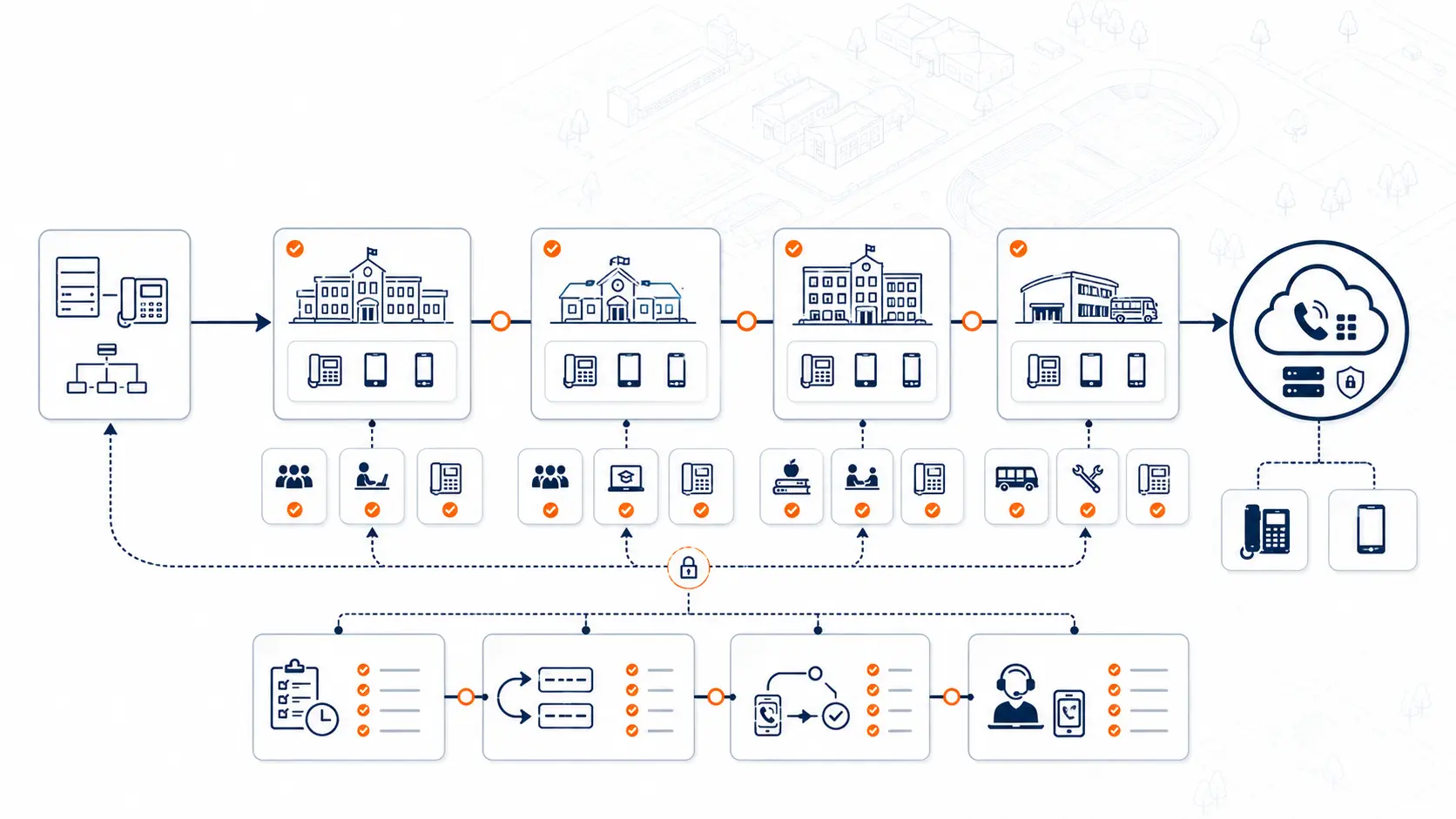
- List every campus and building.
- Identify the main number for each site.
- Identify high-priority departments.
- Document where calls should go during an outage.
- Review backup internet options.
- Review power protection for switches, routers, firewalls, and phones.
- Review E911 behavior during normal and backup operation.
- Identify softphone and mobile app users.
- Review analog and specialty lines.
- Confirm number ownership and porting records.
- Document vendor escalation paths.
- Test failover in a coordinated way.
- Train front office and operations staff.
- Review the plan after major building, routing, or staffing changes.
Planning resource: Use the District Phone System Review Checklist to document current systems, routing, E911 records, phone locations, carrier services, and migration risks.
What to ask vendors about failover
Before choosing or renewing a phone system provider, ask these questions:
- What happens if one campus loses internet?
- Can main numbers forward automatically to another location?
- Can failover routing be different by campus?
- How does E911 behave during failover?
- What happens if the hosted platform has a service issue?
- What happens if the carrier has a service issue?
- Who can change routing during an outage?
- How quickly can changes be made?
- What support is included after hours?
- Do we pay per extension, per device, per user, or by another model?
- Are low-use phones priced the same as full staff users?
- Can we review usage before renewal?
- What are the cancellation, renewal, and porting terms?
These questions help districts compare more than features. They expose whether the provider understands school operations.
How K12 Phone Systems reviews failover planning
A Request System Review can help identify where the current phone environment may be fragile.
The review may include:
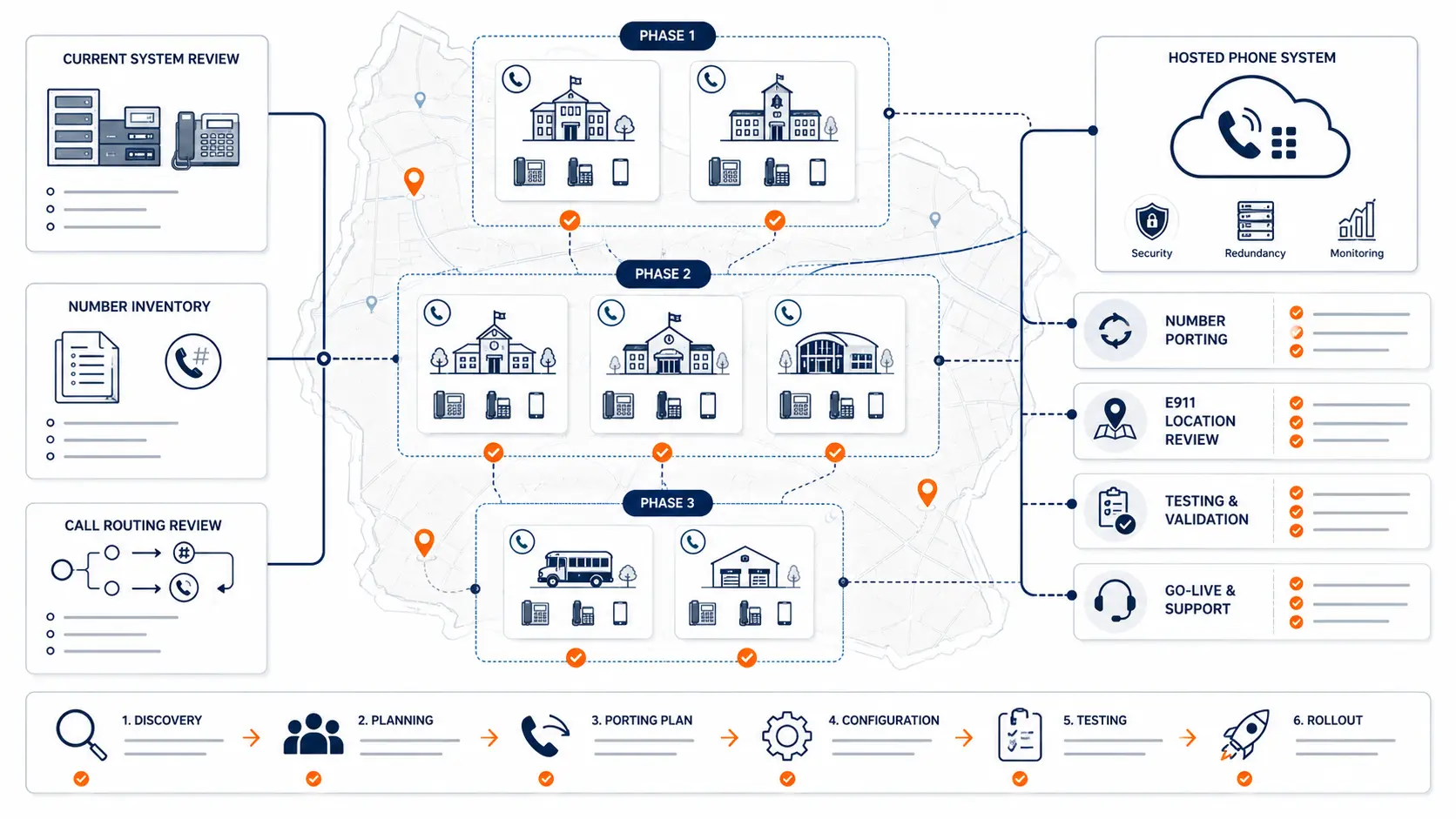
- current PBX or hosted phone system
- campus and building list
- main numbers and call routing
- front office call flow
- E911 planning areas
- analog and specialty lines
- hosted VoIP invoice structure
- per-extension pricing concerns
- number porting requirements
- backup routing options
- cutover and migration risks
The goal is to make the district’s current environment clearer before replacement, renewal, or migration decisions are made.
Related planning resources
- District Phone System Review Checklist
- District Phone System Modernization Roadmap
- K-12 E911 Readiness Checklist
- Legacy PBX Risk Map for School Districts
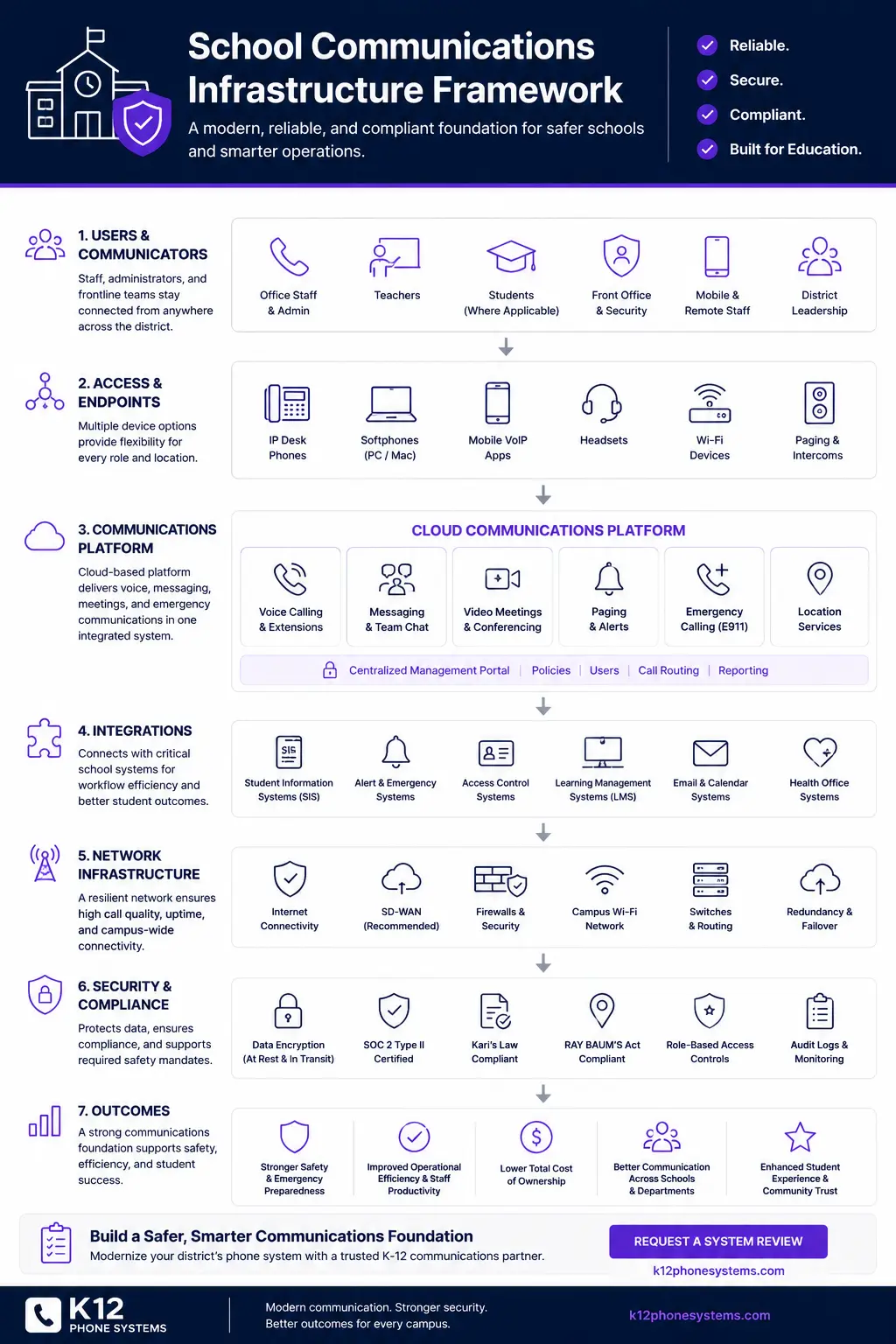
- School Communications Infrastructure Framework
Frequently asked questions
What is phone system failover for schools?
Phone system failover is the plan for how calls should continue, reroute, or be handled when normal phone service is unavailable. For schools, it may involve campus outages, internet failures, power issues, carrier problems, or hosted platform disruptions.
Do hosted phone systems need failover planning?
Yes. Hosted systems can provide flexible routing and centralized management, but they still depend on internet connectivity, power, local network equipment, accurate configuration, and vendor support.
What happens to phones during an internet outage?
It depends on the system design. Desk phones at the affected campus may stop working unless backup internet, local survivability, or alternate routing is in place. Main numbers may be able to forward to another campus or mobile destination.
Does failover affect E911?
It can. Districts should review how emergency calls route during failover, what location information is sent, and who receives on-site notification. E911 behavior should be reviewed before a cutover and after major system changes.
Should every extension have the same failover plan?
No. Main numbers, front office phones, transportation lines, maintenance lines, and classroom phones may require different plans. Reviewing actual call importance can help avoid overbuying and overcomplicating the design.
Can mobile apps help during an outage?
They can help in some situations, especially if staff can use cellular data. They also create E911 planning questions because the user may not be calling from the assigned school location.
Should analog lines stay in place for failover?
Some specialty services may need separate review. Elevator phones, alarm panels, gates, and other systems should be reviewed with the appropriate vendors before a district decides whether to keep, replace, or migrate those lines.
When should districts review failover planning?
Districts should review failover before PBX replacement, hosted VoIP renewal, number porting, campus migration, major network changes, or any project that changes phone routing or emergency calling behavior.
References
- Multi-line Telephone Systems 911 Requirements
- National 911 Program
- Cybersecurity for K-12 Schools and Districts
Ready to review your district phone system failover plan?
Share your current phone setup, phone bill, campus list, or vendor proposal. We will help identify routing risks, continuity gaps, E911 planning areas, and practical next steps before replacement or renewal.