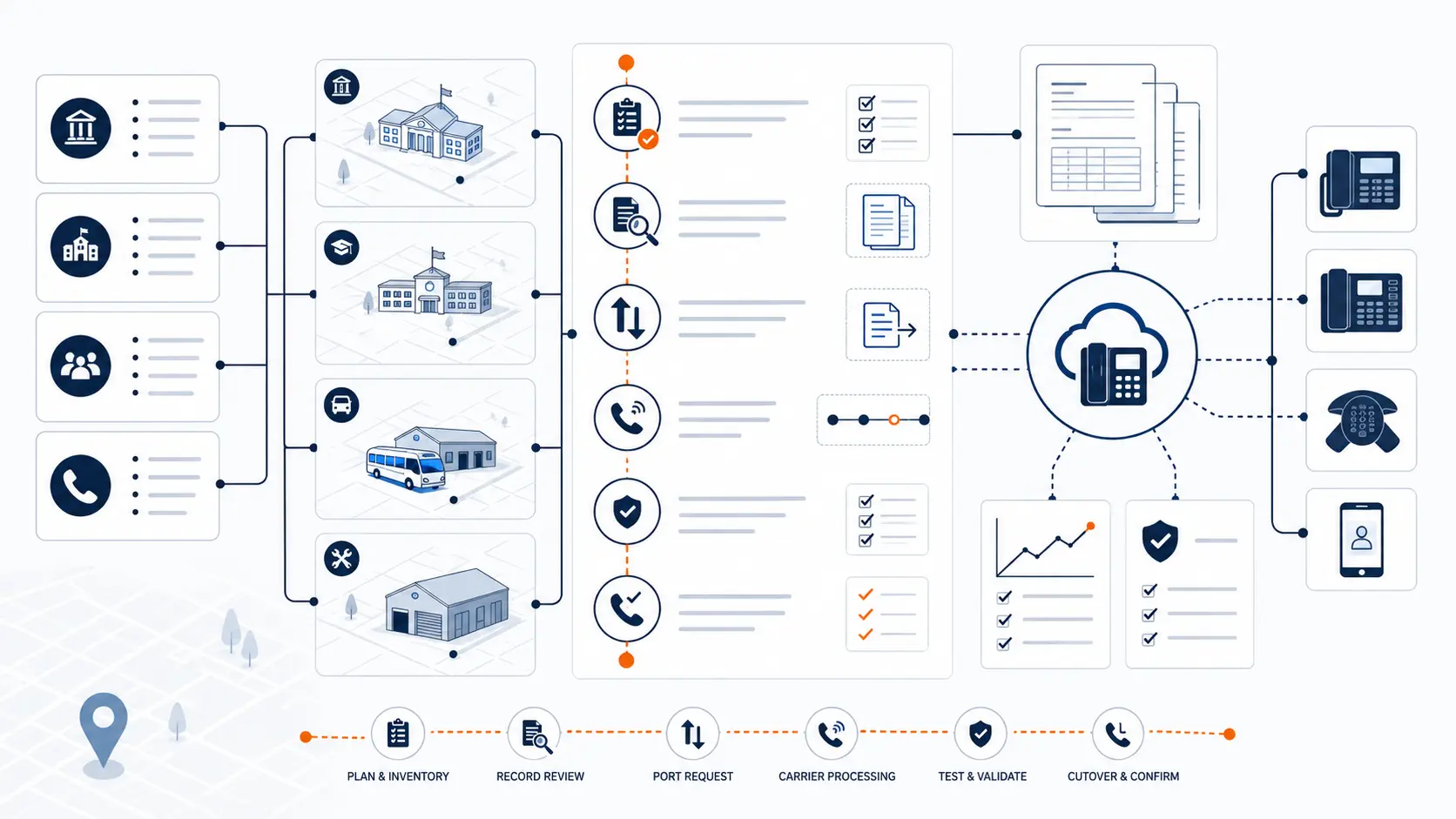
Number porting is one of the most overlooked parts of changing a school phone system. The risk is not usually the port itself. The larger risk is incomplete number inventory, carrier record mismatch, poor cutover planning, and untested call routing after the numbers move. A district can keep the same public phone numbers, but each number still needs a clear owner, routing plan, carrier record, and cutover process.
Key takeaways
- Districts should inventory every main number, campus number, department number, DID, fax line, and specialty line before porting.
- The name, address, and account details on carrier records should match the port request.
- Main numbers and direct numbers may need different routing plans after migration.
- Porting should be coordinated with call flow testing, E911 review, and cutover timing.
- A failed or delayed port is easier to prevent than fix during a live migration.
Table of contents
- What number porting means for school districts
- Why number porting gets complicated in school environments
- Build a complete number inventory first
- Match carrier records before submitting the port
- Decide where each number should ring after the move
- Separate phone numbers from phone extensions
- Review numbers tied to E911 and location records
- Plan the cutover sequence
- Watch for common number porting problems
- What districts should ask vendors before number porting
- Number porting checklist for school districts
- How number porting connects to the larger phone system migration
- When to start the number porting process
- A controlled port starts with a clean inventory
- Frequently asked questions
What number porting means for school districts
Number porting means moving existing phone numbers from the current carrier or provider to a new phone service. For a school district, this may include the district office number, campus main numbers, front office numbers, department numbers, direct inward dial numbers, fax numbers, and other assigned phone numbers.
The district is not changing the number that families, vendors, staff, and community members know. It is changing which provider controls and routes that number.
The FCC explains that customers switching service providers and staying in the same geographic area can generally keep their existing phone number. The FCC calls this process porting [1].
For school districts, school phone system number porting should be treated as a controlled migration task. It is not just a carrier form. It is part of school phone system planning, call routing, E911 review, and go-live support.
Why number porting gets complicated in school environments
Number porting for school districts gets complicated for practical reasons.
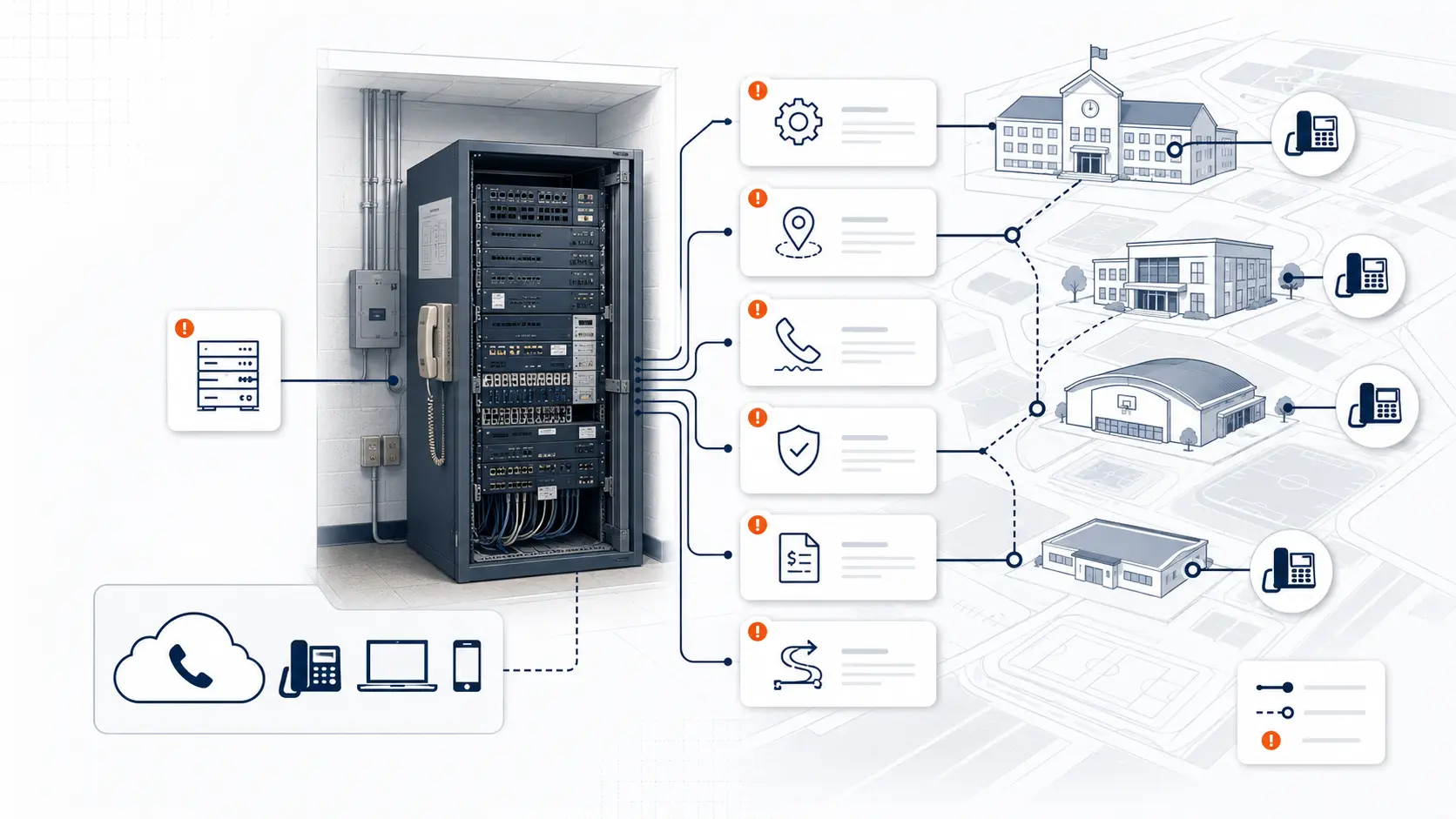
A district may have multiple campuses, each with its own public number, front office number, department lines, fax lines, and direct numbers. Some numbers may still appear on old phone bills. Others may be listed on public websites, staff directories, vendor forms, security procedures, or transportation documents.
Common complications include:
- Multiple campuses with separate carrier accounts
- Main office numbers that ring through old PBX routing
- Department numbers for transportation, maintenance, athletics, or administration
- Direct inward dial numbers, often called DIDs
- Fax numbers that may still support forms or records
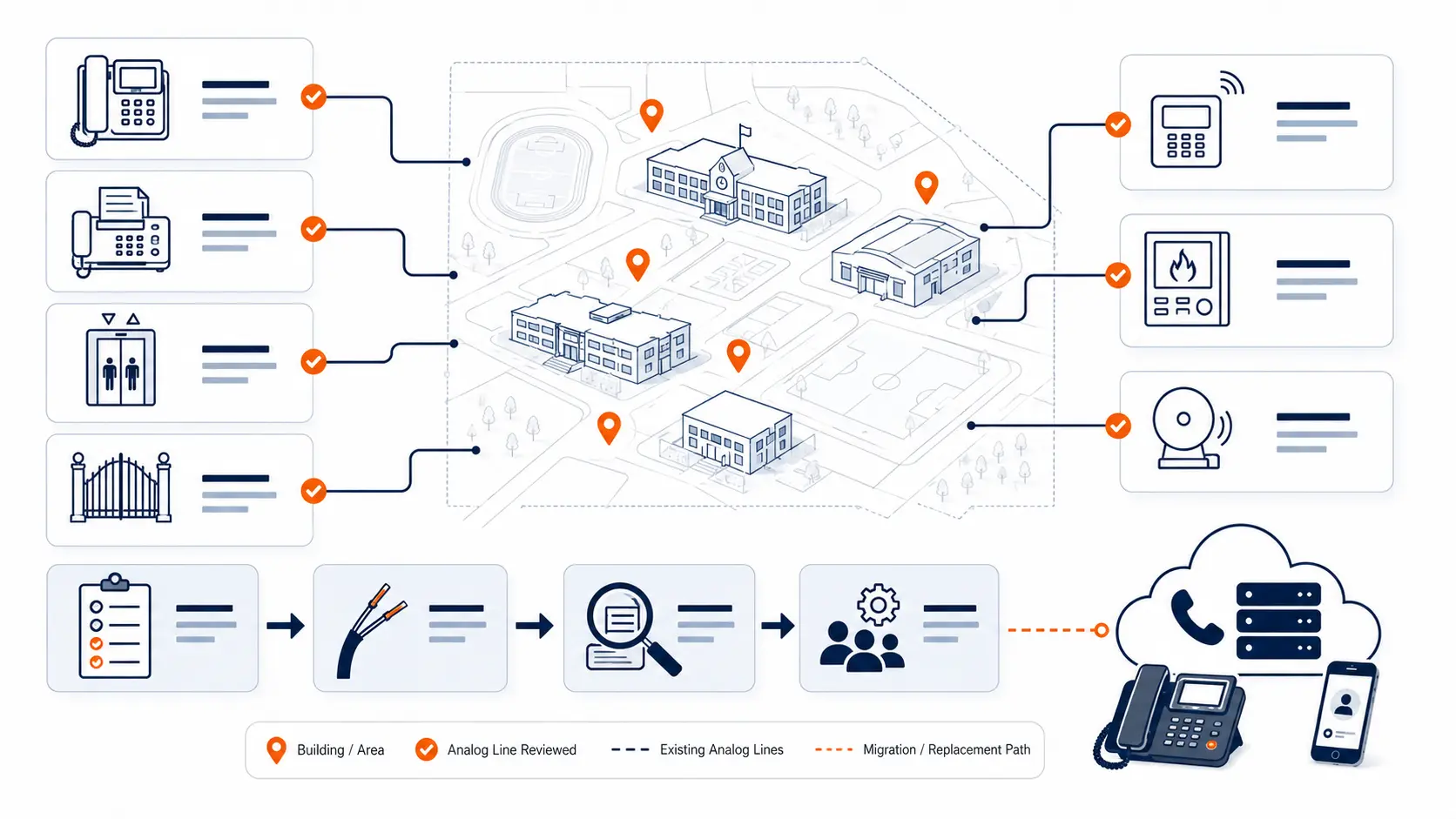
- Alarm, elevator, fire panel, gate, or specialty lines that may not belong in the hosted phone system project
- Numbers tied to old bills nobody has reviewed recently
- Numbers controlled by more than one carrier
- Numbers that ring somewhere unexpected
The receiving carrier can request the port, prepare the order, and coordinate the new routing. It does not fully control the losing carrier’s processing pace. For that reason, a district should treat projected port dates as planned cutover windows, not as a reason to skip testing or internal communication.
Build a complete number inventory first
A complete school phone number inventory should be built before a port request is submitted. Districts should not rely only on a current phone system export. PBX records may show extensions and routes, but they may not show every billable number or every number held by the carrier.
Districts should compare phone bills, carrier portals, PBX records, front office knowledge, department knowledge, and public website listings.
| Number type | Example in a district | What to verify before porting | Common risk |
|---|---|---|---|
| Main district number | District administration main line | Carrier account, public listings, call flow | Number routes correctly but old menu is not rebuilt |
| Campus main number | Elementary, middle, or high school main number | Campus name, service address, routing destination | Calls ring the wrong office after cutover |
| Front office number | Main office direct line | Current ring group and business hours | Staff expect old routing behavior |
| Department number | Transportation, athletics, food service | Department owner and after-hours handling | Number is ported without a new routing plan |
| Direct staff number | DID assigned to a role or office | User, role, or shared function | Number follows a person instead of a role |
| Fax number | Records, administration, health office | Whether fax should remain, change, or move | Fax line is assumed to be voice service |
| Transportation number | Bus dispatch or routing office | Call priority and after-hours handling | Calls reach the wrong group during cutover |
| Maintenance or facilities number | Facilities office or work order desk | Routing, voicemail, mobile needs | Number is missing from PBX export |
| Alarm, elevator, gate, or specialty line | Elevator phone, gate line, alarm panel | Whether it should be ported or separately reviewed | Line is moved without vendor validation |
| Unused or unknown number | Old DID or unassigned billable number | Whether it is active, published, or needed | District keeps paying for a number nobody owns |
Inventory work is not glamorous. It is the part that prevents confusion during a district phone system cutover.
Match carrier records before submitting the port
A port request must match the carrier records closely. A mismatch can delay the port, especially when the losing carrier has different account information from what the district expects.
The district or project team may need to review:
- Customer service record: The carrier’s record of the account, numbers, service address, and related details.
- Authorized name: The name or entity authorized to request changes.
- Service address: The address associated with the numbers.
- Billing telephone number: The main billing number tied to the account.
- Account number: The account identifier used by the losing carrier.
- PIN or port-out authorization: A code or authorization method required by some carriers.
- Letter of authorization: A document authorizing the new provider to request the port.
The FCC states that the new provider initiates the porting process by contacting the current provider. It also advises customers not to terminate the old service before the port is complete [1].
For a district, that means the current service should remain active through the port window. Disconnecting early can create problems that are harder to solve than a normal migration delay.
Decide where each number should ring after the move
Porting only moves the number. It does not decide what happens after someone calls it.
Before porting school phone numbers, the district should define the routing plan for every major number. That plan may include:
- Main number call flow
- Front office routing
- Auto attendant menus
- Ring groups
- After-hours routing
- Holiday schedules
- Transportation routing
- Maintenance routing
- Department routing
- Voicemail routing
- Urgent internal routing procedures
For example, a campus main number might ring the front office during school hours, route to a recorded message after hours, and follow a separate closure schedule during breaks.
If the old PBX had hidden forwarding rules, hunt groups, or manual workarounds, those should be documented before the port. A clean hosted phone system migration should not blindly copy every old route, but it should account for the routes that district operations still depend on.
Separate phone numbers from phone extensions
Districts often confuse public phone numbers with internal extensions. That creates planning problems.
A public phone number is a number outside callers can dial.
A direct inward dial number, often called a DID, is a public number that rings a specific person, department, device, or call flow.
An extension is an internal dialing code used inside the phone system.
A shared extension may be used for a room, front desk, department, or shared phone.
A ring group sends one call to multiple phones or users at the same time or in a set sequence.
A district may port many phone numbers and still redesign extensions, departments, and routing as part of the new system. That is normal. Porting protects number continuity. Extension planning defines how the new system works. See school district extension planning for a related planning step.
Review numbers tied to E911 and location records
Phone number changes can affect how location data and emergency calling records are reviewed. Districts should review E911 location information during the phone system migration with qualified providers, internal IT, and the appropriate public safety or carrier process.
Kari’s Law focuses on direct 911 dialing and on-site notification for covered multi-line telephone systems. RAY BAUM’S Act focuses on dispatchable location information for 911 calls. The FCC summarizes these MLTS 911 requirements in its official guidance [2].
This article is not legal advice and does not determine compliance. The practical point is simple: number porting, device assignment, location records, and call routing should be reviewed together. A district should not treat E911 planning as an afterthought to a phone number port.
For a deeper planning page, see E911 planning for schools.
Plan the cutover sequence
A district phone system cutover should be sequenced before the port date.
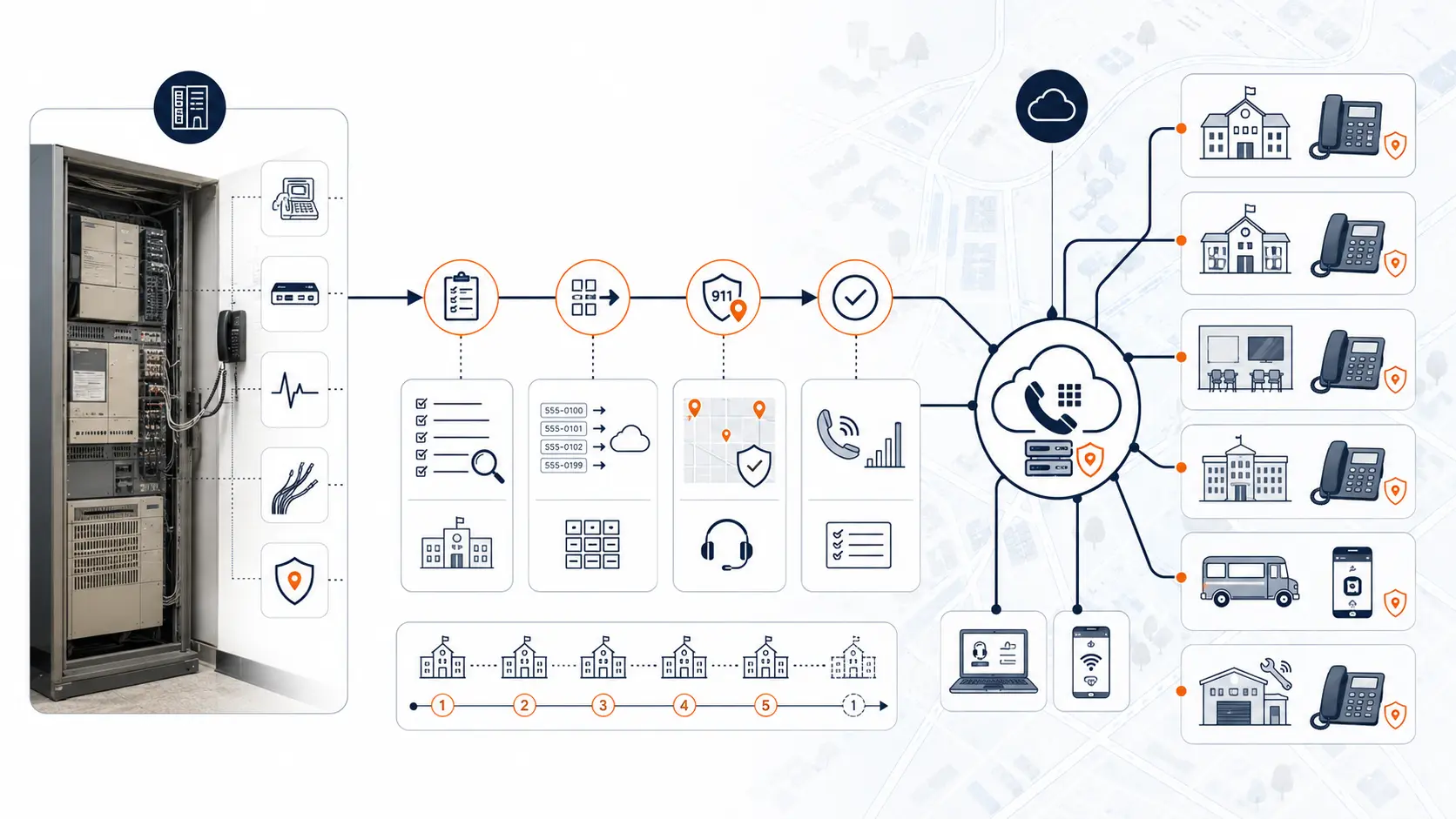
A practical cutover sequence looks like this:
- Confirm number inventory.
- Request carrier records.
- Confirm ownership and authorization.
- Submit the port request.
- Prepare call routing in the new system.
- Test temporary numbers or pilot routing where practical.
- Confirm port date and time window.
- Monitor the port.
- Test inbound calls after porting.
- Confirm routing, voicemail, E911 records, and after-hours behavior.
Simple ports are subject to FCC timing rules, but school districts often have more complex projects involving multiple numbers, accounts, carriers, locations, and routing changes. FCC rules for simple ports are not a substitute for migration planning. The receiving carrier still depends on losing-carrier processing, valid records, and the project scope [1].
Watch for common number porting problems
| Problem | What it usually means | How to prevent it |
|---|---|---|
| Number not found on the account | The number may be under a different account or carrier | Compare bills, carrier portals, and current routing records |
| Account name mismatch | The carrier record does not match the port request | Request carrier records before submitting |
| Service address mismatch | The address on file differs from district expectations | Verify service address by number or account |
| Missing PIN or authorization | The losing carrier requires added validation | Collect authorization details early |
| Number is part of a bundle | The number may be tied to other services | Review bundled voice, internet, and specialty services |
| Number is tied to a specialty line | The number may support fax, alarm, elevator, gate, or fire panel service | Separate specialty lines for vendor review |
| Port date conflicts with school schedule | The cutover window is operationally inconvenient | Select a low-disruption window |
| Calls ring the wrong department after port | Routing was not rebuilt or tested | Test inbound calls after the port |
| Old call forwarding was forgotten | A number depended on carrier-level forwarding | Document old forwarding before migration |
| Public website lists an outdated number | Old numbers remain published | Review website, directory, and public listings |
What districts should ask vendors before number porting
A district should ask practical questions before signing off on hosted phone system porting:
- Who will build the number inventory?
- Who requests the carrier records?
- Who prepares the letter of authorization?
- Which numbers are included in the port request?
- Which numbers should stay where they are?
- How will fax, alarm, elevator, gate, and fire panel lines be handled?
- How will main numbers route on the new system?
- When will inbound call routing be tested?
- What happens if the port is delayed?
- Who is available during the cutover window?
- How will E911 location records be reviewed?
- How will after-hours routing be tested?
These questions should be part of the broader school phone system buyer’s guide conversation, not a last-minute carrier task.
Number porting checklist for school districts
- [ ] Current carrier bills collected
- [ ] Carrier account numbers collected
- [ ] Main numbers identified
- [ ] Campus numbers identified
- [ ] Department numbers identified
- [ ] Direct numbers identified
- [ ] Fax numbers identified
- [ ] Specialty lines separated for review
- [ ] Public website phone numbers checked
- [ ] Google Business Profile or public directory numbers checked
- [ ] Call routing plan created
- [ ] E911 location review scheduled
- [ ] Cutover window selected
- [ ] Test plan documented
- [ ] Internal contacts assigned
- [ ] Vendor escalation path confirmed
How number porting connects to the larger phone system migration
Number porting should not be treated as a standalone paperwork task. It connects to the full school phone system migration.
It should be coordinated with phone bill review, extension planning, call routing, E911 planning, hosted phone system setup, department workflows, training, and go-live support.
Districts replacing an old PBX should connect porting to PBX replacement for schools. Districts moving to hosted service should connect it to cloud phone systems for schools. Districts with fax, alarm, elevator, gate, or specialty lines should complete an analog line replacement review before assuming every number belongs in the same port request.
A port can move the number. It cannot fix an incomplete call flow, unclear department ownership, or missing specialty line review.
When to start the number porting process
The district should start number inventory early, before signing off on the final cutover plan.
There is no universal timeline that fits every district. A single-campus project with clean records is different from a multi-campus district with several carriers, legacy PBX records, specialty lines, and years of billing changes.
Many districts should begin as early as practical once the project scope is clear. Carrier record review, number ownership questions, and inventory cleanup can take time. Starting early gives the district more control over the cutover plan and reduces the chance that the port date becomes the first time anyone finds a missing number.
A controlled port starts with a clean inventory
Before a district changes phone systems, it should know which numbers it owns, where they ring today, where they should ring after migration, and which records must be verified before the cutover.
K12 Phone Systems can help districts review number inventory, call routing, E911 planning, and migration steps before a hosted phone system replacement. Request a school phone system review.
Frequently asked questions
What does number porting mean for a school phone system?
Number porting means moving an existing phone number from the current carrier or provider to a new provider. The district keeps the number, but the new provider becomes responsible for routing it after the port completes.
For a school phone system, this may include district office numbers, campus numbers, department numbers, fax numbers, and direct numbers.
Can a school district keep its existing phone numbers?
In many cases, yes. The FCC says customers changing providers and staying in the same geographic area can generally keep their existing phone number [1].
The district still needs valid carrier records, authorization, and a clear list of which numbers should move. Some specialty lines may need separate review before a decision is made.
How long does number porting take for a school district?
The timing depends on the number type, the carrier records, the losing carrier, and the complexity of the project. Simple ports have FCC timing rules, but district projects are often more complex than a single-number port [1].
The receiving carrier can coordinate and submit the request, but the timeline still depends on losing-carrier processing and the accuracy of the records submitted.
What can delay a number port?
A number port can be delayed by account name mismatch, service address mismatch, missing account numbers, missing PINs, numbers assigned to another carrier account, or numbers tied to bundled services.
Porting can also be delayed when the district discovers late that a number supports fax, alarm, elevator, gate, fire panel, or another specialty use that needs a different review process.
Should fax, alarm, elevator, and gate lines be ported to the new phone system?
Not automatically. These lines should be separated from the standard voice number inventory and reviewed with the correct vendor, carrier, and district stakeholders.
Some may be candidates for replacement or migration. Others may need to remain on a separate service. The right answer depends on the use case, equipment, vendor requirements, and district risk review.