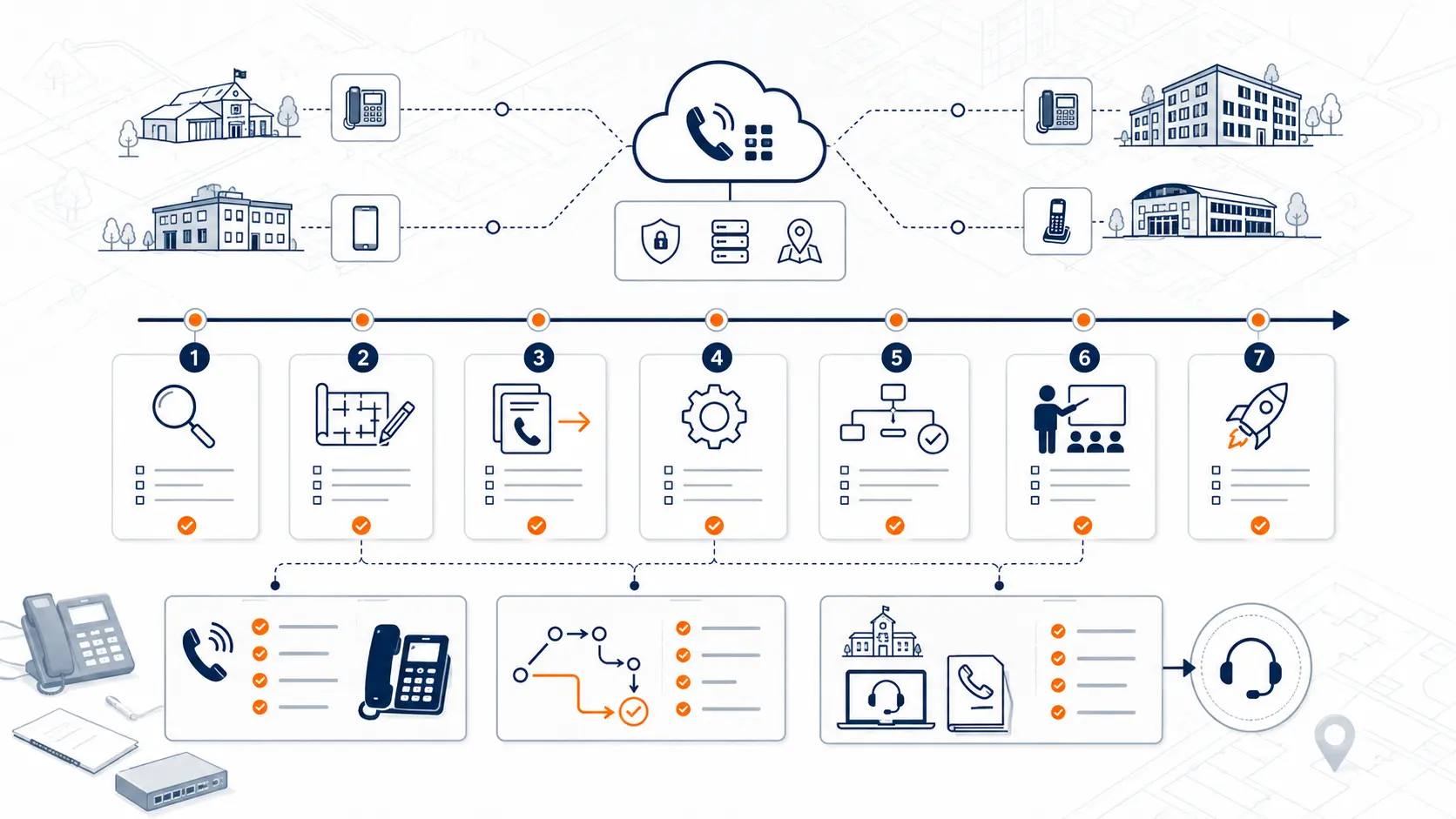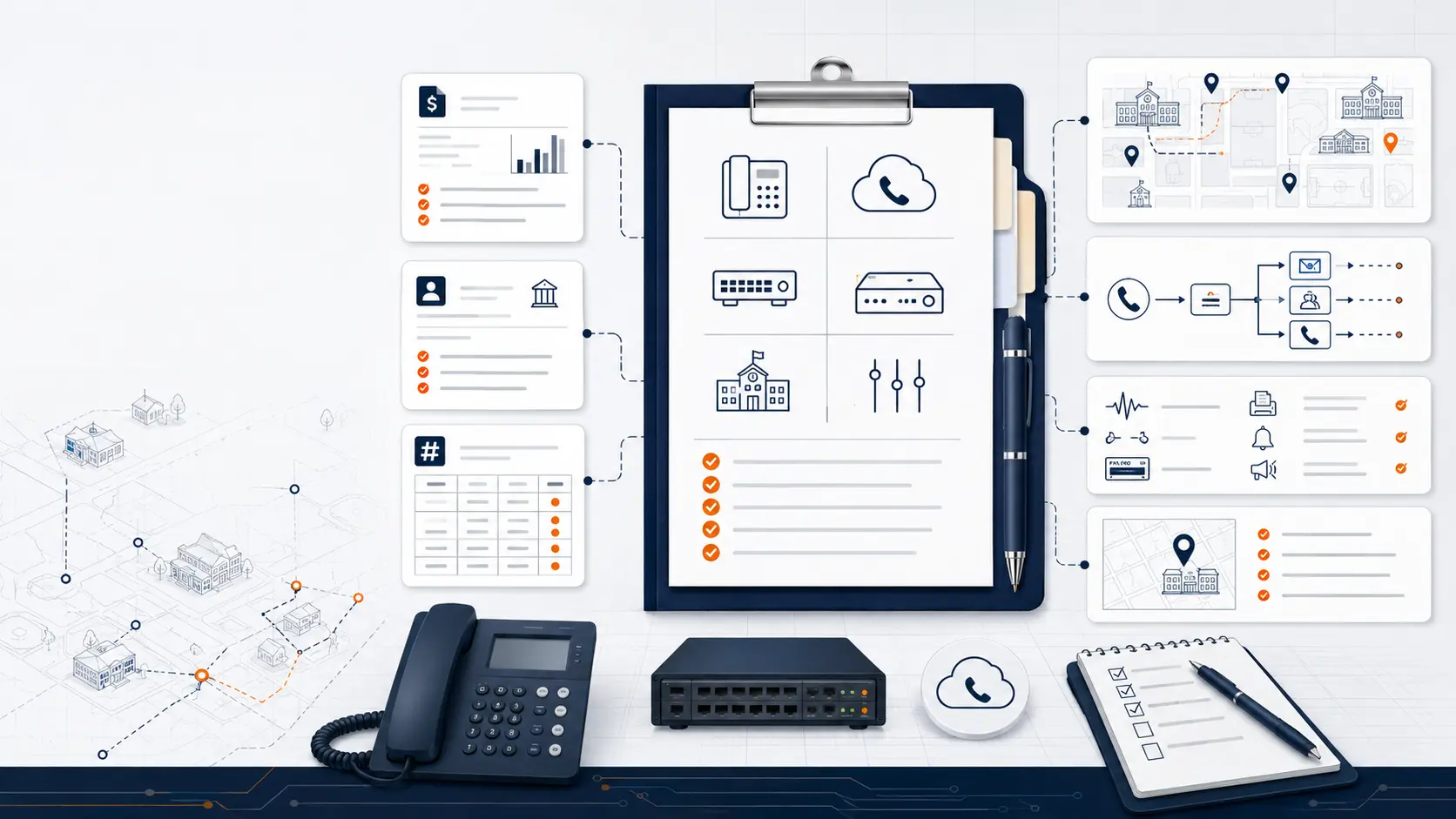
A district phone system review should not start with a product demo. It should start with the system the district already has, the buildings it supports, the numbers people call, the way calls move, the risks the technology team already knows about, and the costs that may be hiding in old carrier bills or hosted VoIP renewals.
Most districts do not need a perfect inventory before asking for help. A rough list of campuses, a current phone bill, a vendor proposal, or a few notes about problems can be enough to begin. The goal is to create a clearer picture of the current environment so the district can decide what to replace, what to keep, what needs testing, and what should be planned before a cutover.
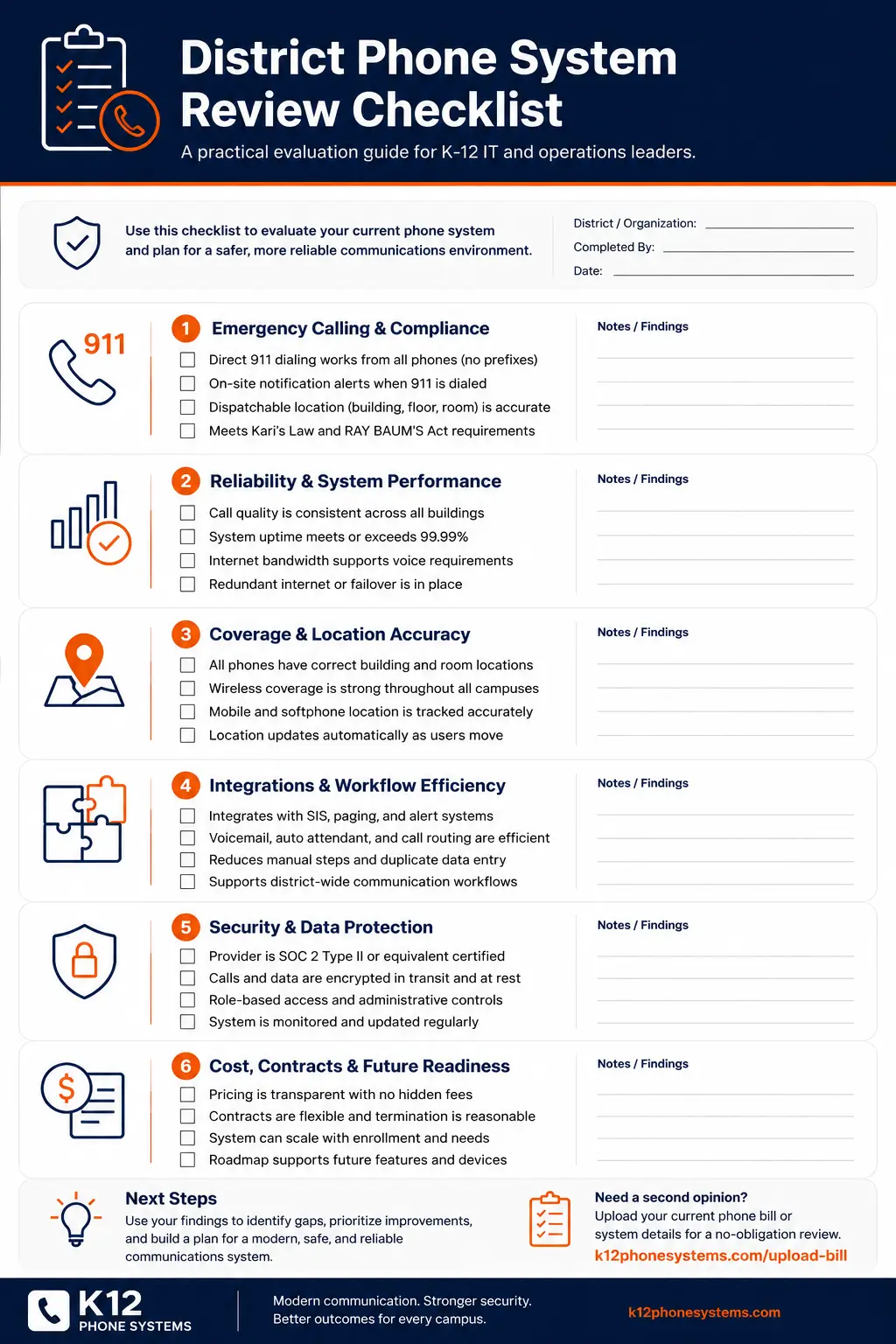
For a structured starting point, use the District Phone System Review Checklist and the Request System Review page.
Why preparation matters before a phone system review
A school phone system touches more than desk phones. It affects front office call flow, main numbers, classroom extensions, district administration, transportation, maintenance, after-hours routing, E911 planning, number porting, carrier records, staff access, and support.
Preparation helps the district avoid three common problems:
- Reviewing only the monthly bill instead of the full environment
- Comparing quotes before call routing and E911 needs are clear
- Moving too quickly into a cutover plan without knowing which numbers, phones, buildings, and specialty services may be affected
A prepared review gives the technology team a better way to discuss risk, timing, cost, and migration with leadership.
What to gather before the review
The district does not need every item on this list before starting. Start with what is available.
| Item to gather | Why it helps | Good enough to start |
|---|---|---|
| Current phone bill | Shows carrier services, numbers, charges, taxes, and fees | Most recent bill |
| Hosted VoIP invoice | Shows users, extensions, licenses, features, and add-ons | Current monthly invoice |
| Campus list | Shows buildings and rollout scope | Spreadsheet or district website list |
| Main phone numbers | Shows public-facing call paths | Main district and campus numbers |
| Extension list | Shows user and device scope | Current export or rough list |
| Call flow notes | Shows how calls reach front offices and departments | Written notes are fine |
| E911 records | Shows location planning status | Current records if available |
| Vendor contract | Shows renewal date, terms, and pricing model | Signed agreement or proposal |
| Network notes | Shows readiness for hosted calling | ISP, firewall, switch, or cabling notes |
| Known issues | Shows why the review matters | Short bullet list |
A review can begin from a phone bill, proposal, or problem summary. The missing items can be requested later.
Current phone bills and carrier services
Phone bills are one of the best places to start. They often reveal services that have been carried forward for years without a clean review.
Look for:
- Business lines
- SIP trunks
- PRI services
- Analog lines
- Toll-free numbers
- Fax lines
- Alarm or elevator lines
- Long-distance charges
- Taxes and surcharges
- Directory listing charges
- Maintenance charges
- Fees tied to old contracts
The bill may not explain what every line does. That is the point of the review. A line that looks unused may support an alarm panel, elevator phone, gate, fax, or backup service. Do not cancel lines before confirming their purpose.
For districts dealing with analog services, review Why Analog Line Replacement Matters for School Districts.
Hosted VoIP invoices and per-extension pricing
A district already using hosted VoIP or a hosted PBX may still need a review. A newer system can have its own cost and design problems.
Review the invoice for:
- Per-extension charges
- Per-user charges
- Licenses assigned to rooms that rarely place calls
- Charges for mobile apps or softphones
- Device rental or lease fees
- Support tier charges
- E911 fees
- Call recording fees
- Admin portal fees
- Contracted minimum user counts
- Renewal increases
- Taxes and cost recovery fees
If the district is paying by extension, the invoice deserves close review. Schools often have many phones that exist for reachability, not daily calling volume. Classroom phones, hallway phones, shared office phones, common-area phones, and low-use department phones can make per-extension pricing expensive.
A phone system review should ask whether the pricing model matches school usage. In some districts, the problem is not the VoIP platform itself. The problem is paying for too many extensions, licenses, or add-ons that do not match how calls actually flow.
For more on this issue, see Why Per-Extension VoIP Pricing Can Cost School Districts Too Much.
Campus and building inventory
The review should include every location that may have phone service, not only instructional campuses.
Include:
- Elementary schools
- Middle schools
- High schools
- District office
- Transportation facilities
- Maintenance buildings
- Athletic facilities
- Alternative education sites
- Portable classrooms
- Annex buildings
- Storage or warehouse locations
- Shared service buildings
For each location, try to capture:
- Site name
- Street address
- Main number
- Main office number
- Building contacts
- Rough phone count
- Known special lines
- Internet provider or circuit details if available
This helps determine whether the project should be phased by campus, building group, department, or number group.
For larger districts, review Multi-Campus Phone Systems.
Main numbers, DIDs, and number ownership
Number ownership and number porting can slow a project if records are unclear.
Document:
- District main number
- Campus main numbers
- Department numbers
- Direct inward dial numbers
- Fax numbers
- Toll-free numbers
- Numbers tied to alarms, elevators, gates, or specialty systems
- Numbers listed on websites, signs, forms, and directories
- Numbers used by parents, vendors, and public agencies
Then ask:
- Which carrier owns each number?
- Which numbers must port?
- Which numbers can forward during transition?
- Which numbers can be retired?
- Which numbers are public-facing?
- Which numbers are attached to E911 records?
For a deeper planning guide, see What School Districts Should Know About Number Porting Before Changing Phone Systems.
Call flow and routing notes
Call routing is often where the real operational problems appear.
Document how calls move today:
- What happens when someone calls the district main number?
- What happens when someone calls a campus main number?
- Which phones ring in the front office?
- What happens during lunch coverage?
- What happens after hours?
- Which calls route to transportation?
- Which calls route to maintenance?
- Which calls route to nurses, counselors, or administration?
- Which calls go to voicemail?
- Which calls need overflow routing?
- Who changes call routing during closures or schedule changes?
You do not need a polished diagram. A written list is useful. A screenshot of an auto attendant menu can be useful. A front office staff member’s explanation can be useful.
A new system should not simply copy the old call flow without review. Old routing may reflect years of workarounds, staffing changes, campus growth, and temporary fixes.
E911 and dispatchable location records
E911 planning should be reviewed before any phone system migration.
Gather:
- Current E911 location records
- Building addresses
- Room or area mapping
- Device location assignments
- On-site notification recipients
- Softphone and mobile app policies
- Testing history
- Local PSAP coordination notes if available
School districts should review direct 911 dialing, on-site notification, and dispatchable location. The FCC provides rules for MLTS 911 direct dialing, notification, and dispatchable location requirements, and the National 911 Program offers resources for Kari’s Law and RAY BAUM’S Act planning.[^1][^2]
For district-specific planning, use the K-12 E911 Readiness Checklist and review E911 Compliance for Schools.
Analog lines, fax, alarms, elevators, and gates
Analog services can be easy to miss during a phone system review. They may not be part of the PBX, but they may still show up on the bill.
Review:
- Fax machines
- Elevator phones
- Fire alarm lines
- Security alarm lines
- Gate or access control lines
- Blue light or emergency phones
- Kitchen or cafeteria lines
- Athletic facility lines
- Old backup lines
- Lines tied to district records or forms
Do not treat every analog line the same way. Some may be candidates for replacement. Some may need coordination with alarm, elevator, access control, or code-compliance vendors. Some may stay in place for a period of time.
The review should separate phone system replacement from specialty service decisions so the district does not create avoidable risk.
Network readiness for hosted calling
A hosted phone system depends on the district network.
Review:
- Internet circuits
- Firewall configuration
- Switch age and capacity
- Power over Ethernet availability
- Cabling condition
- Voice VLAN plans if used
- Battery backup
- Campus failover options
- Wi-Fi use for mobile devices
- Network monitoring
- Support ownership
This does not need to become a deep network engineering project at the start. The first review should identify what needs deeper validation before cutover.
If the network is unreliable, a hosted phone system may expose that weakness. If the network is solid, hosted calling can become easier to manage than aging PBX hardware.
Current support model
A phone system review should capture who supports the current system.
Ask:
- Who handles phone system changes?
- Who supports the PBX or hosted platform?
- Who handles carrier tickets?
- Who updates E911 records?
- Who changes auto attendants?
- Who updates holiday schedules?
- Who supports phones during outages?
- Who supports the system after hours?
- Is support included or billed separately?
- Is the district dependent on one legacy technician?
A district may not need a new system only because hardware is old. It may need a new plan because support has become fragile.
Contract and renewal review
Before signing a renewal or approving a replacement, gather the contract details.
Review:
- Renewal date
- Notice period
- Auto-renewal language
- Term length
- Minimum seats or extensions
- Support terms
- Equipment ownership
- Device rental or lease terms
- Number porting terms
- Early termination language
- Price increase language
- Add-on fee schedule
- E911 responsibility language
This helps the district avoid replacing one expensive system with another expensive system that is only packaged differently.
For vendor questions, see Questions to Ask Before Signing a School Phone System Contract.
What to send before requesting a system review
Send whatever you have. A district can start with a simple packet like this:
- Current phone bill or hosted VoIP invoice
- Campus list
- Main numbers
- Extension list if available
- Notes on call routing problems
- Notes on E911 concerns
- Vendor proposal or renewal offer if available
- Known analog or specialty lines
- Preferred timeline
- Main contact for follow-up questions
The point is not to be perfect. The point is to start with the best available information and identify what needs to be checked next.
What a district should receive from the review
A useful review should produce more than a quote.
The district should expect:
- Current-state findings
- Known risk areas
- Billing and pricing observations
- Number and routing questions
- E911 planning considerations
- Analog line review notes
- Migration issues to plan around
- Phased cutover considerations
- Support and renewal concerns
- Next-step recommendations
The review should make the next conversation sharper. It should help the district decide whether to replace the system, renegotiate, phase a migration, review E911 records, or gather more information before moving forward.
How K12 Phone Systems can help
K12 Phone Systems reviews school district phone environments with a practical focus on buildings, numbers, routing, E911 planning, pricing structure, migration risk, and support needs.
The review can start from a phone bill, a hosted VoIP invoice, a vendor proposal, a campus list, or a short summary of the problems your team is trying to solve.
Start here: Request System Review
Related planning resources
- District Phone System Review Checklist
- District Phone System Modernization Roadmap
- Legacy PBX Risk Map for School Districts
- K-12 E911 Readiness Checklist
- School Communications Infrastructure Framework
Frequently asked questions
Do we need a full inventory before requesting a phone system review?
No. A current bill, hosted VoIP invoice, campus list, vendor proposal, or summary of known issues is enough to begin. The review can identify what information is missing.
What is the most useful document to send first?
A current phone bill or hosted VoIP invoice is often the best starting point. It can show numbers, services, charges, contract patterns, and possible cost issues.
Should we send our current vendor proposal?
Yes. A vendor proposal can be reviewed against your buildings, numbers, E911 needs, cutover plan, pricing model, and support expectations.
Should we review an existing hosted VoIP system?
Yes. Hosted VoIP systems can still have pricing, routing, E911, support, and renewal problems. Per-extension pricing should be reviewed carefully in school environments.
Do we need an extension list?
An extension list is helpful, but not required to start. If one is not available, the review can begin with the district’s best current understanding of phones, users, and shared locations.
Should E911 records be reviewed before replacement?
Yes. E911 location records should be reviewed before cutover, not after launch. Building, room, device, and notification data should be checked as part of planning.
Can analog lines be reviewed at the same time?
Yes. Analog lines should be identified during the review. Fax, alarm, elevator, gate, and specialty lines may need separate treatment from normal voice lines.
Can the review help with a board or leadership discussion?
Yes. A review can organize current-state findings, risk areas, cost concerns, and migration considerations in a way district leaders can discuss internally.
Ready to prepare for a district phone system review?
Send your current phone bill, hosted VoIP invoice, campus list, system notes, or vendor proposal. We will help identify risk areas, cost questions, migration considerations, and practical next steps.
References
[^2]: Kari’s Law and RAY BAUM’S Act resources from the National 911 Program