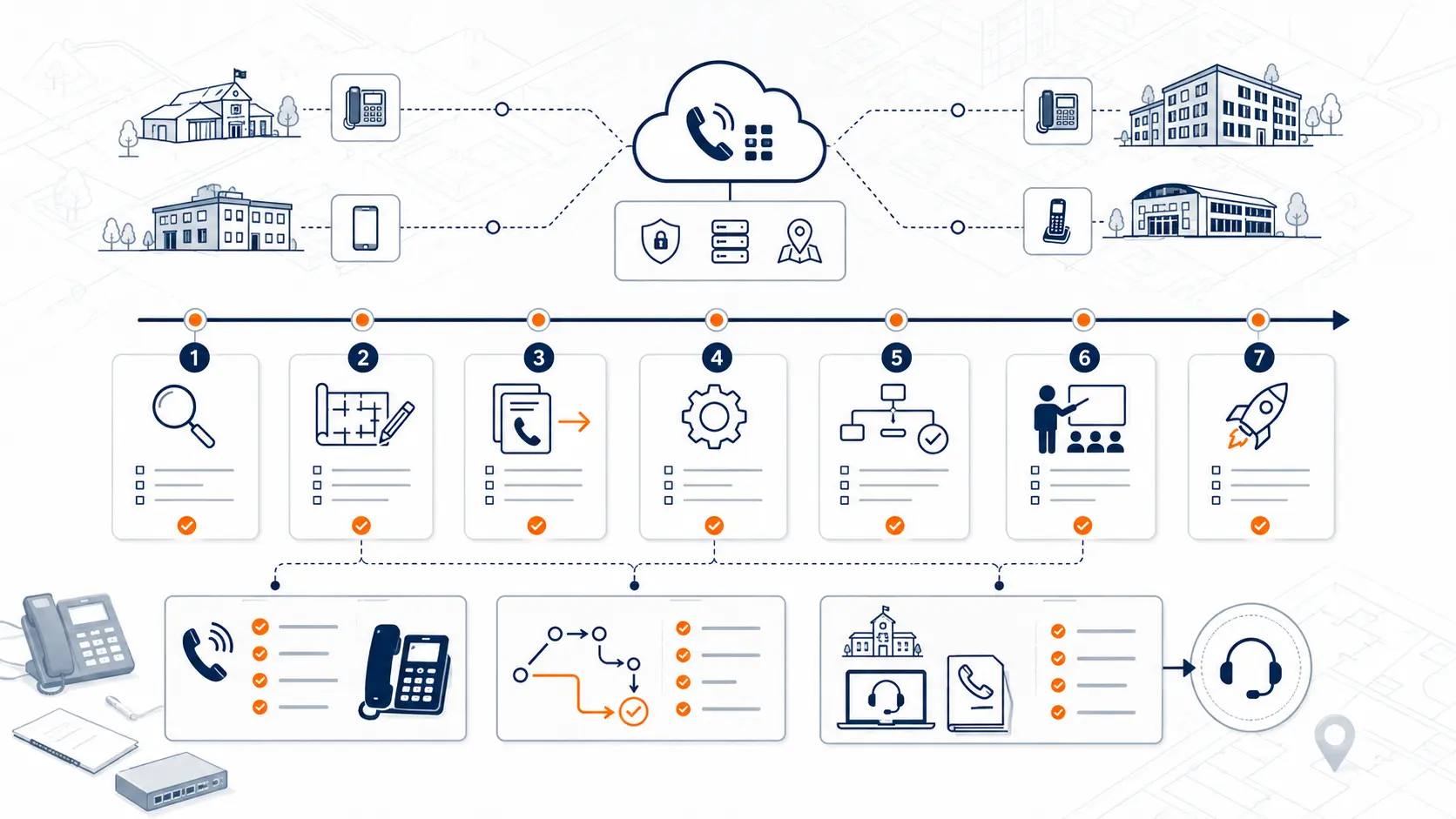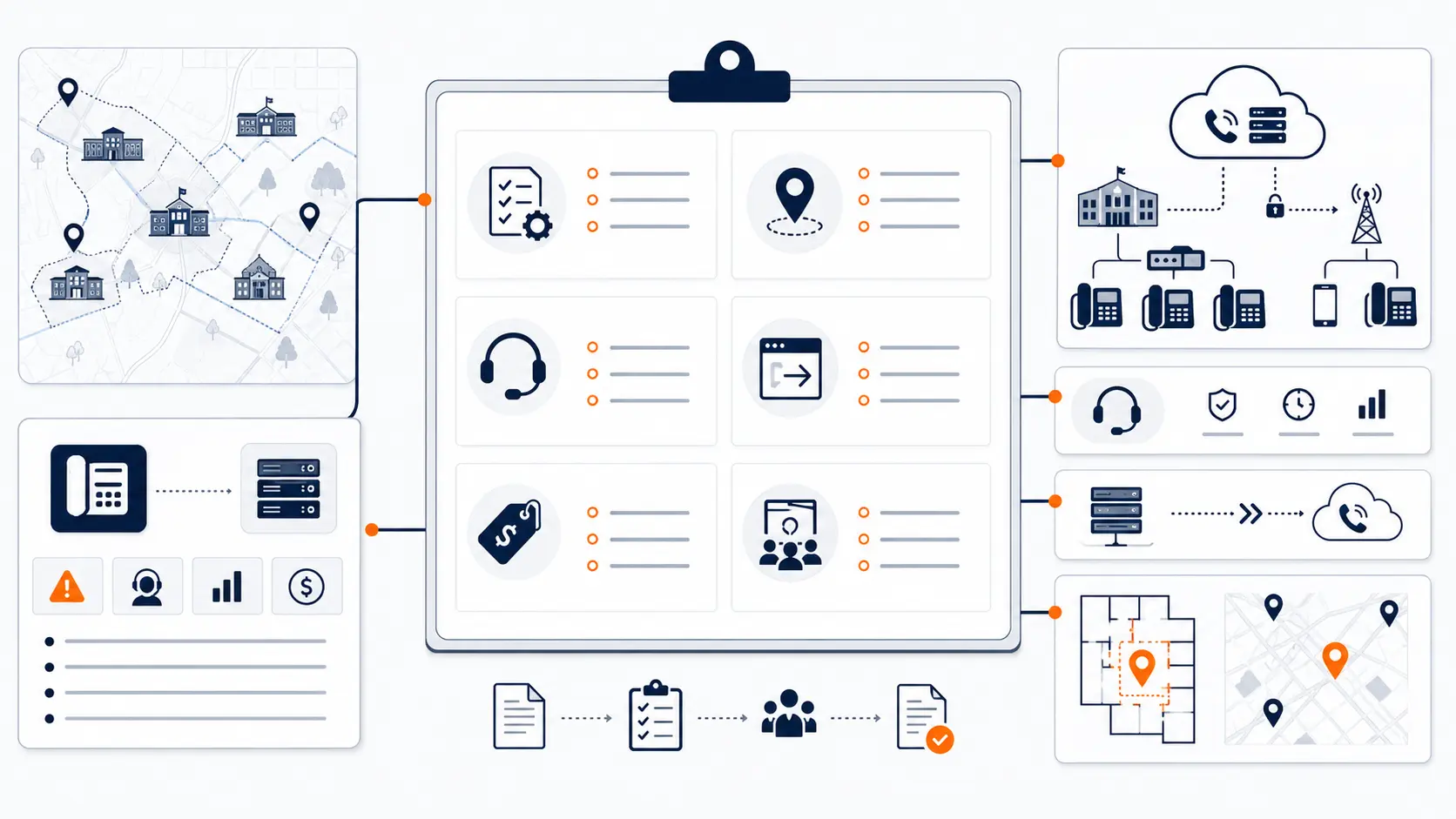
A school phone system RFP should do more than ask vendors for handsets, licenses, and monthly pricing. It should help the district compare vendors against the real operational needs of schools: front office call flow, E911 planning, dispatchable location, number porting, analog line review, multi-campus routing, cutover timing, support, and long-term pricing.
Many districts write phone system RFPs around product features. That can create a weak comparison. One vendor may quote per extension. Another may quote per device. Another may bundle features into a hosted PBX package. Another may leave porting, E911 records, phones, support, taxes, or after-hours cutover work unclear. The district may not find the problem until after award.
This guide outlines what districts should include before requesting proposals for a replacement PBX, hosted VoIP service, cloud phone system, or multi-campus phone system project.
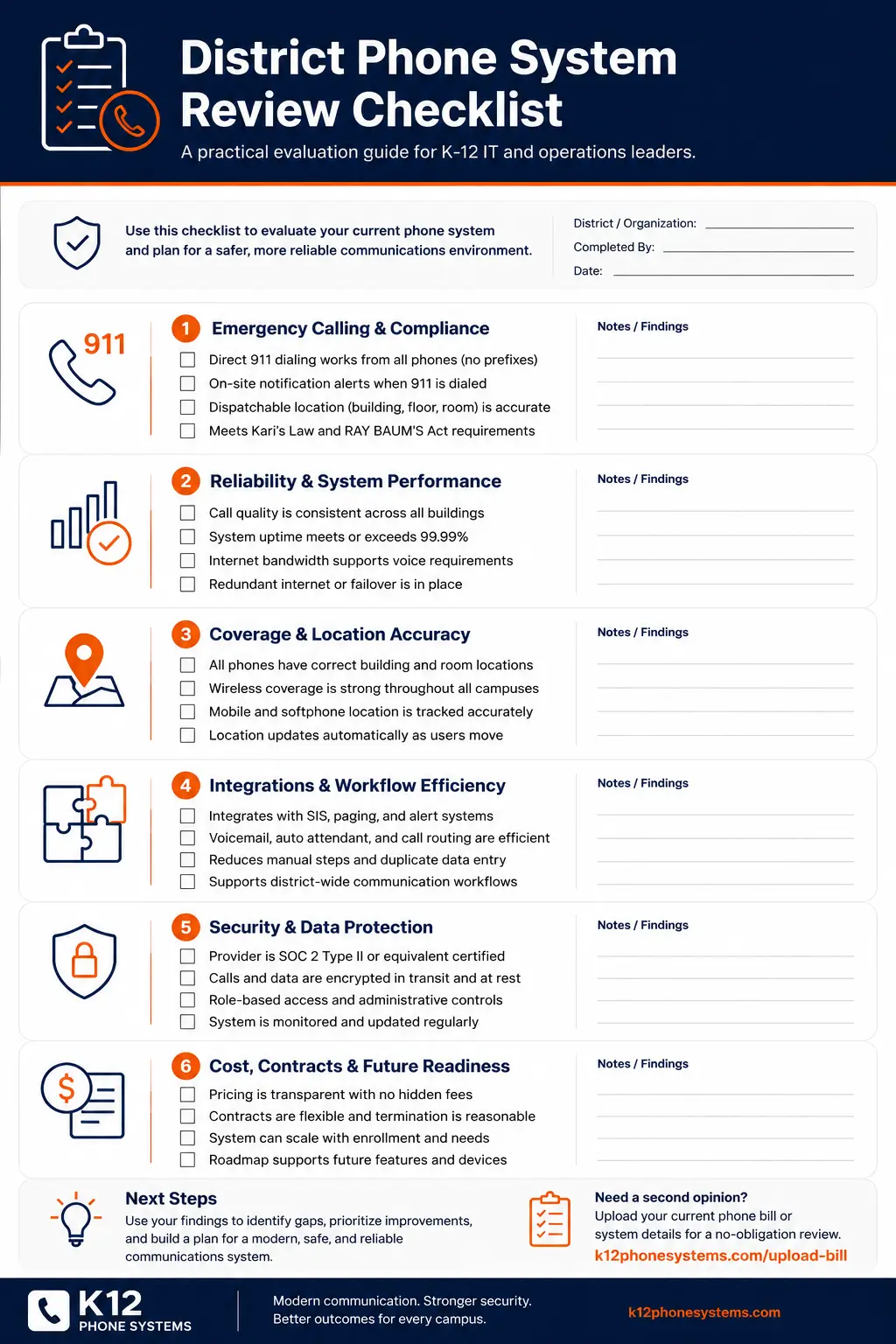
Request System Review | Download the District Phone System Review Checklist
What a school phone system RFP should accomplish
A phone system RFP should help the district compare vendors on more than price. It should create a structured way to evaluate the current environment, define the desired replacement, and identify what the vendor is responsible for during planning, migration, cutover, and support.
A useful RFP should answer these questions:
- What problem is the district trying to solve?
- What campuses, buildings, and departments are included?
- What existing phone services, numbers, devices, and contracts need review?
- How will E911 and dispatchable location be handled?
- How will number porting be sequenced?
- What analog lines or specialty devices must be identified?
- What support is included before, during, and after cutover?
- How will pricing be structured?
- What happens when extensions, users, or campuses change?
Before building the RFP, districts should review the broader planning process in School Phone Systems and the replacement-specific issues in PBX Replacement for Schools.
Start with the current environment
A strong RFP starts with current-state information. Vendors cannot price, design, or support a school phone system correctly when the district only provides a rough extension count.
Include what you know. It does not have to be perfect.
| Current-state item | Why it matters in the RFP |
|---|---|
| Campus and building list | Helps vendors understand routing, deployment, and E911 location needs |
| Main numbers and DID numbers | Supports number porting, routing design, and caller experience |
| Extension list | Helps compare user count, device count, and pricing models |
| PBX or hosted system notes | Shows whether the project is replacement, renewal, or redesign |
| Phone bills and contracts | Reveals carrier services, term dates, fees, and possible savings areas |
| Analog lines | Identifies fax, alarm, elevator, gate, and specialty service dependencies |
| Auto attendants and ring groups | Helps rebuild front office and department call flow |
| Known outages or support issues | Gives vendors context on reliability and support expectations |
The RFP should allow vendors to ask discovery questions before final pricing. A district with several campuses, old PBX hardware, mixed analog lines, and uncertain E911 records should not expect a strong proposal from a short device count alone.
Define the project scope clearly
A school phone system RFP should state whether the project includes a full replacement, partial replacement, hosted VoIP renewal review, district-wide migration, or campus-by-campus rollout.
Use direct scope language. For example:
- Replace legacy PBX equipment at all district sites
- Review hosted VoIP renewal and pricing structure
- Migrate main numbers, extensions, and call routing to a hosted phone system
- Support front office, classroom, administration, transportation, maintenance, and district office communication
- Review E911 planning and dispatchable location requirements
- Coordinate number porting and cutover timing
- Identify analog lines and specialty services before migration
This helps vendors propose against the same project.
For larger districts, connect the scope to Multi-Campus Phone Systems and How to Plan a Multi-Campus Phone System Migration.
Include E911 and dispatchable location requirements
Emergency calling should be one of the clearest sections of the RFP. The RFP should not say only, “system must be E911 compliant.” That is too vague for a school environment.
Include requirements for:
- Direct 911 dialing
- On-site notification
- Dispatchable location
- Building, floor, room, zone, or area information where applicable
- Softphone and mobile app handling
- Phone movement and location updates
- Testing with appropriate public safety coordination
- Documentation of district and vendor responsibilities
Federal MLTS requirements under Kari’s Law and RAY BAUM’S Act address direct 911 dialing, on-site notification, and dispatchable location for covered multi-line telephone systems. Districts should review obligations with legal counsel, public safety authorities, and applicable state or local agencies.
Link the RFP process to E911 Compliance for Schools and the K-12 E911 Readiness Checklist.
Ask vendors to explain the pricing model
Pricing deserves its own RFP section. Many school districts focus on the monthly total, but the structure of the price often matters more than the first-month number.
Ask vendors to explain:
- Is pricing per extension, per user, per device, per call path, per site, or bundled?
- Are classroom phones priced the same as active office users?
- Are unused extensions billable?
- Are mobile apps included or charged separately?
- Are voicemail boxes charged separately?
- Are auto attendants, ring groups, queues, or call recording extra?
- Are phones sold, leased, rented, or included?
- Are taxes, fees, surcharges, and cost recovery items listed clearly?
- What happens when the district adds or removes users?
- What happens at renewal?
Per-extension pricing can be expensive for districts that have many low-use classroom, hallway, cafeteria, gym, or maintenance phones. A district should not pay the same active-user price for every endpoint without understanding whether that pricing model matches real usage.
For districts already using hosted VoIP, the RFP should ask vendors to review the existing invoice. A hosted VoIP system can still be poorly priced, over-licensed, or built around an extension count that no longer matches the district.
Link pricing questions to Why Per-Extension VoIP Pricing Can Cost School Districts Too Much and Hosted VoIP for Schools: What Districts Should Review Before Renewal.
Require a number porting plan
Number porting is one of the most important operational parts of a phone system project. It affects main numbers, direct numbers, department numbers, fax numbers, and sometimes specialty lines.
The RFP should ask vendors to provide:
- Number inventory process
- Letter of authorization requirements
- Carrier coordination responsibilities
- Porting timeline assumptions
- Temporary forwarding plan
- Failed port or delayed port process
- Cutover testing procedure
- Post-port verification steps
A district should not discover porting complexity after signing. Main office numbers, attendance lines, transportation numbers, and district administration numbers need special attention.
For more detail, link to What School Districts Should Know About Number Porting Before Changing Phone Systems.
Identify analog lines and specialty services
Analog lines often remain in school districts long after the main phone system changes. Some may support fax, alarms, elevators, gates, door systems, fire panels, emergency phones, or other specialty services.
The RFP should require vendors to identify how analog lines will be reviewed, but it should not assume every analog service can be moved to hosted VoIP.
Ask:
- Which analog lines are included in the review?
- Which analog lines are excluded from the phone system proposal?
- Which specialty services need coordination with outside vendors?
- Who verifies alarm, elevator, gate, or life-safety service requirements?
- Are any analog lines still tied to old carrier contracts?
- Are analog phone numbers part of the porting plan?
Use cautious language. Specialty services may need review by qualified vendors, inspectors, carriers, or public safety authorities.
Link to Why Analog Line Replacement Matters for School Districts.
Define support expectations
Support is often where phone system projects succeed or fail. The RFP should not simply ask for “support included.” It should define the type of support the district expects.
Include requirements for:
- Pre-project discovery
- Call flow design support
- E911 planning support
- Number porting support
- Cutover support
- Staff readiness support
- Admin training
- Post-launch issue handling
- After-hours emergency support
- Escalation process
- Response expectations
- Change request process after launch
The district should ask who handles support after the sale. Some vendors sell the system, then send support through a general queue. Others provide a clearer project and support model. The RFP should make that difference visible.
Ask for a migration and cutover plan
A school phone system cutover needs timing discipline. It affects front offices, classrooms, district administration, transportation, maintenance, and families calling the school.
The RFP should ask vendors to describe:
- Campus rollout strategy
- Pilot site approach
- Cutover windows
- Testing steps
- Staff communication plan
- Number porting sequence
- E911 validation steps
- Rollback or contingency process
- Post-launch support window
A phased cutover is often safer than a district-wide overnight replacement, especially when the district has several buildings or uncertain records.
Link to How School Districts Can Phase a Phone System Cutover and the District Phone System Modernization Roadmap.
Include network readiness questions
Hosted phone systems depend on the district’s network and internet connection. The RFP should ask enough network questions to identify whether the environment is ready.
Ask vendors how they review:
- Internet reliability
- LAN switching
- Cabling
- Power over Ethernet
- Battery backup
- Voice traffic handling
- Desk phone placement
- Softphone and mobile app use
- Failover options
- Site-to-site dependencies
Do not turn the RFP into a network engineering document, but ask enough to prevent a phone vendor from ignoring network conditions that may affect call quality.
Link to Cloud Phone Systems for Schools for broader planning context.
Compare proposals with a consistent scorecard
A district should not compare proposals only by total monthly cost. Build a scorecard that reflects the priorities of a school environment.
| Evaluation area | What to look for |
|---|---|
| School environment fit | Does the proposal address campuses, front offices, classrooms, departments, and district administration? |
| E911 planning | Does it address direct dialing, notification, dispatchable location, testing, and ownership? |
| Number porting | Is the porting process clear and assigned? |
| Analog line review | Are specialty services identified rather than ignored? |
| Pricing clarity | Are extensions, users, devices, fees, support, and renewals clear? |
| Migration plan | Is rollout sequenced in a practical way? |
| Support model | Does the vendor define support before, during, and after cutover? |
| Contract terms | Are renewal, increases, adds, removals, and support terms clear? |
Use the District Phone System Review Checklist before issuing the RFP or while scoring responses.
Questions to include in the RFP
These questions help districts separate a strong school phone system proposal from a generic phone quote.
- How will you review our current phone system before final design?
- How will you document campuses, buildings, extensions, and call flows?
- How will you handle direct 911 dialing and on-site notification?
- How will dispatchable location be mapped and maintained?
- How will softphones and mobile apps affect E911 planning?
- How will you identify analog lines and specialty services?
- How will number porting be planned and sequenced?
- How will you rebuild auto attendants, ring groups, and department routing?
- How will you support front office call flow?
- How will you support transportation, maintenance, and district administration?
- How is pricing structured?
- Are we paying per extension, per user, per device, per call path, or something else?
- How do we reduce unused or low-use extensions?
- What support is included after launch?
- What happens at renewal?
How a system review helps before an RFP
Some districts are ready to issue an RFP. Others need a current-state review first.
A review can help identify:
- What numbers need to move
- What extensions still matter
- Which phone bills and carrier services are active
- What analog lines exist
- What E911 records need review
- Which call flows should be rebuilt
- Which vendor questions should be included
- Whether the district is overpaying for an existing hosted VoIP system
- What should be included in the migration plan
A review does not replace district procurement rules. It helps the district ask better questions before the procurement process begins.
Related planning resources
- District Phone System Review Checklist
- District Phone System Modernization Roadmap
- K-12 E911 Readiness Checklist
- Legacy PBX Risk Map for School Districts
- School Phone System Buyer’s Guide
Frequently asked questions
What should a school phone system RFP include?
A school phone system RFP should include current system information, campus and building lists, number inventory, E911 requirements, call routing needs, analog line review, migration expectations, support requirements, pricing structure, and contract questions.
Should districts include E911 requirements in a phone system RFP?
Yes. The RFP should address direct 911 dialing, on-site notification, dispatchable location, softphone and mobile app behavior, testing, and ongoing location data maintenance. Districts should review legal obligations with counsel and appropriate public safety authorities.
Should a school phone system RFP ask about per-extension pricing?
Yes. Per-extension pricing can be expensive for districts with many low-use classroom, hallway, gym, cafeteria, or maintenance phones. The RFP should ask vendors to explain the pricing model and how unused or low-use extensions are handled.
Should analog lines be included in the RFP?
They should be included in the review, but not every analog line should be treated the same way. Fax, alarms, elevators, gates, emergency phones, and specialty services may require separate review by qualified vendors or authorities.
Can a phone system RFP require phased deployment?
Yes. A district can ask vendors to propose a phased rollout by campus, building, department, or pilot site. The proposal should explain cutover windows, testing, porting, support, and contingency planning.
Should districts issue an RFP before reviewing their current phone system?
Some can, but a current-state review often makes the RFP stronger. A review can identify active numbers, carrier services, analog lines, E911 records, call flows, pricing problems, and migration risks before the district asks vendors for proposals.
Can K12 Phone Systems help write procurement rules or legal language?
No. K12 Phone Systems provides technical review and phone system planning support. District procurement rules, legal terms, and compliance decisions should be reviewed by district procurement staff, legal counsel, and appropriate authorities.
References
- Multi-line Telephone Systems 911 Requirements
- E-Rate: Universal Service Program for Schools and Libraries
Ready to review your phone system before issuing an RFP?
Share your current phone setup, phone bill, campus list, or vendor proposal. We will help identify risk areas, pricing questions, migration considerations, and practical next steps before your district requests proposals.