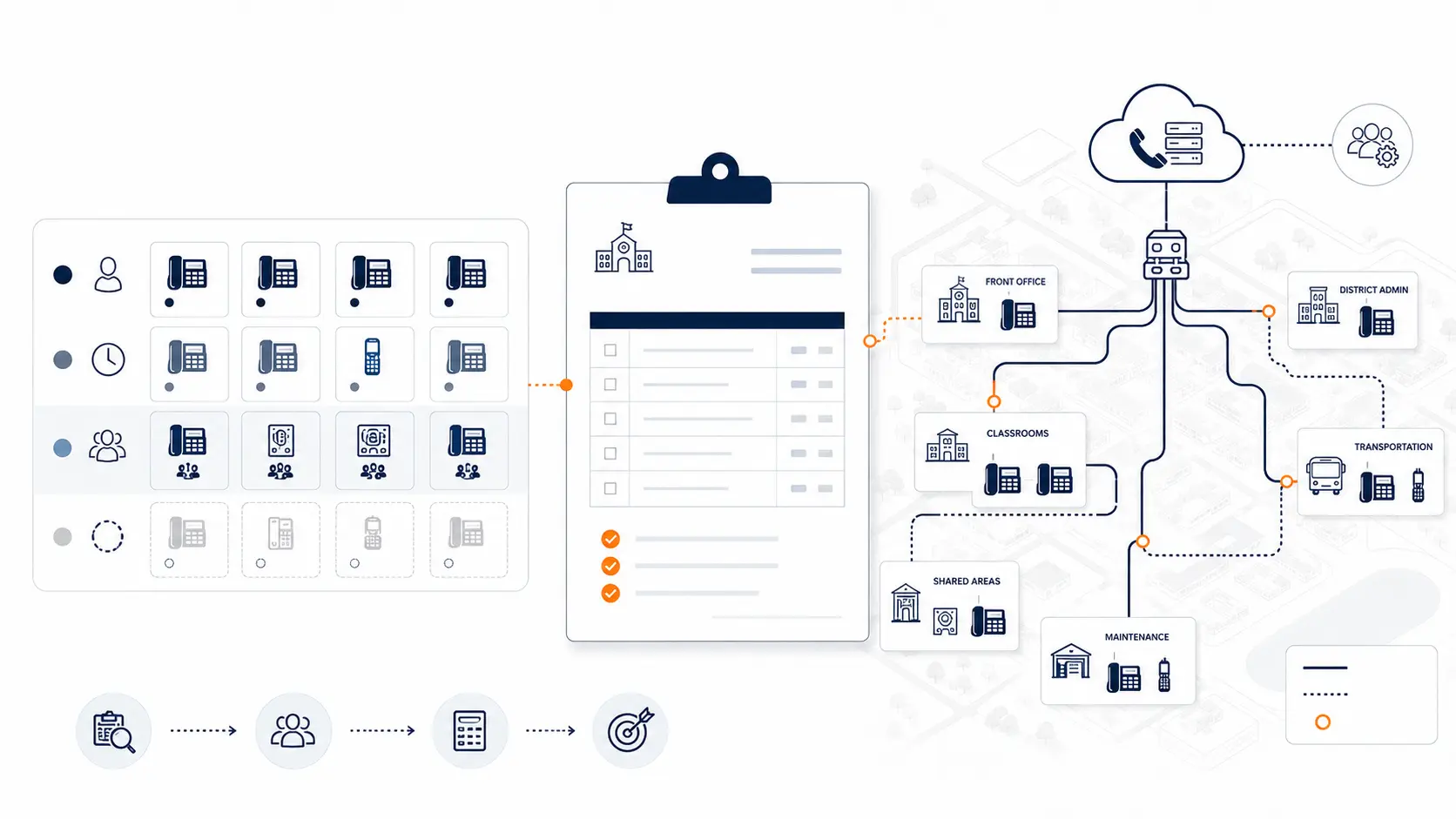
Many school districts moved away from old PBX hardware only to find themselves locked into a different kind of phone system problem: paying for every extension, every user, every device, or every feature whether those items reflect real call activity or not. A hosted VoIP system can be the right choice for a district, but the pricing model still matters. If the district is paying by extension, it may be paying too much for classrooms, shared spaces, seasonal staff, unused phones, and low-usage locations.
Request System Review | Download the District Phone System Review Checklist
Why per-extension pricing can be a problem for schools
Per-extension pricing sounds simple. The vendor counts the number of users, extensions, or devices and bills the district a fixed amount for each one.
That model can work for some businesses, but school districts are different. Districts often have many phones that do not behave like normal business users. A classroom phone may exist for safety and internal reachability, not heavy daily calling. A library phone, gym phone, cafeteria phone, maintenance shop phone, or shared office phone may be important, but it may not justify the same monthly charge as an administrator who makes and receives calls all day.
This creates a mismatch. The phone is needed, but the pricing model treats every extension like a full-time office worker.
For a district with hundreds or thousands of extensions, that mismatch can turn into a large recurring cost.
The core question districts should ask
The question is not:
“Do we need these phones?”
Many of them are needed.
The better question is:
“Should every phone, extension, or shared device be priced the same way?”
If the vendor charges a flat monthly amount for every extension, the district may be paying for capacity it does not use. A school district phone system should be evaluated around real call patterns, routing requirements, emergency calling needs, administrative access, support requirements, and total cost.
A better review starts with how the district actually communicates.
Where per-extension pricing usually gets expensive
Per-extension pricing can create extra cost in several areas.
| Cost area | Why it matters in schools | What to review |
|---|---|---|
| Classroom phones | Often needed for reachability but may have low call volume | Whether every classroom should be billed like a full user |
| Shared spaces | Gyms, cafeterias, libraries, labs, and offices may need phones | Whether shared devices are priced fairly |
| Seasonal or temporary users | Staff roles may change during the school year | Whether short-term users create long-term cost |
| Dormant extensions | Old extensions often remain active after staff moves | Whether the extension list has been cleaned |
| Device-based billing | Some quotes charge by desk phone, not usage | Whether devices and users are being double counted |
| Feature bundles | Every extension may include features not needed by every user | Whether features can be assigned by role |
| Support tiers | Some plans charge more for basic support expectations | Whether support is included or added later |
The issue is not that hosted VoIP is bad. The issue is that a district can have a hosted VoIP system and still have a poor pricing structure.
Why schools are different from normal offices
A typical office may have one phone number or extension per employee. A school district may have a much more complex mix:
- front office phones
- principal and assistant principal extensions
- nurse phones
- classroom phones
- counselor phones
- cafeteria phones
- gym phones
- library phones
- transportation phones
- maintenance phones
- security or reception phones
- shared workroom phones
- district administration extensions
- temporary or substitute staff needs
Some of these are high-usage communication roles. Others exist for reachability, internal routing, or emergency readiness.
That distinction matters. If the vendor prices every extension the same, the district may be paying office-worker pricing for low-usage phones.
Current VoIP installations should still be reviewed
A district does not need to have an old PBX to have a phone system problem.
Many districts already using hosted VoIP should still review their installation before renewal. The problem may not be the technology. It may be the way the system was scoped, priced, configured, or supported.
Common issues include:
- too many billable extensions
- unused licenses
- old users left active
- classroom phones priced like full users
- add-on charges for features the district assumed were included
- support fees added after the original quote
- device rental or lease charges
- long renewal terms
- unclear cancellation language
- weak E911 location records
- poor documentation of call routing
- messy auto attendant design
- no clear plan for changes after launch
A current VoIP PBX can look modern and still be expensive, poorly organized, or misaligned with district operations.
Review extensions before renewal
Before renewing a hosted phone contract, districts should review the extension list carefully.
Start with these questions:
- How many extensions are active?
- How many extensions are assigned to real staff?
- How many extensions are assigned to shared devices?
- How many extensions are unused?
- How many belong to former employees?
- How many classroom phones are billed as full users?
- How many extensions rarely make outside calls?
- How many devices are needed mainly for safety, internal reachability, or convenience?
- Are phone numbers and extensions being billed separately?
- Are desk phones and user accounts being double counted?
This review can uncover cost issues before a district signs a renewal.
Use the District Phone System Review Checklist to organize the review.
Pricing should reflect how the district uses phones
There are several ways phone systems can be priced. Each has tradeoffs.
| Pricing model | How it works | School district concern |
|---|---|---|
| Per extension | Each extension or user has a monthly charge | Can overprice classrooms and shared spaces |
| Per device | Each desk phone has a monthly charge | Can penalize safety or reachability phones |
| Per feature bundle | Every user gets the same package | Can force districts to pay for unused features |
| Per call path or capacity | Pricing is based on simultaneous call capacity | May better reflect actual usage, but must be planned carefully |
| Hybrid pricing | Different roles are priced differently | Can fit schools better if the vendor supports it clearly |
No model is perfect. The point is that the district should understand what it is paying for before signing.
A phone bill should not be a mystery. A proposal should make it clear how the vendor counts users, extensions, phones, numbers, call paths, support, porting, E911 features, and administrative access.
Do not confuse extensions with call capacity
One of the biggest pricing mistakes is assuming that every extension represents a full outside call requirement.
A district may have 700 extensions, but it may not need 700 simultaneous outside calls. Many phones exist so staff can be reached, internal calls can be made, or offices can handle routine communication. Actual outside call capacity is usually a different planning question.
Capacity planning should review:
- peak inbound call volume
- front office call patterns
- dismissal and attendance windows
- transportation call volume
- district office needs
- emergency and outage procedures
- after-hours routing
- expected staff mobility
- number of campuses
This is one reason a system review can be useful. It separates “how many phones exist” from “how much calling capacity the district actually needs.”
Watch for add-on fees
Per-extension pricing is often not the only issue. A hosted phone quote may look reasonable until the district sees add-ons.
Review whether the proposal includes or separately charges for:
- E911 setup or location management
- number porting
- desk phones
- device rental
- softphone or mobile app access
- voicemail to email
- call recording, if needed
- admin portal access
- auto attendant changes
- ring group changes
- after-hours support
- cutover support
- training
- taxes, surcharges, and recovery fees
- early termination or renewal penalties
These items may be legitimate, but they should be clear. The district should not discover them after signing.
E911 should not be buried in a pricing package
Emergency calling readiness should be treated as a planning requirement, not a vague feature line.
Districts should ask:
- Does the quote account for dispatchable location?
- How are buildings, floors, rooms, portables, and shared spaces handled?
- How are softphones and mobile apps handled?
- Who maintains location data after launch?
- How is on-site notification configured?
- What testing process is included?
- What happens when phones move?
For more detail, review E911 Compliance for Schools and the K-12 E911 Readiness Checklist.
Vendor proposals should be compared against actual district needs
A low per-extension price may still cost too much if the district has hundreds of unnecessary billable extensions. A higher per-unit price may be easier to justify if the proposal includes planning, porting, support, E911 configuration, documentation, and post-launch help.
District leaders should compare proposals based on total project reality, not a single price line.
Review:
- how users are counted
- how shared devices are counted
- whether classroom phones need full licenses
- what is included in migration
- what is included in support
- how number porting works
- what the district pays for after launch
- how moves, adds, and changes are handled
- how E911 location updates are handled
- how renewal terms work
The best question is not “What is the monthly price per extension?”
The better question is:
“What will this cost the district based on how we actually use phones?”
Signs your current hosted VoIP installation needs review
A district should review an existing VoIP PBX if any of these are true:
- the bill keeps increasing without a clear reason
- the district is paying for hundreds of extensions
- classroom phones are priced the same as office users
- many users no longer work for the district
- staff do not understand call routing
- campuses use different call handling patterns
- E911 records have not been reviewed recently
- softphones or mobile apps are active without clear location policy
- support costs are unclear
- renewal is approaching
- the district cannot explain the bill internally
This does not mean the system is bad. It means the district may need a clearer current-state review before renewing, expanding, or replacing it.
What to review before renewing a hosted phone contract
Before renewal, review:
- Current extension count
- Active users
- Shared phones
- Classroom phones
- Assigned numbers
- Main numbers and routing
- Auto attendants
- Ring groups
- E911 location records
- Softphone and mobile app users
- Support history
- Add-on fees
- Contract renewal terms
- Cancellation terms
- Porting rights
- Device ownership or lease terms
Document what is still needed, what can be cleaned up, and what should be renegotiated.
How K12 Phone Systems reviews VoIP pricing
A review can help separate real communication needs from billing clutter.
K12 Phone Systems reviews:
- current phone bill
- extension count
- active users and shared devices
- classroom and common-area phones
- call routing
- auto attendants and ring groups
- E911 planning needs
- support expectations
- number porting requirements
- contract or renewal concerns
- migration options if replacement makes sense
The goal is not to replace a system just because it is old or expensive. The goal is to understand whether the current phone environment still fits district operations.
Related planning resources
- District Phone System Review Checklist
- District Phone System Modernization Roadmap
- School Phone Systems
- K-12 VoIP Phone Systems
- Cloud Phone Systems for Schools
- PBX Replacement for Schools
Frequently asked questions
Is per-extension VoIP pricing always bad for schools?
No. Per-extension pricing is not always wrong. It becomes a problem when a district has many low-usage extensions, classroom phones, shared devices, inactive users, or duplicated billing. The district should review whether the pricing model matches actual communication needs.
Why can classroom phones make per-extension pricing expensive?
Classroom phones may be necessary for reachability and emergency planning, but they often do not behave like full office users. If every classroom phone is billed at the same rate as a front office or administrator extension, the district may be overpaying.
Should districts review an existing hosted VoIP system before renewal?
Yes. A hosted VoIP system can still have outdated routing, unused licenses, unclear E911 records, excessive extension counts, or poor pricing. Renewal is a good time to review whether the installation still fits the district.
What is the difference between an extension and call capacity?
An extension is an endpoint or user identity in the phone system. Call capacity is how many calls the district needs to handle at one time. A district may have many extensions but need far fewer simultaneous outside call paths.
Can a district reduce phone costs without replacing the system?
Sometimes. A district may reduce cost by cleaning up inactive extensions, changing the pricing structure, removing unused add-ons, revising support terms, or renegotiating before renewal. In other cases, replacement may make more sense.
What should districts send for a pricing review?
A phone bill, extension list, vendor proposal, campus list, and known call flow issues are helpful. A complete inventory is not required to start.
Does cheaper per-extension pricing mean a better deal?
Not necessarily. A low rate can still be expensive if it applies to too many unnecessary extensions or excludes support, porting, E911 planning, or migration work. Districts should compare total cost and operational fit.
References
- FCC Multi-line Telephone Systems 911 Direct Dialing, Notification, and Dispatchable Location Requirements
- USAC E-Rate Eligible Services Overview
- National 911 Program: Kari's Law and RAY BAUM'S Act
Ready to review your district’s VoIP pricing?
Share your current phone bill, extension list, vendor proposal, or renewal terms. We will help identify billing questions, system review areas, and practical next steps.