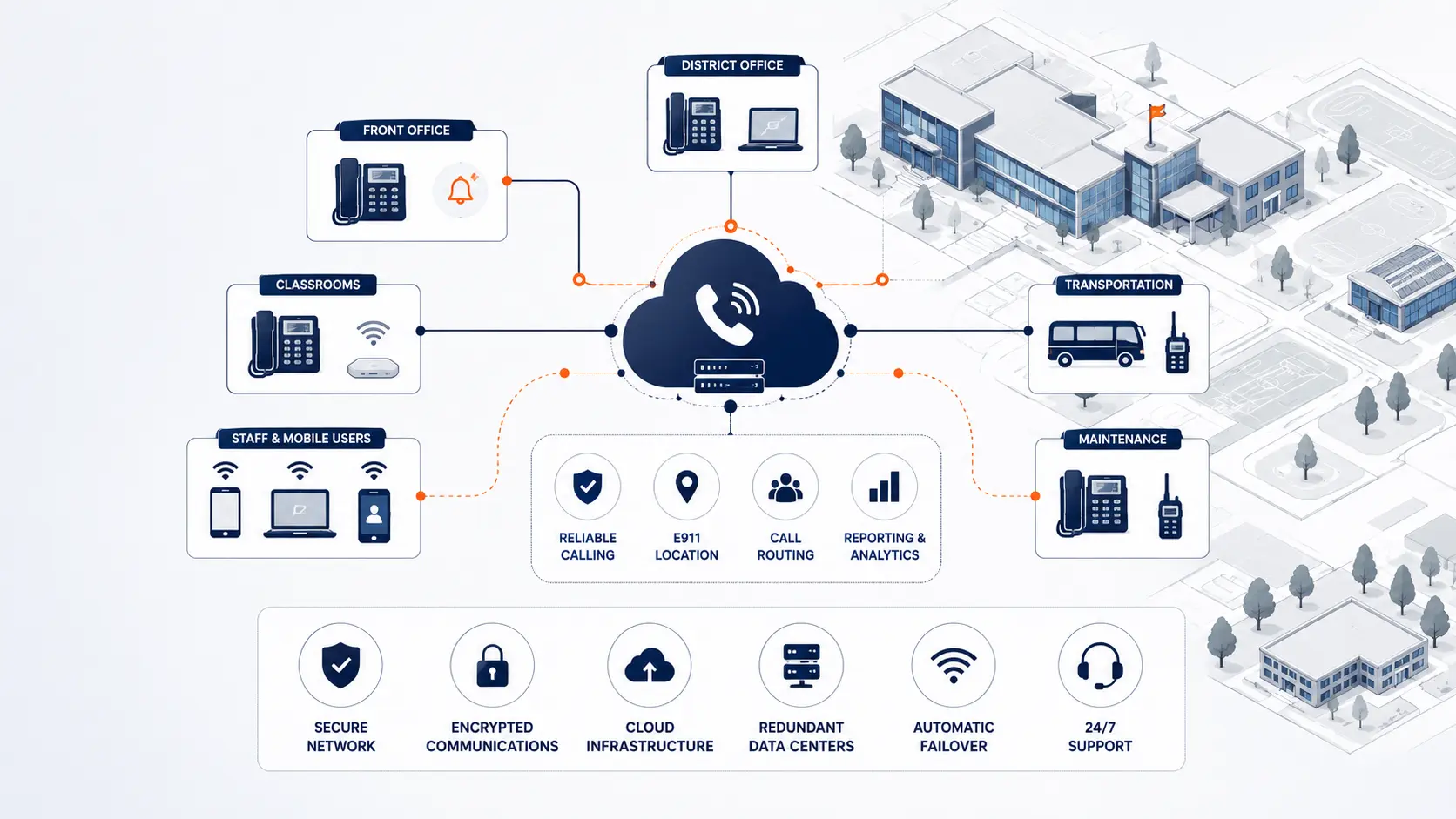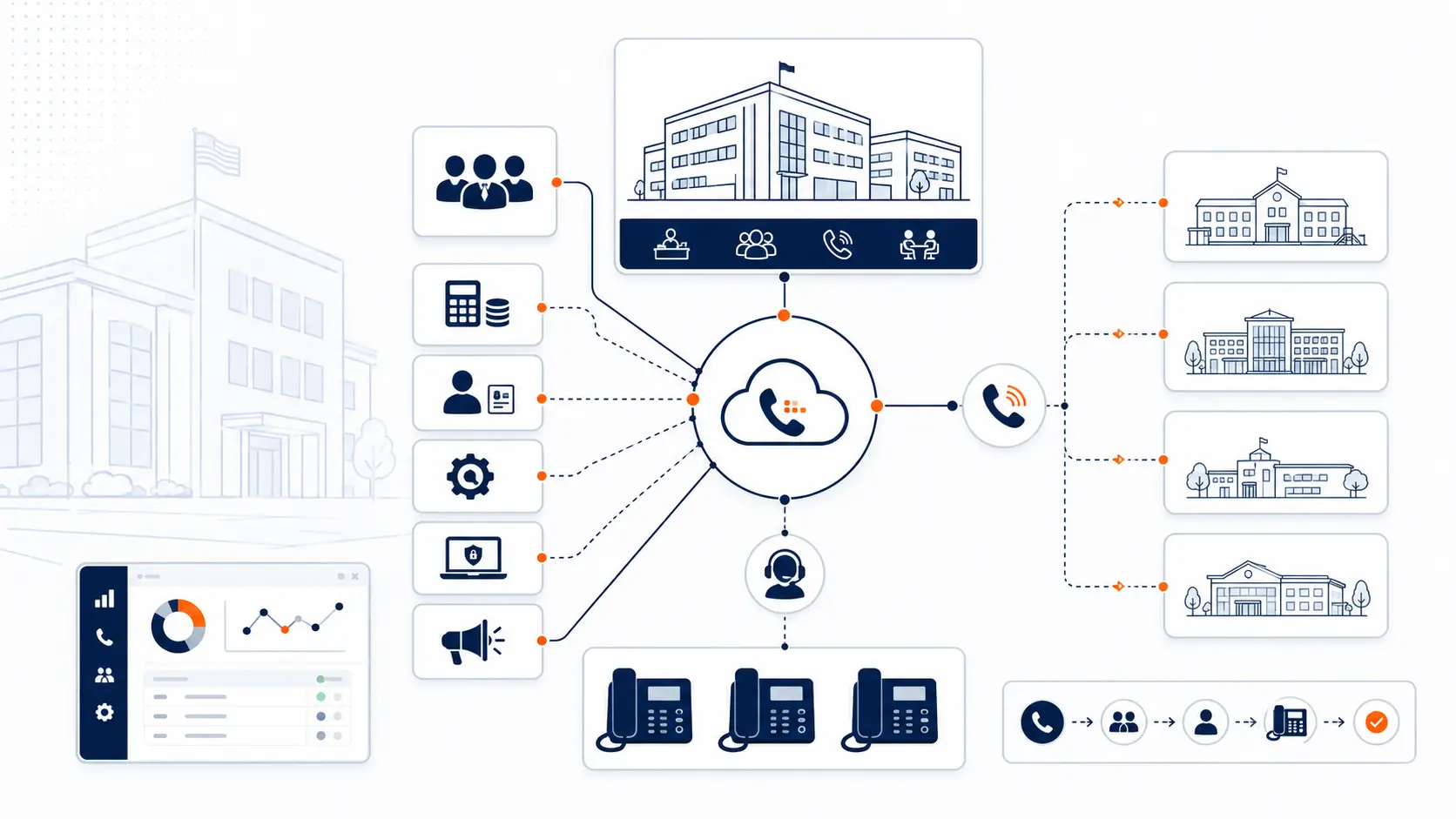
District administration phone systems carry a different load than a single school front office. The district office may support the superintendent, technology, finance, human resources, student services, transportation coordination, facilities, board communication, and public inquiries. When the phone system is outdated, misconfigured, or priced around every extension, the district can lose control of routing, support, cost, and emergency calling records.
A district administration phone system review should look beyond phones on desks. It should examine main numbers, department routing, executive availability, voicemail paths, call transfer behavior, E911 records, carrier services, hosted VoIP charges, number porting, and the way office staff work during normal days and urgent situations.
Request System Review | Download the District Phone System Review Checklist
Why district administration calling needs its own review
District administration offices are often the hub of the district phone environment. They may receive parent calls, vendor calls, board-related inquiries, staff support calls, media calls, finance questions, employment inquiries, and department-specific calls that should not all land in one general mailbox.
A phone setup that works for one school office may not work for a district office. District administration usually needs more careful routing, clearer department ownership, and better fallback handling when key staff are unavailable.
A district office review should answer practical questions:
- Which numbers reach the district office?
- Which numbers should route to specific departments?
- Which calls need a live answer path?
- Which calls can go to voicemail?
- Which calls should route differently after hours?
- Which staff need mobile access or softphones?
- Which extensions are tied to E911 location records?
- Which paid VoIP seats are not truly needed?
- Which numbers must be ported during replacement?
For a broader system view, see School Phone Systems and K-12 VoIP Phone Systems.
What district offices should review first
Before replacing, renewing, or expanding a district administration phone system, the district should document the current environment.
| Review area | What to check | Why it matters |
|---|---|---|
| Main numbers | District main line, department numbers, direct numbers | Prevents lost calls during porting or routing changes |
| Department routing | Finance, HR, IT, transportation, student services, facilities | Keeps calls from landing in the wrong office |
| Executive routing | Superintendent, cabinet, board office, assistants | Protects important calls from generic handling |
| Voicemail paths | Department mailboxes, individual mailboxes, shared mailboxes | Prevents dead-end messages |
| E911 records | Address, building, suite, room, device location | Supports emergency calling readiness |
| Hosted VoIP charges | Per-extension pricing, unused users, add-on fees | Helps identify overspending |
| Analog lines | Fax, elevator, alarm, gates, specialty devices | Prevents accidental disconnection |
| Cutover timing | Board meetings, payroll cycles, enrollment periods | Reduces disruption during migration |
This review should happen before a quote is accepted. A quote built on a weak inventory often turns into change orders, missed numbers, poor routing, or avoidable subscription cost.
Department routing in the district office
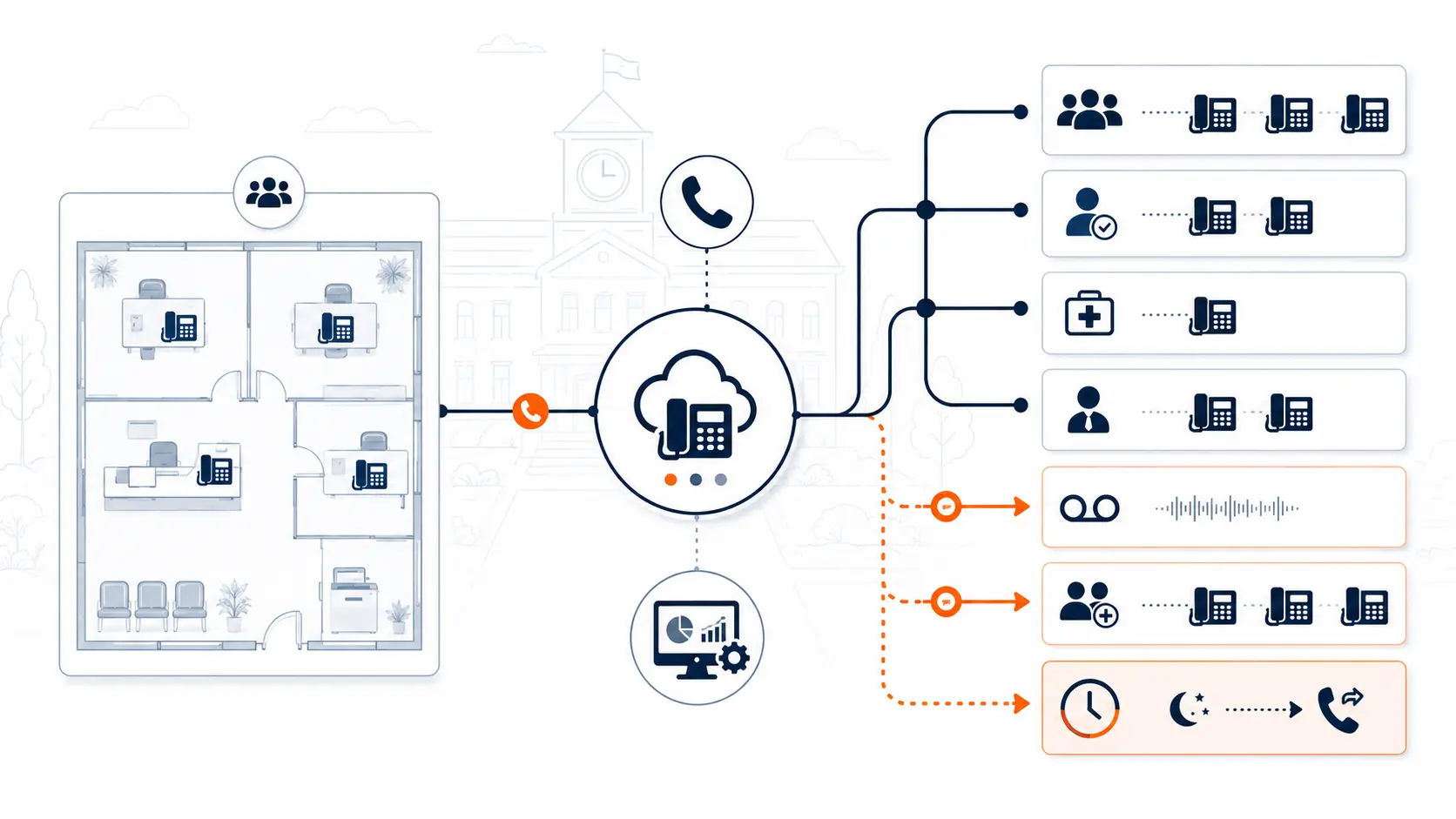
District offices usually need clean routing by department. A caller trying to reach payroll should not be routed through the same path as a parent trying to reach student services. A vendor calling purchasing should not land in the technology support queue.
Common district administration routing groups include:
- Superintendent or executive office
- Board office or administrative assistant
- Technology department
- Finance and payroll
- Human resources
- Student services
- Special education administration
- Transportation administration
- Facilities or maintenance administration
- Communications or public information
- Records or enrollment support
A good review should identify which departments need direct numbers, which can share a main route, which need ring groups, and which should have after-hours voicemail instructions.
Routing should reflect real staff behavior. If three people cover payroll calls during peak periods, the phone system should support that. If the technology department receives both internal staff calls and outside vendor calls, those paths may need to be separated.
Executive office and superintendent routing
Superintendent and executive office routing needs careful handling. These calls may involve board members, principals, parents, staff, vendors, public agencies, or community stakeholders.
The review should define:
- Which calls go directly to an assistant
- Which calls can ring a shared office group
- Which calls need voicemail after hours
- Which numbers should not be published broadly
- Which staff can transfer to leadership
- Which calls need backup coverage when the assistant is unavailable
This does not require a complicated system. It requires a clear call path. Many districts have phone systems with years of routing changes layered on top of each other. The result is often confusion. A replacement or renewal is the right time to simplify.
E911 planning for district administration offices
District offices are part of the emergency calling environment. They need the same careful E911 review as school buildings.
The review should confirm:
- Direct 911 dialing works without a prefix
- On-site notification is configured for the right staff
- Dispatchable location reflects the correct district office address
- Building, floor, room, suite, or area data is accurate where needed
- Softphones and mobile apps are handled with clear rules
- Phones moved between offices trigger a location record update
Kari’s Law and RAY BAUM’S Act affect covered multi-line telephone systems, including systems used in enterprise and school settings. The FCC explains that Kari’s Law includes direct 911 dialing and notification requirements, and RAY BAUM’S Act addresses dispatchable location for 911 calls from covered multi-line systems.[^1]
This page provides technical planning information, not legal advice. Districts should review legal and regulatory obligations with qualified counsel, public safety authorities, and appropriate state or local agencies.
For deeper planning, use the K-12 E911 Readiness Checklist and read E911 Compliance for Schools.
Hosted VoIP renewal risk in district offices
Many district administration offices have already moved to hosted VoIP or a cloud PBX. That does not mean the installation is still right.
A district should question its current hosted VoIP setup when:
- The district pays for every named extension
- Old users remain on the bill
- Shared spaces are billed as full users
- Common area phones are priced the same as staff seats
- Mobile apps are included for users who never use them
- Add-on fees make the invoice hard to read
- Support is slow or routed through several layers
- E911 location records are unclear
- Department routing still does not match current operations
- The renewal locks in the same problems for another term
Per-extension pricing can become expensive in district administration. A district may need phones in offices, conference rooms, reception areas, shared workspaces, IT rooms, and support spaces. Not all of those phones represent a full-time user. If the district pays the same monthly rate for every extension, the bill may be higher than it needs to be.
A system review should compare the actual calling pattern against the billing model. The goal is not to remove needed access. The goal is to stop paying for unused or mispriced capacity.
For more on this issue, see Why Per-Extension VoIP Pricing Can Cost School Districts Too Much and Hosted VoIP for Schools: What Districts Should Review Before Renewal.
Number porting for district administration
District administration numbers are often among the most sensitive numbers in the district. They may appear on websites, board documents, public notices, HR postings, vendor records, state reporting documents, email signatures, and printed materials.
Before changing systems, document:
- District main number
- Superintendent office number
- Department direct numbers
- Fax numbers
- Published public numbers
- DID numbers assigned to staff
- Numbers used for voicemail-only lines
- Numbers tied to alarm, elevator, gate, or specialty services
- Numbers that should not be ported
Porting should not be treated as a clerical task at the end of the project. It should be part of the migration plan. The district needs to know which numbers move, which stay, which forward during cutover, and which require special handling.
For a deeper porting plan, see What School Districts Should Know About Number Porting Before Changing Phone Systems.
Analog and specialty lines in district offices
District offices may still have analog services that do not behave like normal VoIP extensions. These may include:
- Fax lines
- Elevator phones
- Alarm lines
- Gate or door systems
- Fire panel communication paths
- Postage machines
- Specialty vendor lines
- Backup or emergency lines
These should be inventoried separately. Some can be replaced or moved into new workflows. Some may need to remain with a carrier or be reviewed by a qualified specialty vendor. A district should not assume that every analog line can be replaced the same way.
A phone system migration can create problems when analog lines are missed. A bill review may show numbers that no one recognizes. Those numbers should be traced before cancellation.
See Why Analog Line Replacement Matters for School Districts for a more detailed review.
Softphones and mobile access for administration staff
District administration staff may need flexibility. Technology leaders, facilities leaders, communications staff, cabinet members, and department heads may work between buildings or take calls away from the desk.
Softphones and mobile apps can help, but they need policy and E911 planning.
Review:
- Who needs mobile calling
- Who only needs voicemail access
- Who needs a desk phone
- Which roles should not use personal numbers for district business
- How caller ID should display
- How call recording, if used, is handled
- How location data works for softphones and mobile apps
- What happens when staff leave the district
Softphones should not be added just to justify per-user licenses. They should match actual work patterns.
For emergency calling concerns, see E911 Compliance for Schools.
A practical review checklist for district administration
Use this checklist before replacing, renewing, or expanding the district office phone system:
- List every district administration number
- Separate published numbers from internal-only numbers
- Review department routing
- Review executive office routing
- Confirm voicemail ownership
- Identify shared office phones
- Identify true users versus common area phones
- Review hosted VoIP seat charges
- Review mobile app usage
- Confirm E911 location records
- Identify analog and specialty lines
- Review after-hours call handling
- Review support history
- Confirm porting requirements
- Document cutover timing constraints
- Confirm staff training needs
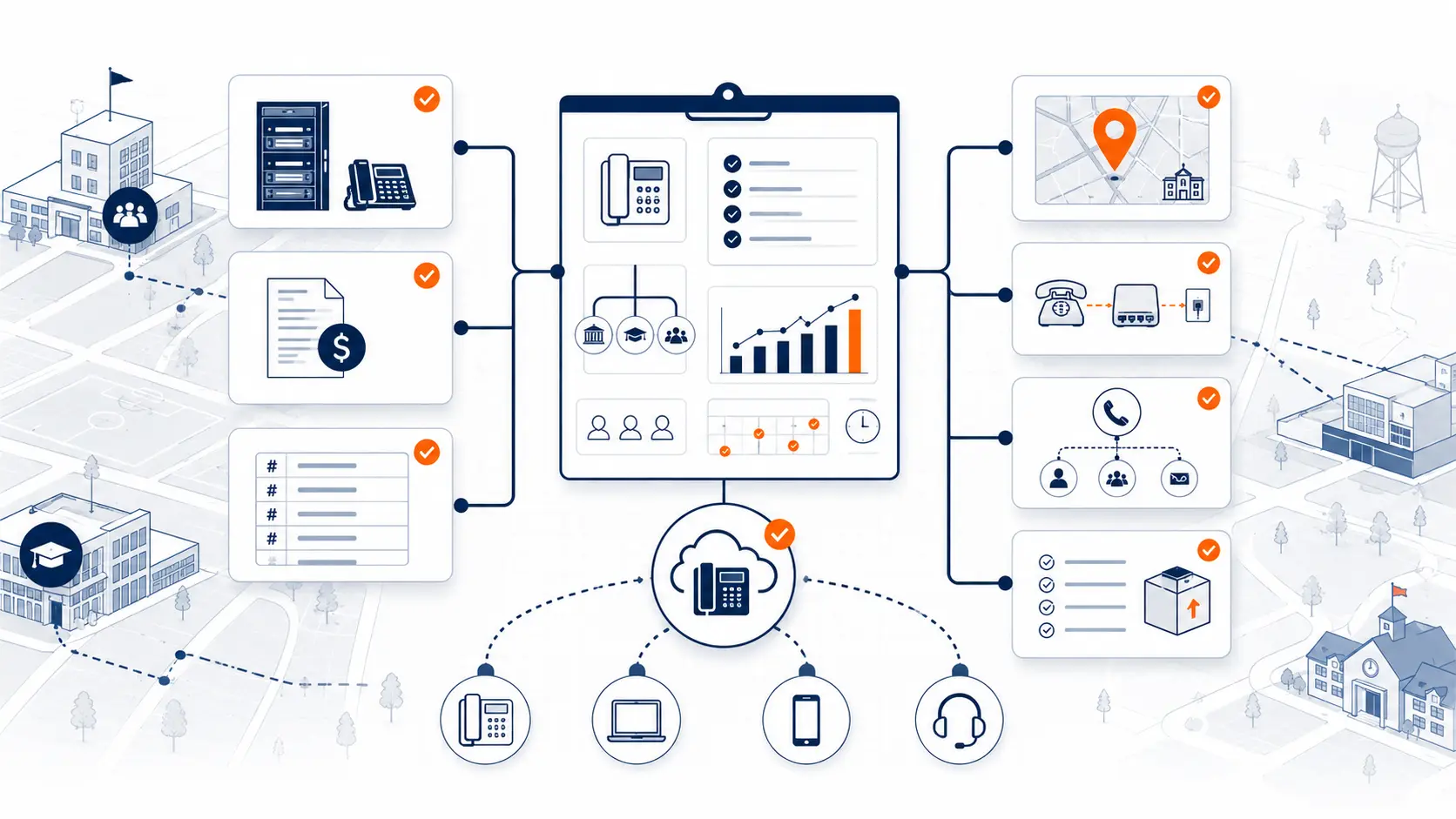
The District Phone System Review Checklist can help organize this process.
What a district administration phone system review should include
A district administration phone system review should cover more than the main number. K12 Phone Systems reviews the current phone environment, district office numbers, department routing, extensions, E911 planning needs, hosted VoIP billing, porting requirements, analog lines, cutover risks, and support expectations.
The review helps clarify:
- What is working now
- What is outdated
- What is mispriced
- What needs to be ported
- What needs to be re-routed
- What needs E911 review
- What needs staff training
- What should be phased
Frequently asked questions
What is a district administration phone system?
A district administration phone system supports the central office and district-level departments such as superintendent, finance, HR, technology, transportation administration, student services, and facilities administration.
Is the district office phone system different from a school front office phone system?
Yes. A school front office is usually campus-focused. A district office may support district-wide departments, leadership, board-related communication, vendor calls, and public inquiries.
Should district offices use hosted VoIP?
Hosted VoIP can work well when routing, E911 records, number porting, network readiness, support, and pricing are planned carefully. It should not be adopted or renewed without reviewing actual district needs.
Can a district office keep existing phone numbers during replacement?
Yes, in many cases. The numbers should be inventoried early, matched to carrier records, and included in the porting plan before cutover.
Why can per-extension pricing be a problem for district offices?
District offices may have shared spaces, conference rooms, common area phones, old users, and low-use extensions. Paying the same monthly amount for every extension can create unnecessary cost.
Do district administration phones need E911 location records?
Yes. District administration phones should have accurate emergency calling location information based on the physical location of the device or approved policy for non-fixed devices.
Should analog lines be reviewed before replacing the district office phone system?
Yes. Fax, alarm, elevator, gate, and specialty lines may still appear on carrier bills. They should be identified before any number cancellation or porting work.
What should we send before a district administration phone system review?
Send a phone bill, list of district office numbers, department routing notes, extension list, hosted VoIP invoice, campus or building list, and any vendor proposal you are reviewing.
Related planning resources
- District Phone System Review Checklist
- District Phone System Modernization Roadmap
- K-12 E911 Readiness Checklist
- Legacy PBX Risk Map for School Districts
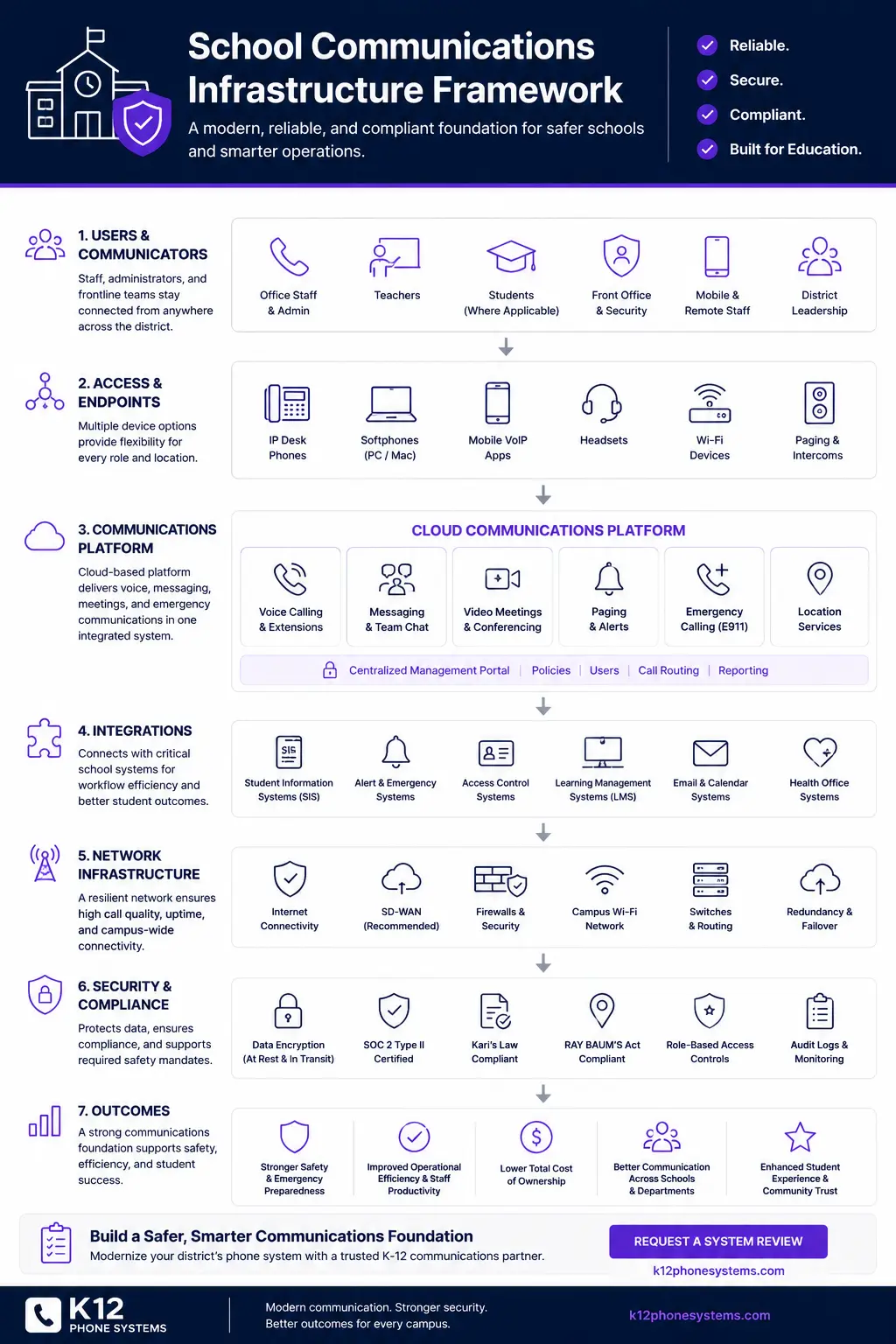
- School Communications Infrastructure Framework
References
[^1]: FCC: Multi-line Telephone Systems 911 Requirements
Ready to review your district administration phone system?
Share your current phone bill, hosted VoIP invoice, department routing notes, number list, or vendor proposal. We will help identify routing issues, pricing concerns, E911 review areas, porting considerations, and practical next steps.