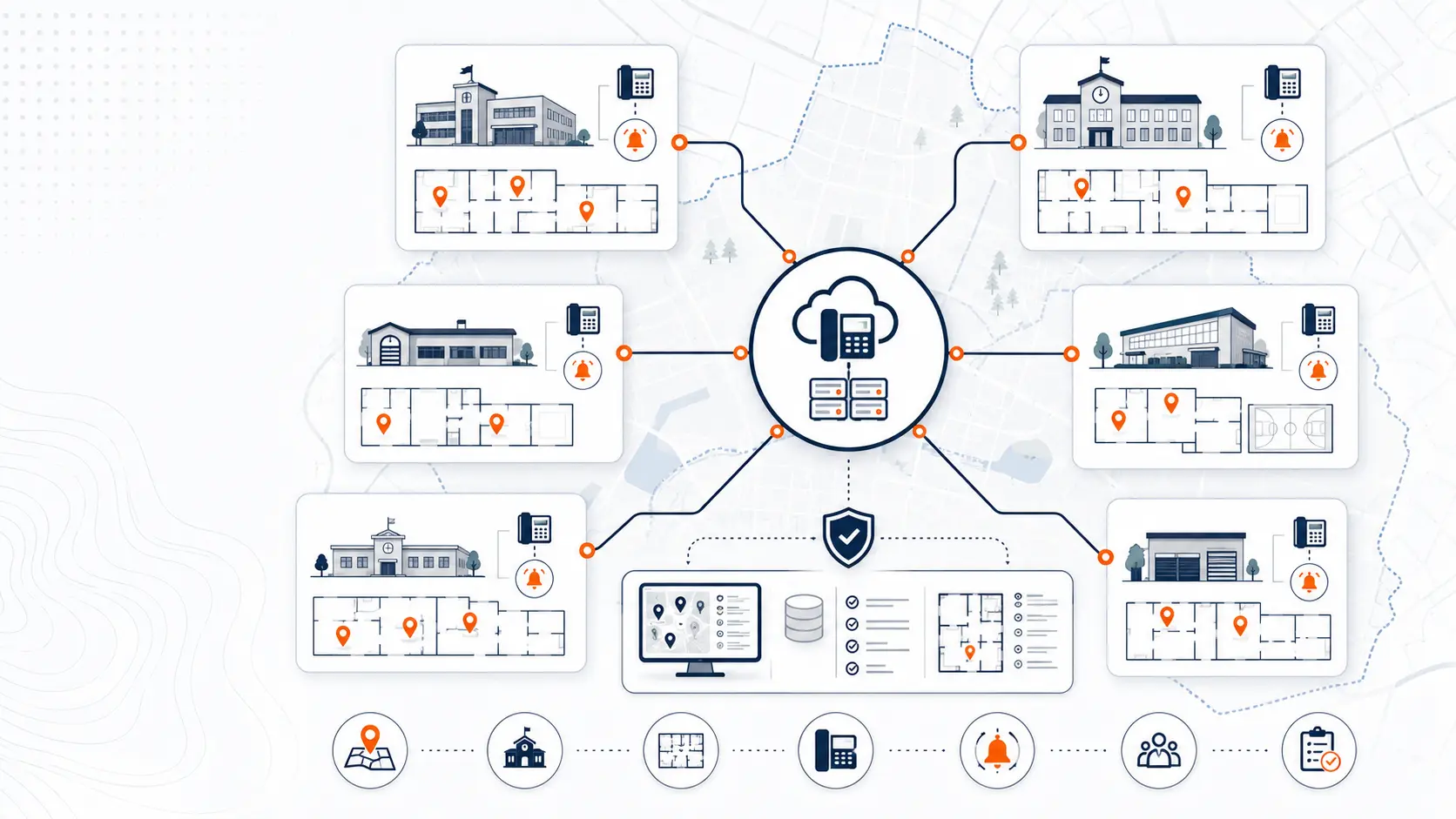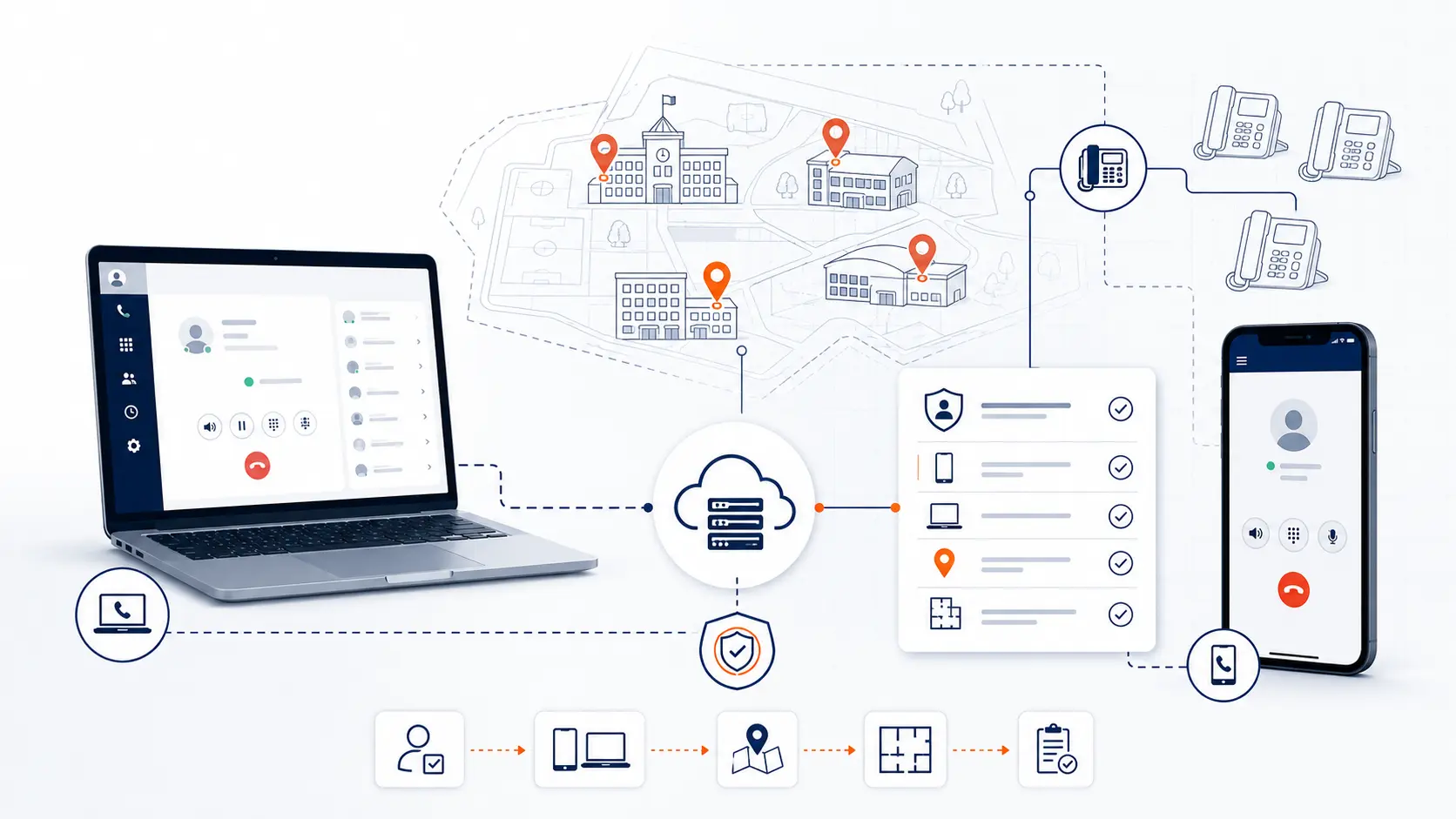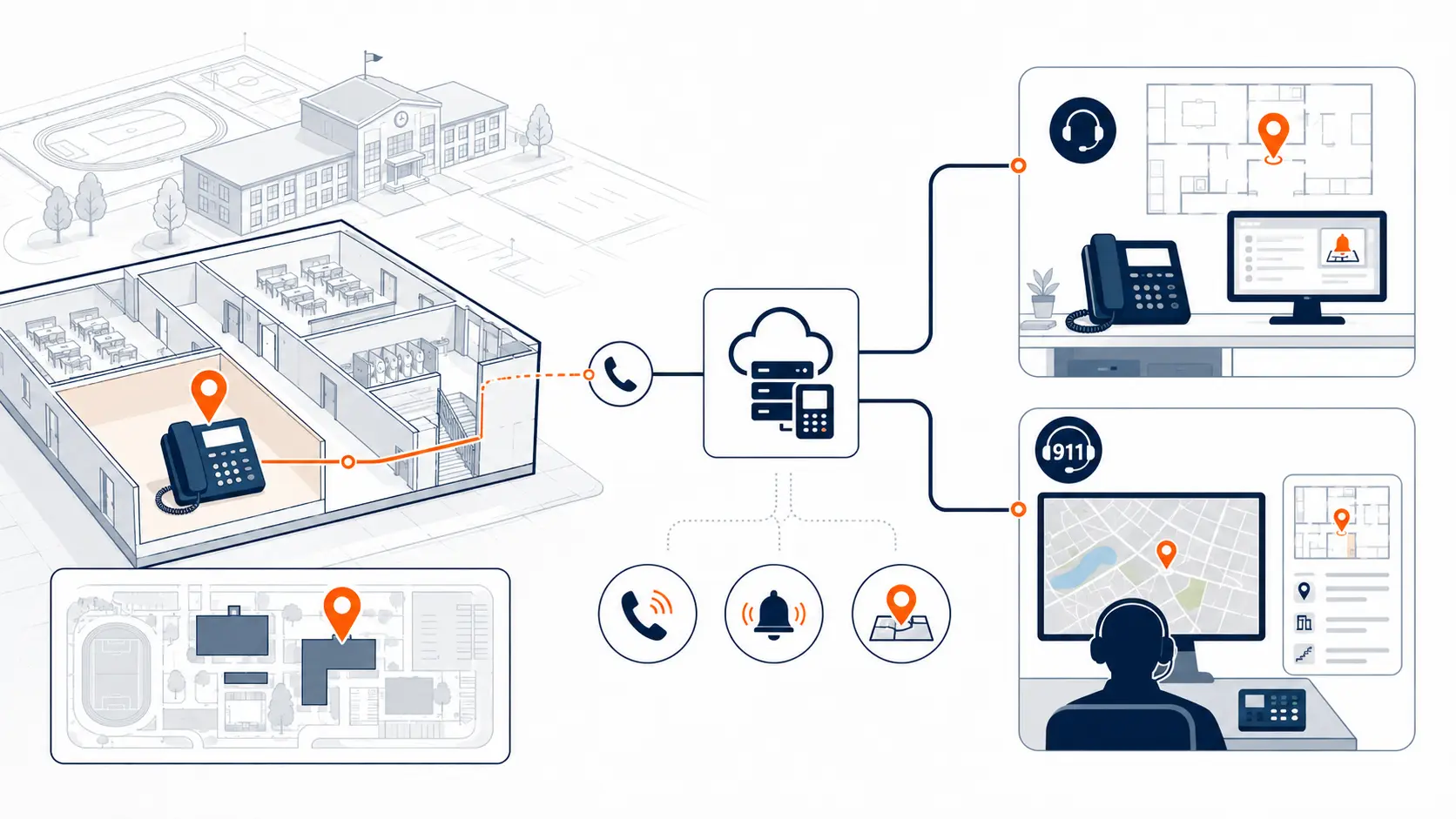
Kari’s Law and RAY BAUM’S Act changed how districts should think about emergency calling from school phone systems. For K-12 technology teams, the issue is not only whether a phone can call 911. The larger question is whether a caller can reach 911 directly, whether the right people on-site receive notice, and whether responders receive location details that help them find the caller inside a school environment.
This guide is for technical planning and general education only. It is not legal advice. Districts should review legal and regulatory obligations with qualified counsel, public safety authorities, and appropriate state or local agencies.
Request System Review | Download the K-12 E911 Readiness Checklist
What Kari’s Law and RAY BAUM’S Act mean in plain English
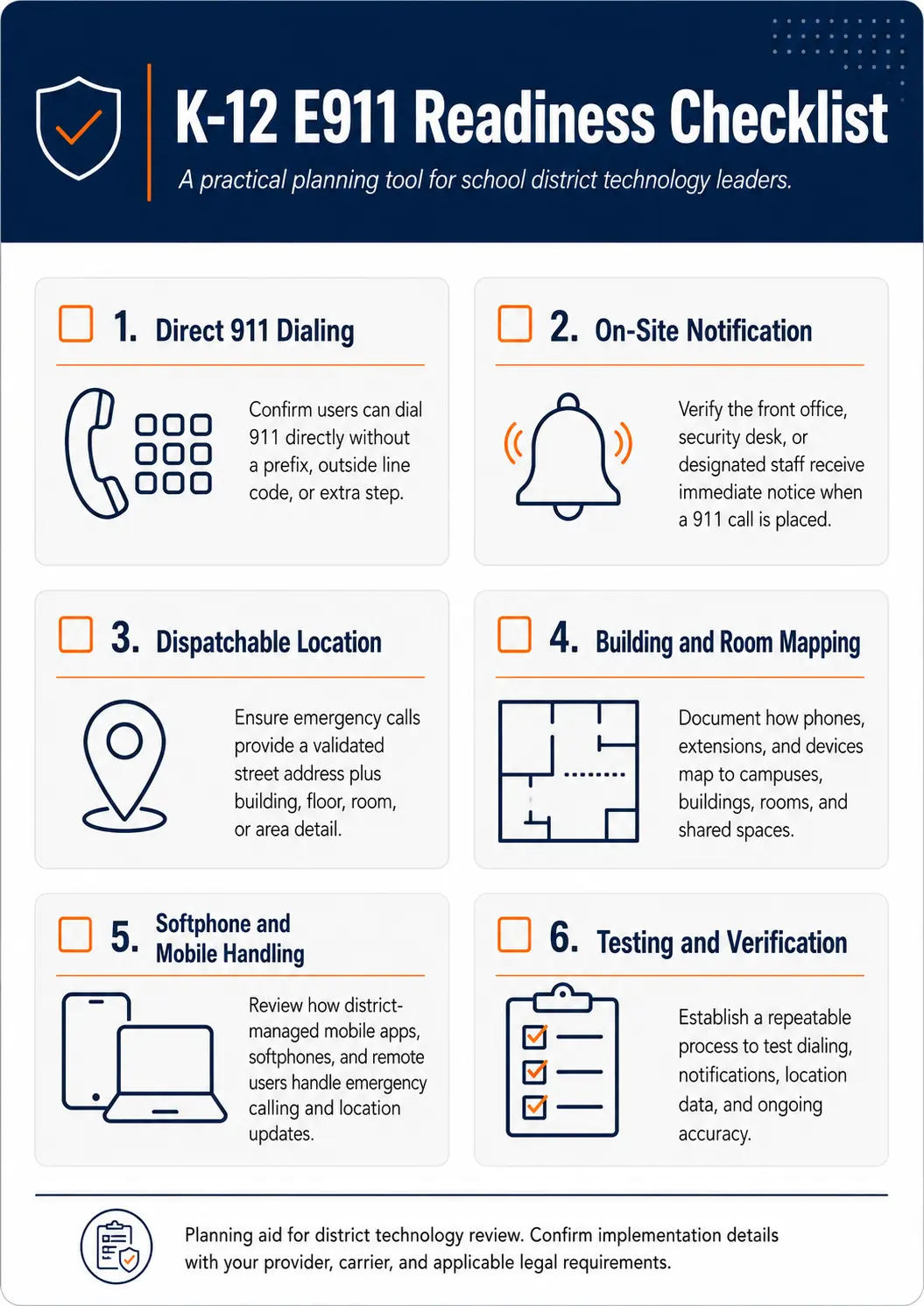
Kari’s Law focuses on direct 911 dialing and notification for covered multi-line telephone systems, often called MLTS. A person using a covered MLTS should be able to dial 911 without a prefix such as 9 for an outside line. The law also includes a notification requirement so designated personnel can be alerted when a 911 call is made from the system [1].
Applicability is not simply retroactive to every older installed phone system. The federal requirements focus on covered MLTS manufactured, imported, offered for sale or lease, sold, leased, or first installed after the effective date. Existing systems, state and local rules, and major changes should be reviewed with qualified counsel, public safety authorities, and the phone system provider.
RAY BAUM’S Act focuses on location. Under FCC rules, 911 calls need to send a dispatchable location to the public safety answering point when required by the rule [2]. For a school district, that means the location information should be more useful than a general billing address.
In a district setting, emergency calling readiness touches several parts of the phone environment:
- Desk phones
- Front office phones
- Classroom phones
- Shared spaces
- Portables
- Softphones
- Mobile apps
- Campus routing
- Location records
- Testing procedures
- Ongoing move, add, and change processes
A hosted phone system can make this easier to manage, but it still needs correct planning and configuration. A legacy PBX can sometimes be corrected, but older systems often lack clean documentation, current location records, or flexible administration.
Why these laws matter for school districts
School phone systems are not like small office phone systems. A single district may have elementary schools, middle schools, high schools, administration buildings, bus facilities, maintenance sites, athletic buildings, portables, and shared-use spaces.
That creates a location problem. If a staff member calls 911 from a classroom, the responder needs to know more than the district’s main address. A campus may have multiple buildings, entrances, floors, wings, and rooms.
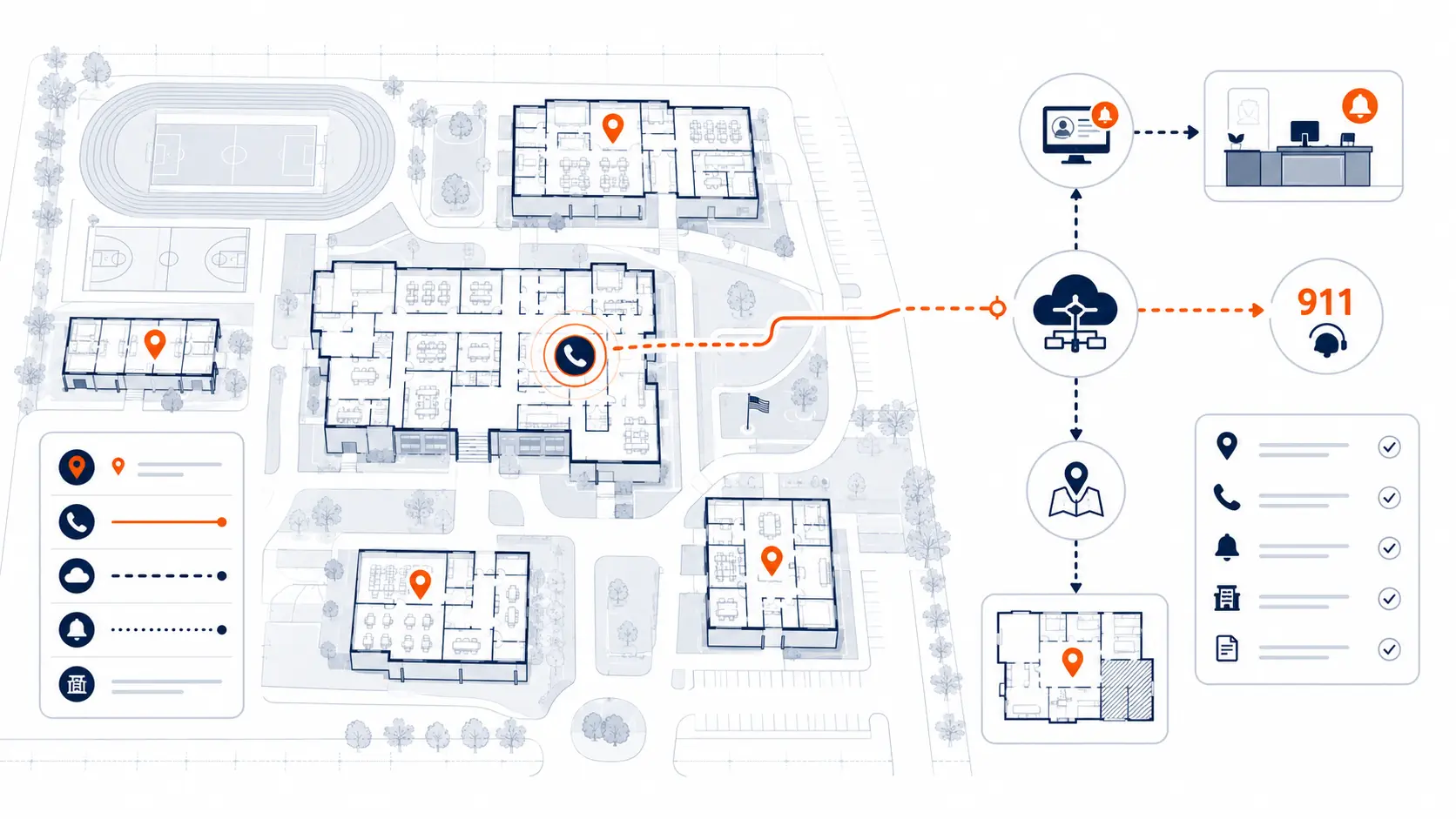
That creates a notification problem too. If a 911 call is placed from a classroom or office, local staff may need to know quickly so they can meet responders, unlock doors, direct traffic, or provide context.
Kari’s Law and RAY BAUM’S Act push districts to review emergency calling in terms of access, notification, and location data. That is why emergency calling should be reviewed before a school phone system replacement, not after the cutover.
For a wider planning view, see E911 Compliance for Schools.
Kari’s Law requirements school teams should review
The FCC describes Kari’s Law as applying to covered multi-line telephone systems. It includes direct 911 dialing and notification to a central location at the facility where the system is installed, or to another person or organization, when technically feasible [1].
For a school phone system review, the practical questions are:
| Review area | Planning question | District impact |
|---|---|---|
| Direct 911 dialing | Can any phone dial 911 without a prefix? | Reduces confusion under pressure |
| On-site notification | Who receives notice when a 911 call is placed? | Helps local staff respond |
| Device coverage | Which phones or calling devices are included? | Prevents gaps across buildings |
| Old dial patterns | Does the system still use 9 for outside calls? | May create emergency calling confusion |
| Testing | Has direct dialing been verified safely? | Confirms configuration before cutover |
| Documentation | Who owns the process after launch? | Keeps records current |
The key school issue is that many legacy phone systems were designed around old dialing habits. Staff may have learned to dial 9 before outside calls, or a PBX may still have old outbound route rules. The review should confirm that 911 works directly, not just through a traditional outside-line pattern.
RAY BAUM’S Act and dispatchable location
RAY BAUM’S Act is tied to dispatchable location. The FCC describes dispatchable location as a validated street address plus more location detail, such as suite, apartment, or similar information, needed to identify the caller’s location [2].
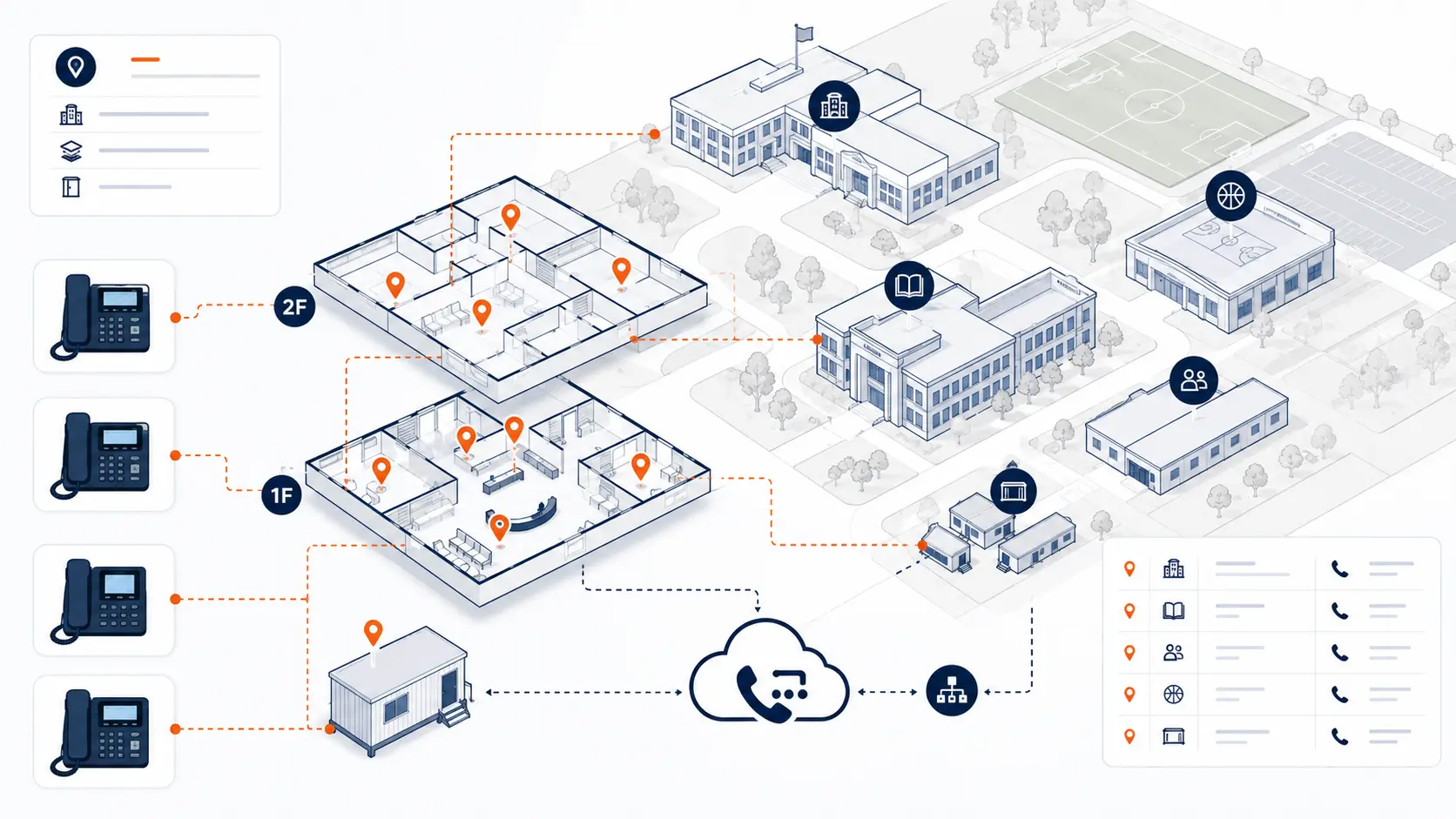
In a school, that extra detail may need to account for:
- Building name or number
- Floor
- Room
- Wing
- Portable classroom
- Gym
- Cafeteria
- Library
- Administrative office
- Transportation facility
- Maintenance building
The location data should match how a responder would find the caller. A room number alone may not help if the campus has multiple buildings with similar numbering. A building name may not help if the entrance is hard to locate. A district should map location data in a way that fits real campus navigation.
A good starting point is to compare current phone locations against building lists, room records, campus maps, and call routing. The K-12 E911 Readiness Checklist can help structure that review.
Where older PBX systems create E911 gaps
Older PBX systems can create emergency calling issues in several ways. Some still use old dialing patterns. Some have incomplete extension records. Some depend on location data that nobody has reviewed for years.
Common gaps include:
- Extensions tied to the wrong room
- Phones moved without location updates
- Main address used for all devices
- Unmapped portables
- Old analog lines with unclear address records
- Little documentation for auto attendants and call paths
- No clear owner for location data
- Retired vendor or technician knowledge
- No tested process for non-fixed devices
Aging systems often carry hidden operational risk. Even if calls work day to day, emergency calling data may be stale. That is why districts reviewing PBX replacement should review E911 readiness at the same time.
For more on old systems, see PBX Replacement for Schools and the Legacy PBX Risk Map for School Districts.
Hosted phone systems still need E911 planning
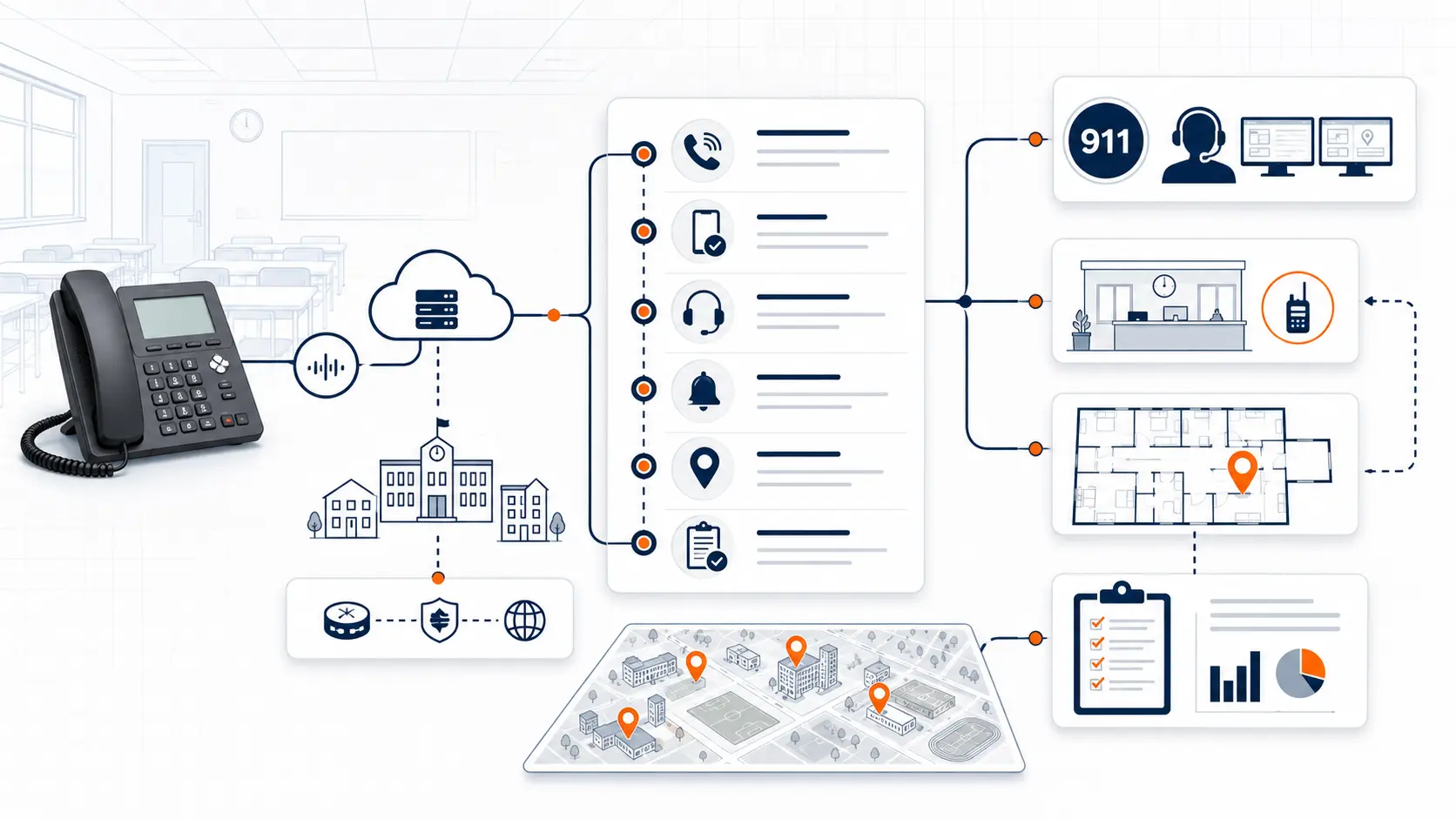
A hosted school phone system can centralize administration, simplify changes, and make it easier to manage users and devices across campuses. That does not mean E911 readiness happens on its own.
A hosted system still needs:
- Correct address records
- Accurate device assignments
- Location mapping
- Softphone and mobile app policies
- Network planning
- Testing procedures
- Staff instructions
- Change management after launch
Softphones and mobile apps need close review. A staff member may use an app in the district office one day and from another building the next day. Districts need clear rules for how location data is entered, updated, and maintained for those users.
That is why hosted phone projects should include E911 review during design, not just during final testing.
For broader hosted calling planning, see K-12 VoIP and Cloud Phone Systems for Schools.
What school districts should review before a phone system change
Before replacing a PBX, moving to hosted VoIP, or renewing an existing VoIP contract, districts should review how emergency calling works now.
Use this checklist:
- Can every phone dial 911 directly?
- Does the system still rely on outside-line prefixes?
- Who receives on-site notification?
- Are notification recipients current?
- Are building addresses validated?
- Are room, floor, and area details mapped?
- Are portable classrooms included?
- Are phones tied to the correct locations?
- Are softphones and mobile apps included in the plan?
- Are analog lines documented?
- Are carrier records accurate?
- Has testing been coordinated with the proper public safety authority?
- Who updates location records after moves?
- Who reviews E911 settings after staff or building changes?
This review should happen before vendor selection when possible. It gives the district a clearer requirement list and reduces the chance of rushing location work at the end of a migration.
Use the District Phone System Review Checklist to document these areas before requesting quotes.
E911 planning during phased school phone migrations
Many districts should not replace every phone in a single cutover. A phased migration can reduce risk, especially for districts with multiple campuses, older wiring, mixed analog services, or limited staff availability.
E911 planning should follow the same phased logic.
For each site or phase, review:
| Migration phase | E911 planning task | Why it matters |
|---|---|---|
| Before design | Document buildings, rooms, numbers, and devices | Creates the data foundation |
| Before cutover | Configure direct dialing, notification, and location records | Prepares the new system |
| During cutover | Test emergency calling paths using an approved process | Confirms routing and location |
| After launch | Review move, add, and change ownership | Keeps records current |
| Future changes | Retest after major building, routing, or device changes | Prevents stale data |
For multi-site deployments, see Multi-Campus Phone Systems and the District Phone System Modernization Roadmap.
Who should own E911 location data?
One of the biggest district planning questions is ownership. E911 location data is not a one-time setup item. It changes when phones move, offices relocate, portables are added, staff assignments change, or calling devices are added.
Possible owners include:
- IT
- facilities
- front office leadership
- safety or security staff
- operations
- the phone system vendor
- public safety contacts
- district administration
The district should define who owns each part.
A practical model is:
| Responsibility | Likely owner |
|---|---|
| Phone system configuration | IT or vendor |
| Building and room records | Facilities or operations |
| Campus maps | Facilities or administration |
| Notification recipients | IT and school leadership |
| Staff instructions | Administration and building leaders |
| Testing coordination | IT with public safety contacts |
| Change documentation | IT with operations support |
The exact ownership model can vary. The key is to avoid a situation where everyone assumes someone else is maintaining the data.
Common mistakes to avoid
Districts can reduce risk by avoiding a few common mistakes:
- Assuming a hosted system handles E911 without configuration
- Waiting until cutover week to review location records
- Treating the district office address as enough for all locations
- Forgetting portables, gyms, cafeterias, libraries, and support buildings
- Ignoring softphone and mobile app behavior
- Leaving old 9-for-outside-line habits in place
- Not reviewing analog lines
- Testing 911 casually without coordination
- Failing to document who owns updates after launch
- Not reviewing E911 when phones move
Most of these mistakes come from treating emergency calling as a technical checkbox. For schools, it should be part of the replacement design.
How a system review helps
A district phone system review helps turn E911 concerns into a practical plan. K12 Phone Systems reviews the current phone environment, buildings, numbers, routing, E911 planning needs, analog lines, hosted readiness, and cutover considerations.
The review can help district leaders answer:
- Are we still relying on old PBX behavior?
- Can phones dial 911 directly?
- Do notification recipients make sense?
- Do location records match real rooms and buildings?
- Are softphones and mobile apps covered?
- What needs to be fixed before migration?
- What should be tested before launch?
Start with a Request System Review if your district is replacing a PBX, reviewing hosted VoIP, or trying to understand E911 readiness before a phone system decision.
Related planning resources
- K-12 E911 Readiness Checklist
- District Phone System Review Checklist
- District Phone System Modernization Roadmap
- Legacy PBX Risk Map for School Districts
- School Phone Systems
- E911 Compliance for Schools
Frequently asked questions
What is Kari’s Law?
Kari’s Law applies to covered multi-line telephone systems and addresses direct 911 dialing without a prefix, such as dialing 9 for an outside line. It also includes a notification requirement for 911 calls from the system. Applicability for older systems should be reviewed with qualified counsel and appropriate public safety authorities.
What is RAY BAUM’S Act?
RAY BAUM’S Act led to FCC rules for dispatchable location with 911 calls. In practical terms, the caller’s location information should be detailed enough to help responders find the caller.
Do Kari’s Law and RAY BAUM’S Act apply to schools?
Schools commonly use multi-line phone systems, so districts should review these rules with counsel, public safety authorities, and appropriate state or local agencies.
Does a hosted phone system automatically solve Kari’s Law and RAY BAUM’S Act?
No. Hosted systems still require correct dialing rules, notification setup, location records, device assignments, softphone policies, and testing.
What is dispatchable location in a school building?
Dispatchable location usually means a validated street address plus location details that help identify where the caller is located. In a school, that may include building, floor, room, wing, portable, or area information.
Do softphones and mobile apps affect E911 planning?
Yes. Softphones and mobile apps are not fixed to one desk. Districts need policies and configuration for how location information is handled when staff use these tools.
Should E911 planning happen before replacing a PBX?
Yes. E911 should be reviewed during planning, before cutover. Waiting until launch can create rushed fixes and unclear responsibility.
Who should maintain E911 location records?
Districts should assign ownership. IT may manage phone system records, facilities may maintain building and room data, and leadership may approve notification recipients.
How should schools test emergency calling readiness?
Testing should be planned with the proper public safety authority or local PSAP. Districts should not place casual test calls without coordination.
Can K12 Phone Systems provide legal compliance advice?
No. K12 Phone Systems provides technical review and E911 planning support for phone system projects. Districts should confirm legal and regulatory obligations with qualified counsel, public safety authorities, and appropriate state or local agencies.
References
- FCC MLTS 911 requirements for Kari’s Law and RAY BAUM’S Act
- FCC dispatchable location requirements
- 911.gov overview of Kari’s Law and RAY BAUM’S Act
Ready to review your district’s emergency calling readiness?
Share your current phone setup, phone bill, campus list, or vendor proposal. We will help identify technical review areas, migration considerations, and practical next steps for school phone system readiness.